A Quiet Paradox: The Enigma of René Magritte’s Vision
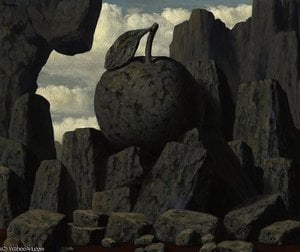
In the vast landscape of Surrealism, few images possess the deceptive simplicity and profound intellectual weight of René Magritte’s 1964 masterpiece, "This Is Not an Apple." At first glance, the viewer is presented with a scene that feels almost mundane—a single, vibrant apple resting upon a surface, accompanied by a cryptic inscription. Yet, to look at this painting is to enter a psychological labyrinth where the boundaries between object and language begin to dissolve. Magritte, the Belgian master of the uncanny, does not merely paint fruit; he paints the tension between what we see and what we know. The composition serves as a deliberate provocation, designed to unsettle the viewer’s most basic assumptions about reality and the reliability of our own senses.
The painting operates through a brilliant linguistic trap. By pairing the realistic depiction of an apple with the French phrase “Ceci n'est pas une pomme” (“This is not an apple”), Magritte forces a confrontation between the physical world and the symbols we use to describe it. He reminds us that the painted image is merely oil on canvas, a representation that can never truly be the object itself. This philosophical inquiry into the nature of representation has made his work a cornerstone of modern thought, influencing everything from conceptual art to contemporary pop culture. For the collector or the lover of fine art, this piece offers more than visual beauty; it offers a continuous intellectual dialogue that evolves every time one gazes upon it.
Mastery of Technique and the Illusion of Reality
Magritte’s technical approach in "This Is Not an Apple" is characterized by a meticulous, almost academic precision. Eschewing the frantic brushwork of the Impressionists, he employed a smooth, controlled oil technique that lends the apple a startlingly tactile quality. One can almost sense the crispness of its skin and the subtle weight of its form. This hyper-realistic rendering is essential to his strategy; by making the subject appear undeniably "real," he makes the subsequent subversion of that reality all the more jarring. The lighting is soft yet purposeful, casting gentle shadows that ground the object in a tangible space, even as the starkness of the background pushes it toward the realm of the dream.
The composition is a study in calculated balance. The placement of the apple and the accompanying text creates a visual rhythm that guides the eye across the canvas, inviting a slow, meditative observation. This level of detail makes the work an exceptional choice for high-quality reproductions intended for sophisticated interiors. Whether placed in a minimalist modern gallery or a classic study, the painting’s clean lines and striking color palette—the deep reds and vibrant greens against a neutral backdrop—provide a focal point that is both aesthetically pleasing and intellectually stimulating. It is a piece that commands attention through its quietude rather than through noise.
A Timeless Legacy for the Discerning Collector
Beyond its technical merits, "This Is Not an Apple" carries an emotional resonance that speaks to the universal human experience of mystery and loss. Magritte’s life, marked by early childhood tragedies, often infused his work with a sense of the hidden and the veiled. In this painting, that sense of mystery is channeled into a cerebral curiosity. It does not demand an emotional outburst; instead, it invites a quiet, contemplative state of mind. For interior designers seeking to add depth to a space, this artwork provides a "conversation piece" in the truest sense—a work that stimulates thought and adds a layer of sophisticated intrigue to any room.
Owning a reproduction of such a seminal Surrealist work allows one to bring a piece of art history into the domestic sphere. It is an investment in a legacy of creativity that challenges the status quo. As we navigate an era increasingly dominated by digital illusions, Magritte’s exploration of truth and falsehood feels more relevant than ever. To display this painting is to celebrate the enduring power of the human imagination and to honor the beautiful, unsettling paradoxes that define our existence.



 Anteprima in scala reale
 Acquista il dipinto realizzato a mano
 Invia
Invia Condividi
 Dettagli opera

 Scarica immagine
 Simili
 Radiografia
 Slideshow
 Statistiche

 Espandi i dettagli






































 L'opzione vetro è disponibile solo per dimensioni inferiori a 110 cm