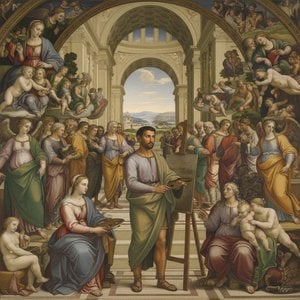
St. Cecilia: A Symphony of Faith and Form – Detail from Raphael’s Masterpiece
Raphael's "St. Cecilia," specifically this exquisite detail, offers more than just a portrait; it’s an immersion into the heart of Renaissance spirituality and musical devotion. Painted around 1514 during his Roman period, this work transcends mere representation, becoming a vibrant testament to the saint’s legacy as patron of music and a poignant exploration of harmony and balance. The painting, likely commissioned for the church of San Giovanni in Monte in Bologna, immediately draws the eye with its central figure – St. Cecilia herself – radiating an ethereal grace amidst a richly layered scene.
The composition is meticulously crafted, reflecting Raphael’s mastery of perspective and his deep understanding of classical principles. Cecilia, positioned at the apex of the triangular arrangement, dominates the space yet remains integrated within a carefully constructed network of supporting figures. Notice how her pose – hands raised in prayer, eyes fixed heavenward – embodies both serenity and fervent devotion. The surrounding saints—St. John the Evangelist, St. Paul, St. Augustine, and Mary Magdalene—each contribute to this symbolic tapestry, representing virtues associated with Cecilia’s life and faith. The placement of these figures isn't arbitrary; it establishes a clear hierarchy, guiding the viewer’s eye through the narrative.
Musical Instruments: A Language of Devotion
Beyond the human figures, the painting is punctuated by an astonishing array of musical instruments – violins, cellos, a viola da gamba, and even a portable organ. These aren't merely decorative elements; they are integral to the artwork’s meaning. The inclusion of these instruments speaks directly to St. Cecilia’s role as the protector of musicians, suggesting that her music transcends earthly pleasures and ascends to divine harmony. The specific arrangement—the three violins, each subtly different in tone and placement—creates a visual echo of musical intervals and harmonies. The detail shown on the instruments themselves – the delicate curves of the bows, the intricate carvings – reveals Raphael’s meticulous attention to craftsmanship and his appreciation for the beauty of these tools of artistic expression.
Interestingly, Vasari attributed the still-life elements, including the instruments, to Giovanni da Udine, Raphael's assistant. However, a closer examination confirms that Raphael himself was responsible for their execution, demonstrating his ability to seamlessly integrate complex compositional elements into a single work. The placement of the instruments—some clustered near Cecilia, others scattered throughout the scene—creates a dynamic interplay between earthly and divine realms.
Symbolism and Renaissance Ideals
“St. Cecilia” is deeply rooted in the intellectual currents of the High Renaissance. The painting embodies several key ideals: the pursuit of harmony, the celebration of beauty, and the elevation of spiritual values. The triangular composition itself—a hallmark of Renaissance art—represents stability and order, mirroring the desired balance between faith and reason. Furthermore, the use of light and shadow – *chiaroscuro* – creates a sense of depth and drama, drawing the viewer’s attention to Cecilia's serene face and the instruments surrounding her.
The inclusion of books further reinforces this theme of learning and contemplation. They represent the intellectual pursuit that complements spiritual devotion, suggesting that true understanding requires both faith and reason. The overall effect is one of profound beauty and contemplative serenity – a testament to Raphael’s genius and his ability to capture the essence of Renaissance spirituality.
A Reproduction for Your Space
WahooArt offers meticulously hand-painted reproductions of this iconic masterpiece, allowing you to bring its timeless beauty into your home or office. Our skilled artisans replicate Raphael's delicate brushstrokes and vibrant colors with unparalleled accuracy, ensuring that your reproduction captures the full emotional impact of the original painting. Whether you’re an art collector, a design enthusiast, or simply someone seeking to infuse their space with inspiration, a WahooArt reproduction of “St. Cecilia” is a stunning addition to any collection. Explore our range of sizes and framing options to find the perfect way to showcase this extraordinary work of art.
Domande e risposte
"St. Cecilia (dettaglio)" è un'opera celebre del High Renaissance?
"St. Cecilia (dettaglio)" di Raffaello è classificata come Iconici e appartiene al movimento High Renaissance.
Qual è il colore dominante di "St. Cecilia (dettaglio)" di Raffaello?
Il colore che risalta maggiormente in "St. Cecilia (dettaglio)" è Verde ftalocianina (#271613). Il colore dominante è utile per abbinare un'opera d'arte a un ambiente interno.
È possibile visualizzare un'anteprima in realtà aumentata di "St. Cecilia (dettaglio)"?
"St. Cecilia (dettaglio)" dispone di un'anteprima in realtà aumentata: la pagina Anteprima in AR dell'opera ti permette di visualizzarla nel tuo spazio tramite un dispositivo compatibile.



 Anteprima in scala reale
 Passa alle stampe
 Invia
Invia Condividi
 Dettagli opera
 Guida
Guida

 Scarica
 Simili
 Radiografia
 Slideshow
 Statistiche

 Espandi i dettagli






































 L'opzione vetro è disponibile solo per dimensioni inferiori a 110 cm