x
Anteprima in scala realeAnteprima in scala reale Anteprima ARAnteprima AR Acquista il dipinto realizzato a mano Acquista il dipinto realizzato a manoAcquista immagine Acquista immagine InviaInvia
Dettagli operaDettagli opera Aggiungi ai preferiti Aggiungi ai preferiti Scarica immagineScarica immagine SimiliSimili RadiografiaRadiografia SlideshowSlideshow


The Visit

Pieter de Josselin de Jong (1861-1694) was a Dutch painter known for his portraits, genre scenes & industrial landscapes. Trained in Den Bosch, Antwerp & Paris, he captured Dutch society and the rise of industry with skill.

Scopri Pieter de Hooch (1629-1694), maestro olandese dell'età d'oro! Scene di vita quotidiana, architetture luminose e realismo che ha ispirato l'Impressionismo.

Giclée / Stampe d'arte

Stampa giclée o su tela di qualità museale, con produzione rapida e diverse opzioni di finitura. (Acquista il dipinto realizzato a mano Acquista il dipinto realizzato a manoAcquista immagine Acquista immagine)

P118B $10
P118H $10
P118W $10
P438Z $10
P508JH $12
P508YH $12
P805H $10
P805Z $10
P919BZ $10
P919G $10
P919XJ $10
P959ZH $10
P968JZ $12
W106C $8
W218G $10
W218JH $8
W218Y $10
W307PJ $10
W316G $10
W316PJ $8
W316Y $10
W398PJ $8
W4111J $10
W500HY $15
W500JH $15
W692G $12
W849H $8
W940BG $15
W953PJ $8

Formato standard
su misura
CM
INCH

Scegli tra le nostre dimensioni predefinite, che rispettano le proporzioni originali dell'opera d'arte.

larghezza
altezza

È possibile inserire dimensioni personalizzate per adattare l'opera a una cornice o a uno spazio specifico. Se la dimensione selezionata non corrisponde alle proporzioni dell'immagine originale, procederemo al ritaglio dell'opera o all'estensione dell'immagine con un bordo specchiato o a tinta unita. Un mockup digitale ti verrà inviato per approvazione prima dell'inizio della produzione.
Si prega di notare che l'anteprima a schermo non riflette il ritaglio o l'estensione effettivi. Solo il mockup mostrerà accuratamente la composizione finale.
Sebbene siano disponibili dimensioni personalizzate, si raccomanda di selezionare una dimensione dall'elenco predefinito per preservare le proporzioni originali.

Consegna in tutto il mondo () in 2 settimane invece delle normali 4/5 settimane. (30 Agosto)

why_choose_icon
Spedizione espressa gratuita in tutto il mondo
why_choose_icon
Tela in lino di alta qualità
why_choose_icon
Assicurazione completa sulla spedizione
why_choose_icon
Garanzia di rimborso dei dazi doganali
why_choose_icon
Garanzia di fedeltà cromatica
why_choose_icon
Politica di reso entro 60 giorni (solo per difetti di fabbricazione)
why_choose_icon
Garanzia di rimborso al 100%
why_choose_icon
Offerta per acquisti multipli

Prezzo totale

$ 68

reproduction

The Visit

Giclée / Stampe d'arte

Dimensioni riproduzione

-

Prezzo totale calcolato

$ 68

Informazioni rapide

  • Movement: Dutch Baroque
  • Location: Private Collection
  • Influences: Nicolas Berchem
  • Title: The Visit
  • Artist: Pieter de Hooch
  • Artistic style: Domestic genre painting
  • Dimensions: 68 x 58 cm

A Moment Frozen in Delft Light

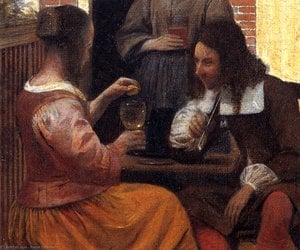
In the quiet, sun-drenched interiors of the seventeenth century, moments of profound connection were often found in the most mundane settings. Pieter de Hooch's "The Visit," painted in 1657, stands as a quintessential emblem of Dutch Baroque artistry—a deceptively simple tableau that speaks volumes about the social fabric and artistic sensibilities of its era. Captured in muted tones of ochre, ivory, and charcoal gray, this masterpiece transports us back to Delft during the zenith of the Dutch Golden Age, offering an intimate glimpse into the daily life of a bourgeois household. The painting’s enduring appeal lies not merely in its visual beauty but also in its masterful execution and subtle symbolic resonance, inviting viewers to step through a doorway into a world of domestic tranquility.

The scene unfolds with a palpable sense of realism, as de Hooch captures a group of individuals gathered around a dining table. There is a quiet drama in the way the figures are positioned; some stand while others sit, their presence suggesting a convivial conversation and shared enjoyment. The table itself is laden with details that ground the scene in reality—multiple wine glasses catch the light, hinting at a celebratory or social meal, while a book rests near one of the guests, perhaps a remnant of a shared intellectual pursuit before dinner began. Even the subtle inclusion of a clock on the wall serves as a poignant reminder of the passage of time, anchoring this fleeting social interaction within the eternal flow of history.

Mastery of Light and Texture

De Hooch's style embodies the Baroque preoccupation with illusionism and chiaroscuro—the dramatic interplay between light and shadow. Unlike the overtly theatrical compositions of his contemporaries, "The Visit" achieves grandeur through the meticulous observation of natural light filtering into a domestic interior. The artist skillfully renders textures with remarkable accuracy; one can almost feel the grain of the worn wooden bench and the crispness of the linen tablecloth. Through subtle gradations of tone, de Hooch sculpts form and conveys a profound sense of depth, drawing the viewer’s eye into the room's corners and through its architectural layers.

This technical precision makes the work an extraordinary subject for high-quality reproductions. For the art collector or interior designer, the painting offers a sophisticated palette that complements a variety of decor styles. Its monochrome-leaning tones of gray and earth colors provide a neutral yet emotionally resonant anchor for a room, bringing a sense of historical weight and calm sophistication to any space. The way de Hooich utilizes light creates an atmospheric quality that can transform a modern living area into a sanctuary of classical elegance.

A Reflection of Golden Age Prosperity

Beyond its aesthetic brilliance, "The Visit" reflects a pivotal moment in Dutch history—the burgeoning prosperity fueled by global trade and exploration. During this era, Delft was a thriving center for craftsmanship and commerce, attracting affluent families eager to establish their social standing through the cultivation of refined domestic environments. De Hooch’s depiction captures the aspirational ideal of bourgeois comfort: a world where peace, plenty, and companionship are the ultimate markers of success.

To possess a reproduction of this work is to invite the spirit of the Dutch Golden Age into one's home. It serves as more than just decoration; it is a window into a vanished era of stability and grace. Whether placed in a sunlit study or a formal dining room, "The Visit" continues to inspire awe through its ability to find the extraordinary within the ordinary, reminding us that true beauty often resides in the quietest moments of human connection.


Biografia dell'artista

Early Life and Artistic Beginnings

Pieter de Hooch, a name synonymous with the quiet intimacy of Dutch domestic life, was born in Rotterdam on December 20, 1629. His origins were humble; his father, Hendrick Hendricksz de Hooch, was a skilled bricklayer – an artisan whose craft instilled a keen eye for detail and structure within his son. Pieter’s mother, Annetge Pieters, contributed her expertise as a midwife, shaping his understanding of human experience and the rhythms of daily existence. Little is definitively known about his formative years, but it's believed he received his initial artistic training in Haarlem under the tutelage of Nicolaes Berchem, a landscape painter whose influence subtly shaped de Hooch’s early style. This period laid the groundwork for his future success, introducing him to the principles of composition and color that would become hallmarks of his work. The connection with Jacob Ochtervelt, another prominent Haarlem artist, further broadened his artistic horizons. De Hooch's upbringing in a working-class environment instilled a deep appreciation for the realities of everyday life – a perspective he would later translate into his captivating paintings.

A Delft Master: Style and Themes

De Hooch’s career truly blossomed in Delft, where he established himself as a leading figure within the city’s thriving artistic community. His style is instantly recognizable—a masterful blend of realism and subtle lyricism that captured the essence of Dutch bourgeois life. He specialized in “kamergezichten,” or room views, depicting scenes of women engaged in domestic activities: preparing meals, sewing, receiving visitors, or simply enjoying quiet moments with their children. These weren’t grand historical narratives; instead, they offered intimate glimpses into the lives of ordinary people—a remarkable departure from the heroic subjects favored by many of his contemporaries. His use of light is particularly noteworthy – a delicate interplay of shadows and highlights that creates a sense of atmosphere and depth within each scene. De Hooch skillfully employed muted colors and subtle details to evoke a feeling of tranquility and realism, drawing inspiration from both Jan Vermeer’s meticulous observation of light and shadow and the atmospheric techniques of Rembrandt van Rijn. The influence of Emanuel de Witte, another Delft painter, is also evident in his later works, particularly in the use of architectural settings.

Notable Works and Artistic Evolution

Among de Hooch's most celebrated paintings are “The Empty Glass” (circa 1650), a deceptively simple scene that reveals an extraordinary sensitivity to light and form; "Woman Nursing" (1658) and "Woman with a Baby on Her Lap" (1658), which capture the tenderness of maternal love; and “Cardplayers in a Sunlit Room” (1658), a vibrant depiction of social interaction within a domestic setting. His work from the mid-1660s, particularly “A Woman Preparing Bread and Butter for a Boy” (1661) and "The Merry Drinker" (c. 1650), showcases his ability to create compelling narratives through subtle gestures and expressions. Later in his career, influenced by the trends of the time, de Hooch began incorporating more elaborate settings—marble rooms from the new Amsterdam Town Hall—offering a grander stage for his subjects. Despite these shifts, he retained his signature style and attention to detail, producing works like “The Clothes Cupboard” (1667) and "The Minuet" (1680), which demonstrate his continued mastery of light, composition, and human emotion.

Legacy and Influence

Pieter de Hooch’s impact on the course of Dutch painting is undeniable. He stands as one of the most important figures in the Delft School, a movement characterized by its focus on domestic scenes and realistic depictions of everyday life. His work profoundly influenced subsequent generations of artists, particularly those who followed in the footsteps of Vermeer—artists like Jacob van Ruisdael and Frans Hals. De Hooch’s legacy extends beyond his individual paintings; he helped to establish a new genre of painting that celebrated the beauty and dignity of ordinary people. His meticulous observation, subtle use of light, and intimate portrayal of domestic life continue to resonate with viewers today, cementing his place as a master of Dutch Golden Age art. His works are now housed in prestigious museums around the world, including the Koninklijk Museum voor Schone Kunsten in Antwerpen, Belgium, where a vast collection of European art from the 15th to the 20th centuries offers a comprehensive view of his artistic journey.
Pieter de Hooch

Pieter de Hooch

1629 - 1694 , Paesi Bassi

Dati rapidi

  • Artistic Movement Or Style: Realismo, Età dell'Oro
  • Artists Or Movements Influenced By This Artist: ['Impressionismo']
  • Artists Who Influenced This Artist: ['Nicolaes Berchem']
  • Date Of Birth: 1629
  • Date Of Death: 1694
  • Full Name: Pieter de Hooch
  • Nationality: Olandese
  • Notable Artworks:
    • Donna che legge una lettera
    • Il cortile di una casa a Delft
  • Place Of Birth (City And Country): Rotterdam, Paesi Bassi
Esplora le opere d'arte organizzate per temi, stili e caratteristiche.