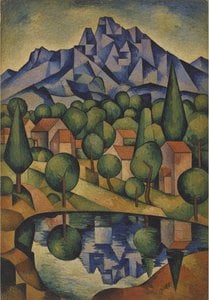
Orchard: A Symphony of Light and Texture by Paul Cézanne
Paul Cézanne, one of the most influential artists of the late 19th century, stands as a pivotal figure bridging Impressionism’s fleeting moments with Cubism's fractured perspectives. His artistic vision wasn’t merely about depicting nature; it was about distilling its essence into fundamental geometric forms—a revolutionary approach that would reshape the landscape of modern art. Cézanne’s journey toward this groundbreaking style was marked by experimentation and a persistent refusal to conform to prevailing artistic trends, ultimately securing his place as a cornerstone of artistic innovation.
- Artist: Paul Cézanne
- Painting Title: Orchard
- Museum: Honolulu Academy of Arts
- Year: 1885
- Medium: Oil on Canvas
- Style: Post-Impressionism
“Orchard” embodies Cézanne’s distinctive post-impressionist style, prioritizing the conveyance of feeling and structure over meticulous representation. Unlike Impressionists who sought to capture immediate visual sensations—the shimmering light of a summer afternoon—Cézanne aimed for something deeper: an exploration of underlying forms and spatial relationships. This ambition is palpable in every brushstroke, creating a textured surface that vibrates with color and invites contemplation.
The Painting's Details
Painted in 1885 using oil on canvas, Cézanne’s technique exemplifies the meticulous observation of nature combined with an intellectual reimagining of its appearance. The Honolulu Academy of Arts houses this remarkable piece, allowing visitors to experience firsthand the artist’s masterful manipulation of color and form. The scene depicts a tranquil orchard brimming with mature trees—some positioned prominently in the foreground, others receding into the distance—establishing a compelling sense of depth and perspective. Lush green foliage dominates the canvas, evoking serenity and celebrating the beauty of the natural world.
Two figures are subtly integrated into the landscape, adding an element of human presence that enhances the painting’s contemplative mood. Their placement contributes to the overall composition, guiding the viewer's eye across the textured surface and reinforcing Cézanne’s desire to portray not just what is seen but how it feels.
Artistic Style and Influence
Cézanne’s stylistic innovations profoundly impacted subsequent generations of artists. He skillfully blended Impressionist color palettes with Cubist geometric simplification, forging a path toward abstraction that would become central to the artistic discourse of the early 20th century. Artists like Camille Pissarro, Cézanne's fellow Impressionist and lifelong friend, absorbed his influence, furthering the movement’s exploration of form and materiality.
Considered a precursor to Cubism, Cézanne’s approach challenged traditional artistic conventions by dismantling illusionistic space and presenting objects as fragmented planes—a technique that anticipates Picasso's groundbreaking experiments. This bold reimagining of representation continues to inspire artists today who strive to convey emotion and conceptual ideas through visual language.
Relevance in Art History
“Orchard” stands as a testament to Cézanne’s unwavering commitment to artistic experimentation and his enduring legacy as a pioneer of modern art. It exemplifies the transformative potential of blending observation with intellectual consideration—a principle that resonates across centuries of artistic endeavor. For those seeking inspiration or delving into the history of art, exploring Cézanne's oeuvre offers invaluable insight into the genesis of 20th-century aesthetics.
Domande e risposte
I colori di "Frutteto" appaiono intensi o delicati?
I colori in "Frutteto" di Paul Cézanne hanno un'intensità Equilibrato.
A quale fase dello sviluppo di Paul Cézanne appartiene "Frutteto"?
"Frutteto" rappresenta il Mature Period di Paul Cézanne.
Qual è la spiegazione relativa allo stato del copyright di "Frutteto" di Paul Cézanne?
"Frutteto" di Paul Cézanne è di di pubblico dominio - il suo copyright è scaduto. I termini del copyright si calcolano a partire dalla morte dell'artista, e Paul Cézanne è deceduto nel 1906.



 Anteprima in scala reale
 Ordina la riproduzione dipinta a mano
 Condividi
 Condividi
 Dettagli
 Guida stampabile

 Scarica
 Articoli simili
 Radiografia
 Slideshow
 Statistiche

 Leggi tutto






































 L'opzione vetro è disponibile solo per dimensioni inferiori a 110 cm