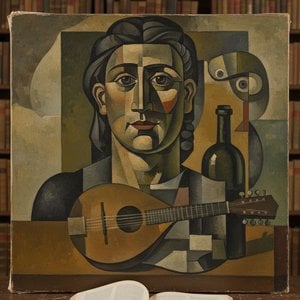
Woman and pears (Fernande) – A Pioneering Vision of Analytical Cubism
Pablo Picasso’s
Woman and Pears (Fernande) stands as a cornerstone of Modern Art, specifically embodying the groundbreaking principles of Analytical Cubism. Painted in 1909, this artwork isn’t merely a depiction of fruit—it's an audacious exploration of perception and form that irrevocably altered artistic conventions. Created during Picasso’s fervent engagement with Georges Braque, it represents the first phase of Cubism, marking a decisive break from traditional representation.
The Artistic Movement: Analytical Cubism
Analytical Cubism, championed by Juan Gris, revolutionized painting by dismantling subjects into geometric shapes—cubes, cylinders, and spheres—and reconstructing them in fragmented planes. This radical approach prioritized intellectual analysis over visual illusion, forcing artists to reconsider how we perceive reality. Picasso’s intention wasn't simply to reproduce what he saw; it was to distill the essence of his subject matter into its fundamental components. The resulting images are unsettling yet undeniably captivating, inviting viewers to actively participate in constructing meaning.
The Painting: Woman and Pears (Fernande)
The composition itself is deliberately disconcerting. Picasso presents a woman’s face—a portrait of Fernande Olivier—against a muted green background. However, instead of striving for realistic shading or perspective, he fractures her features into interlocking planes of color and shape. The woman's gaze directs the viewer's eye across the canvas, creating a dynamic interplay between stillness and movement. Scattered around her are pears, apples, and oranges – fruits rendered in a manner that contrasts sharply with their natural form. These objects aren’t depicted as solid spheres; they’re dissected into geometric fragments, mirroring the overall stylistic strategy. A bowl positioned on the left side adds to the visual complexity, emphasizing the artist's meticulous attention to detail.
Artistic Techniques
Picasso’s masterful use of color—primarily shades of brown and ochre—contributes significantly to the painting’s mood. The geometric shapes aren’t merely decorative; they are integral to conveying Picasso’s conceptual vision. He employs a technique known as “trompe l'œil,” creating an illusion of depth through carefully positioned planes that appear to overlap and recede into space. This method challenges conventional notions of perspective, forcing the viewer to reconsider how visual information is processed. The artist’s deliberate fragmentation underscores his desire to transcend representational accuracy, prioritizing intellectual exploration over sensory experience.
Relevance to Art History
Woman and Pears (Fernande) is considered a pivotal work in Picasso’s artistic development and cemented his position as one of the foremost innovators of Modern Art. It foreshadowed the subsequent developments of Synthetic Cubism, where Picasso experimented with bolder colors and collage techniques—further expanding the boundaries of artistic expression. Its influence can be seen throughout the art world, inspiring generations of artists to embrace abstraction and challenge established conventions. For those seeking a stunning reproduction of this iconic masterpiece, WahooArt offers exceptional quality prints that capture the painting's nuanced beauty and intellectual depth. Explore more works by Picasso at
WahooArt.



 Anteprima in scala reale
 Ordina la riproduzione dipinta a mano
 Condividi
 Condividi
 Dettagli
 Guida stampabile

 Scarica
 Articoli simili
 Radiografia
 Slideshow
 Statistiche

 Leggi tutto






































 L'opzione vetro è disponibile solo per dimensioni inferiori a 110 cm