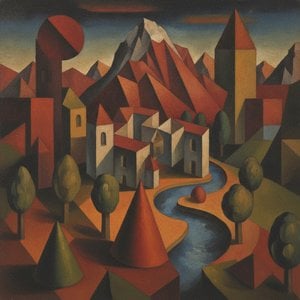
Landscape 3: A Cubist Echo of Provence
Pablo Picasso’s “Landscape,” painted in 1972, represents a poignant return to the expressive language that defined his artistic prime. Executed during his final years, this deceptively simple composition—a muted palette dominated by blues and greens—offers a profound meditation on perception and memory, mirroring themes explored throughout Picasso's prolific career. Unlike monumental canvases like Guernica or monumental portraits of Dora Maar, “Landscape” embodies a quiet contemplation, reflecting the artist’s own evolving inner landscape as he approached his twilight years.
- Style: The painting firmly establishes itself within Cubism’s second phase—Analytic Cubism—characterized by fragmentation and geometric abstraction. Picasso dismantles traditional representation, presenting multiple viewpoints simultaneously to challenge viewers' understanding of space and form.
- Technique: Picasso employs a masterful layering technique using thin washes of pigment applied over textured surfaces. The brushstrokes are visible yet subdued, contributing to the overall sense of stillness and conveying an impression of weathered time. This deliberate materiality underscores the painting’s connection to the natural world—specifically, the Provençal countryside that served as inspiration for many of Picasso's later works.
Historical Context & Inspiration
“Landscape” emerged from Picasso’s ongoing exploration of expressive abstraction following the devastation wrought by World War II and the horrors witnessed during the Spanish Civil War. The influence of Hermann Max Pechstein, a fellow Expressionist artist who championed bold colors and emotional intensity, is palpable in Picasso's handling of hue—particularly the dominant blues—which evoke feelings of melancholy and solitude. As noted in scholarly research, Picasso’s meticulous attention to detail—the careful depiction of palm trees and the subtle variations in tonal color—reflects a desire to capture not merely what he sees but how he *feels*.
- Provence Connection: The painting's setting in Mougins, France – Picasso’s adopted home during his later years – speaks to his fascination with the region’s light and atmosphere. This connection is reinforced by the luminous greens of the foliage and the hazy blues of the sky, creating an illusionistic space that transcends literal depiction.
- Symbolism: The fragmented geometric shapes—the house, the chair, the palm trees—are not merely decorative elements; they represent a deliberate attempt to distill visual experience into its essential components. Picasso’s use of dots and zigzag lines adds dynamism to the composition, hinting at underlying forces shaping perception.
Emotional Impact & Artistic Legacy
“Landscape” transcends mere visual representation, inviting viewers to engage in a dialogue with the artist's inner world. Its understated beauty belies its profound psychological depth—a characteristic that aligns Picasso’s work with the broader tradition of Expressionism. The painting’s enduring power lies in its ability to convey a sense of quiet contemplation and remembrance, mirroring the artist’s own reflections on life and mortality. As evidenced by reproductions displayed at Musée Picasso Paris and showcased within collections like Meadowsmuseumdallas.org, “Landscape” continues to resonate with audiences today—a testament to Picasso's unparalleled mastery of artistic expression.
Further Exploration
For a deeper understanding of Picasso’s oeuvre and the broader context of Cubism, consider examining his monumental painting Guernica (Picasso), or delving into his exploration of landscape themes in works such as Landscape of Juan-les-Pins and Paysage à Juan-les-Pins. These pieces offer invaluable insights into Picasso's artistic evolution and his unwavering commitment to conveying emotion through abstraction—a legacy that continues to inspire artists and collectors worldwide.
Domande e risposte
Di cosa è fatto "Paesaggio 3" e in quale stile è realizzato?
"Paesaggio 3" di Pablo Picasso combina la tecnica Acrilico su tela con lo stile Cubist Landscape. La tecnica e il movimento descrivono la realizzazione e lo stile dell'opera.
Come posso visualizzare un'anteprima di una riproduzione di "Paesaggio 3" di Pablo Picasso?
È disponibile un'anteprima di "Paesaggio 3" di Pablo Picasso nella pagina Anteprima dell'opera.
"Paesaggio 3" di Pablo Picasso utilizza forti contrasti o armonie delicate?
La composizione cromatica di "Paesaggio 3" di Pablo Picasso unisce un Dichiarazione contrasto con una Forte unità cromatica armonia.



 Anteprima in scala reale
 Ordina la riproduzione dipinta a mano
 Condividi
 Condividi
 Dettagli
 Guida stampabile

 Scarica
 Articoli simili
 Radiografia
 Slideshow
 Statistiche
 Leggi tutto






































 L'opzione vetro è disponibile solo per dimensioni inferiori a 110 cm