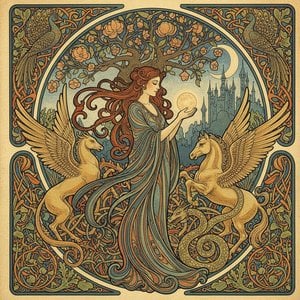
Vignetta per libro ''N. K. Roerich'' (1918) di Nikolaj Roerich, riproduzione di un dipinto a olio realizzato a mano da un maestro d'arte
Anteprima in scala reale Anteprima in AR Passa alle stampe Passa all'immagine digitale Invia
Dettagli opera Guida Aggiungi ai preferiti Scarica Simili Radiografia Slideshow Domande e risposte Presentation Statistiche

Vignetta per libro ''N. K. Roerich'' Riproduzione di un dipinto a olio dipinto a mano

Vignetta per libro ''N. K. Roerich''' è un disegno bianco e nero che raffigura un paesaggio montuoso con nuvole e uccelli in volo, simbolo di serenità e maestosità nella visione simbolista del pittore russo Nicholas Roerich.

Esplora l'affascinante arte di Nicholas Roerich (1874-1947): Simbolismo, paesaggi himalayani e dipinti mistici. Progettazioni per i Balletti Russi e sostenitore della preservazione culturale.

Riproduzione a olio fatta a mano

Olio su tela dipinto a mano nelle tue dimensioni e con la tua cornice, realizzato su ordinazione dai nostri artisti. ( Passa alle stampe Passa all'immagine digitale)

Corner sample of the P118B picture frame: polistirene stampato, 5 cm wide and 3 cm thick
P118B €10
Corner sample of the P118H picture frame: polistirene stampato, 5 cm wide and 3 cm thick
P118H €10
Corner sample of the P118W picture frame: polistirene stampato, 5 cm wide and 3 cm thick
P118W €10
Corner sample of the P438Z picture frame: polistirene stampato, 5.5 cm wide and 3.5 cm thick
P438Z €10
Corner sample of the P508JH picture frame: polistirene stampato, 7 cm wide and 3.5 cm thick
P508JH €12
Corner sample of the P508YH picture frame: polistirene stampato, 7 cm wide and 3.5 cm thick
P508YH €12
Corner sample of the P805H picture frame: polistirene stampato, 5 cm wide and 3.5 cm thick
P805H €10
Corner sample of the P805Z picture frame: polistirene stampato, 5 cm wide and 3.5 cm thick
P805Z €10
Corner sample of the P919BZ picture frame: polistirene stampato, 7 cm wide and 3.5 cm thick
P919BZ €10
Corner sample of the P919G picture frame: polistirene stampato, 7 cm wide and 3.5 cm thick
P919G €10
Corner sample of the P919XJ picture frame: polistirene stampato, 7 cm wide and 3.5 cm thick
P919XJ €10
Corner sample of the P959ZH picture frame: polistirene stampato, 5 cm wide and 3 cm thick
P959ZH €10
Corner sample of the P968JZ picture frame: polistirene stampato, 6 cm wide and 4 cm thick
P968JZ €12
Corner sample of the W106C picture frame: legno massello, 5 cm wide and 3 cm thick
W106C €8
Corner sample of the W218G picture frame: legno massello, 5 cm wide and 3 cm thick
W218G €10
Corner sample of the W218JH picture frame: legno massello, 5 cm wide and 3 cm thick
W218JH €8
Corner sample of the W218Y picture frame: legno massello, 5 cm wide and 3 cm thick
W218Y €10
Corner sample of the W307PJ picture frame: legno massello, 6 cm wide and 3 cm thick
W307PJ €10
Corner sample of the W316G picture frame: legno massello, 6 cm wide and 3 cm thick
W316G €10
Corner sample of the W316PJ picture frame: legno massello, 6 cm wide and 3 cm thick
W316PJ €8
Corner sample of the W316Y picture frame: legno massello, 6 cm wide and 3 cm thick
W316Y €10
Corner sample of the W398PJ picture frame: legno massello, 5 cm wide and 3 cm thick
W398PJ €8
Corner sample of the W4111J picture frame: legno massello, 6.5 cm wide and 3.5 cm thick
W4111J €10
Corner sample of the W500HY picture frame: legno massello, 7 cm wide and 5 cm thick
W500HY €15
Corner sample of the W500JH picture frame: legno massello, 7 cm wide and 5 cm thick
W500JH €15
Corner sample of the W692G picture frame: legno massello, 8 cm wide and 4 cm thick
W692G €12
Corner sample of the W849H picture frame: legno massello, 5 cm wide and 3 cm thick
W849H €8
Corner sample of the W940BG picture frame: legno massello, 7.5 cm wide and 4.5 cm thick
W940BG €15
Corner sample of the W953PJ picture frame: legno massello, 6 cm wide and 3.5 cm thick
W953PJ €8

Formato standard
su misura
CM
INCH

Scegli tra le nostre dimensioni predefinite, che rispettano le proporzioni originali dell'opera d'arte.

larghezza
altezza

Inserisci la larghezza e l'altezza desiderate, per adattarle alla tua cornice o alla tua parete. Trattandosi di un'opera dipinta a mano, in caso di dimensioni con un formato differente, l'artista può estendere leggermente il dipinto oltre i bordi dell'immagine o ritagliare una piccola parte — la scelta spetta a te. Ti invieremo un mockup digitale da approvare prima che la realizzazione abbia inizio. L'immagine mostrata in questa pagina non rappresenta il risultato finale — solo il mockup lo fa.

Esempi di ciò che può essere modificato: sostituire il volto con una foto del cliente; aggiungere un animale domestico (ad esempio, sostituire un gatto con un cane); inserire un messaggio nascosto nello sfondo; cambiare il paesaggio o gli elementi dello sfondo.
Dopo l'ordine, il team di WahooArt.com contatterà il cliente via e-mail per ricevere le istruzioni e fornirà un'anteprima del mockup

Consegna in tutto il mondo () in 3/4 settimane anziché nelle normali 5 settimane. (5 Novembre). Nessun compromesso sulla qualità.

Spedizione espressa gratuita in tutto il mondo
Tela in lino di alta qualità
Assicurazione completa sulla spedizione
Garanzia di rimborso dei dazi doganali
Garanzia di fedeltà cromatica assoluta
Politica di reso entro 100 giorni (solo per difetti di fabbricazione)
Garanzia di rimborso al 100%
Offerta per acquisti multipli

Prezzo totale

€ 243

Vignetta per libro ''N. K. Roerich''

Tecnica di riproduzione

Dimensioni riproduzione

-

Prezzo finale calcolato

€ 243

Informazioni rapide

  • Movement: Art Nouveau
  • Year: 1918
  • Subject or theme: Mountains, birds, serenity
  • Influences: Early 20th-century graphic art
  • Notable elements or techniques: Line work, hatching, crosshatching

A Window into Himalayan Mysticism: Exploring Nicholas Roerich’s ‘Vignette for Book ‘N. K. Roerich’’

Nicholas Roerich's “Vignette for Book ‘N. K. Roerich’” (1918) stands as a testament to the enduring power of Art Nouveau and its fascination with organic forms and spiritual contemplation. Created during a pivotal moment in artistic history—the burgeoning Modern movement—this monochrome drawing transcends mere visual representation, inviting viewers into a realm of serene beauty imbued with profound symbolic meaning.

  • Subject Matter: The artwork captures a breathtaking Himalayan landscape – specifically, towering mountains and expansive skies populated by graceful birds in flight. Roerich’s meticulous attention to detail reflects his deep connection to the natural world and his belief in its inherent spiritual significance.
  • Style & Technique: Executed with masterful pen and ink on paper, “Vignette” exemplifies the hallmarks of Art Nouveau. The artist skillfully employs hatching and cross-hatching techniques to achieve remarkable tonal variations, creating textures that mimic the rugged grandeur of the mountains and the ethereal diffusion of clouds. Thick, bold lines delineate the mountain range, establishing a strong compositional foundation while finer lines delicately depict avian forms and atmospheric haze.
  • Composition & Perspective: The composition prioritizes simplicity—a horizontal band of mountains dominating the lower third against a backdrop of swirling clouds—yet achieves considerable depth through overlapping elements and variations in line weight. Closer to the viewer, the mountain peaks are rendered with greater detail and bolder lines, conveying immediacy and solidity, whereas distant peaks fade into softer hues, fostering a sense of vastness and timelessness.
  • Symbolism & Emotional Impact: Beyond its aesthetic qualities, “Vignette” resonates with deeper symbolic themes. The predominance of white and black underscores the duality inherent in existence—light versus darkness, stillness versus movement—reflecting Roerich’s philosophical exploration of cosmic harmony and spiritual awakening. The stylized depiction of birds symbolizes aspiration and transcendence, mirroring the artist's unwavering faith in humanity's capacity for enlightenment.

Historical Context: Roerich’s Artistic Vision Amidst Modernity

Born in Saint Petersburg in 1874, Nicholas Roerich emerged as a multifaceted figure—painter, archaeologist, writer, and philosopher—whose artistic endeavors were deeply informed by his spiritual convictions. He began his artistic journey at St. Petersburg University alongside Igor Stravinsky, collaborating on the libretto and sets for “The Rite of Spring,” a groundbreaking ballet that challenged conventional musical norms and sparked controversy.

However, Roerich’s most enduring legacy resides in his Himalayan landscapes—a series of paintings created during his decades-long residency in Kullu valley. These works represent more than just visual representations; they embody Roerich's belief that art could serve as a conduit for accessing universal consciousness and fostering spiritual understanding. “Vignette” embodies this ethos, capturing the essence of Himalayan serenity and inviting contemplation on themes of harmony and transcendence.

Detailed Analysis: Line Work & Texture – The Artist’s Craftsmanship

The artist's meticulous craftsmanship is evident in the artwork’s textural richness achieved through masterful line work. Hatching and cross-hatching patterns skillfully mimic the rugged contours of mountains and the diffused luminosity of clouds, creating a palpable sense of depth and realism. The deliberate use of varying line weights contributes to this effect—bold lines define prominent peaks while delicate lines depict birds in flight and atmospheric haze.

Concluding Thoughts: An Echo of Himalayan Beauty

"Vignette for Book ‘N. K. Roerich’” remains a captivating exemplar of Art Nouveau’s aesthetic principles, demonstrating Roerich's profound engagement with both artistic technique and spiritual contemplation. Its enduring appeal lies in its ability to transport viewers to the majestic Himalayas—a realm where beauty and tranquility converge—inspiring awe and prompting reflection on the timeless quest for enlightenment.

Domande e risposte

Posso esaminare "Vignetta per libro ''N. K. Roerich''" più nel dettaglio?

La vista a raggi X di "Vignetta per libro ''N. K. Roerich''" di Nikolaj Roerich è disponibile nella pagina Raggi X dell'opera: un esame interattivo dell'immagine attraverso undici strati ottici.

Qual è la tonalità dominante di "Vignetta per libro ''N. K. Roerich''"?

La tonalità dominante di "Vignetta per libro ''N. K. Roerich''" di Nikolaj Roerich è Spettro dal verde al viola, un colore che costituisce il tono di fondo dell'intera tavolozza.

Qual è il soggetto di "Vignetta per libro ''N. K. Roerich''"?

I soggetti di "Vignetta per libro ''N. K. Roerich''" sono landscape, mountains, birds, clouds, blackwhite, illustration, symbolism, harmony.


Biografia dell'artista

Nicholas Roerich: Vita, Arte e Eredità

Primi Anni di Vita ed Educazione

  • Nicholas Konstantinovich Roerich nacque il 9 ottobre 1874 a San Pietroburgo, Russia.
  • Suo padre, notaio tedesco baltico, e sua madre, una donna russa, coltivarono in lui fin da giovane un apprezzamento per le arti.
  • Roerich perseguì sia il diritto che l'arte contemporaneamente, iscrivendosi all'Università di San Pietroburgo e all'Accademia d'Arti Imperiali nel 1893.
  • Ricevette il titolo di “Artista” nel 1897 e una laurea in legge l'anno successivo.

Iniziative Artistiche e Influenze

  • Lo sviluppo artistico di Roerich fu significativamente influenzato da Simbolismo Russo, un movimento che enfatizzava la spiritualità e la profondità emotiva.
  • Diventò coinvolto nella società “World of Art” di Sergei Diaghilev, diventando presidente dal 1910 al 1916.
  • Il suo lavoro iniziale mostrava un fascino per l'archeologia e il design teatrale, portando a collaborazioni su produzioni per i Ballets Russes.
  • Fu anche influenzato da apocrifi e scritti settari medievali come il Libro dell’Oca.

Collaborazione con i Ballets Russes

  • I progetti di Roerich per i Ballets Russes furono molto apprezzati, in particolare il suo lavoro su Alexander Borodin's Principe Igor (1909) e Igor Stravinsky’s Il Rituale della Primavera (1913).
  • I suoi progetti di scenografia combinavano ricerca storica con arte immaginativa, creando produzioni visivamente sbalorditive.
  • Questa collaborazione lo affermò come figura di spicco nel design teatrale nei primi anni del XX secolo.

Sviluppo Artistico e Temi

  • I dipinti di Roerich si evolsero per incorporare temi sempre più mistici e spirituali, riflettendo il suo crescente interesse per la Teosofia e le religioni orientali.
  • La sua serie Studi Architettonici (1904–1905) dimostrò la sua abilità architettonica e il suo impegno nella preservazione del patrimonio culturale.
  • Motivi ricorrenti nelle sue opere includono paesaggi maestosi, antiche città e figure religiose come San Pantelemon e Kuan Yin.
  • Spesso raffigurava l'Himalaya, una regione che per lui aveva un profondo significato spirituale.

Realizzazioni Principali e Riconoscimenti

  • Roerich fu un fervente sostenitore della protezione dell’arte e dell’architettura durante i tempi di guerra.
  • I suoi sforzi portarono alla creazione del Patto Roerich (1935), un trattato internazionale per la conservazione degli oggetti culturali, guadagnandogli numerose nomine per il Premio Nobel per la Pace.
  • Viaggiò ampiamente in Asia Centrale, conducendo ricerche archeologiche e documentando culture antiche.
  • Le sue opere sono esposte in importanti collezioni museali in tutto il mondo, tra cui la Galleria d'Arte di Astrakhan.

Significato Storico ed Eredità

  • L’impatto di Nicholas Roerich sull’arte e sulla cultura russa è immensurabile.
  • Ha colmato il divario tra l'espressione artistica e l'esplorazione spirituale, influenzando generazioni di artisti e pensatori.
  • Il suo impegno nella conservazione del patrimonio culturale rimane rilevante oggi, evidenziando l’importanza di proteggere la nostra eredità condivisa.
  • L’eredità di Roerich si estende oltre i suoi dipinti; è ricordato come un artista visionario, studioso e umanitario.
Nikolaj Roerich

Nikolaj Roerich

1874 - 1947 , Russia

Dettagli rapidi

  • Artisti Influenti:
    • Gauguin
    • Van Gogh
  • Data Di Nascita: 9 ottobre 1874
  • Luogo Di Nascita: San Pietroburgo, Russia
  • Movimento Artistico: Simbolismo russo
  • Nazionalità: Russo
  • Nome Completo: Nikolaj Konstantinovič Rerich
  • Opere Notevoli:
    • Monte dei cinque tesori
    • Percorso verso Kailas 4
    • Ponte di Gloria
    • Lago dei Naga
Esplora le opere d'arte organizzate per temi, stili e caratteristiche.