

L'opera d'arte visualizzata in questa pagina è protetta dalle leggi sul diritto d'autore, il che significa che non possiamo legalmente creare o vendere una riproduzione identica. Tale protezione è garantita da accordi internazionali quali la Convenzione di Berna e dalle leggi nazionali, incluse quelle stabilite da Legge sul copyright degli Stati Uniti - Titolo 17. Tutti i diritti riservati. Le immagini presenti su questo sito sono protette da copyright e non possono essere riprodotte o utilizzate senza l'autorizzazione scritta di WahooArt.com o dei rispettivi proprietari del copyright.
Questo metodo è pienamente conforme alle normative sul diritto d'autore poiché non prevede la copia o la duplicazione dell'opera protetta. Si tratta invece di una rielaborazione creativa: un nuovo dipinto che trae ispirazione dall'originale, senza tuttavia esserne identico.
Stampa giclée o su tela di qualità museale, con produzione rapida e diverse opzioni di finitura. ( Acquista il dipinto realizzato a mano Passa all'immagine digitale)





























Scegli tra le nostre dimensioni predefinite, che rispettano le proporzioni originali dell'opera d'arte.

Inserisci la larghezza e l'altezza desiderate, per adattarle alla tua cornice o alla tua parete. Una stampa può essere solo ritagliata, mai resa più grande dell'immagine originale; pertanto, un formato con una forma differente comporterà la perdita di una parte dell'opera. Ti invieremo un mockup digitale da approvare prima di procedere con la stampa. L'immagine mostrata in questa pagina non rappresenta il ritaglio reale — solo il mockup lo mostra.
Consegna in tutto il mondo () in 2 settimane invece delle normali 4/5 settimane. (9 Novembre)
Landscape 1
Dimensioni riproduzione
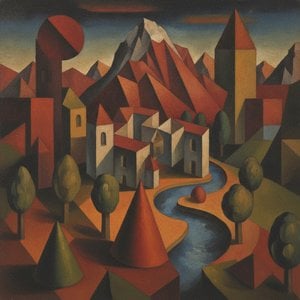
Max Ernst’s “Landscape,” painted in 1957, isn't merely a depiction of a rural scene; it’s an embodiment of the core tenets of Surrealist art – a deliberate disruption of rational thought and a fascination with the subconscious mind. This striking piece showcases Ernst’s signature blend of Cubism and Dada influences, resulting in an image that feels both meticulously crafted and profoundly unsettling.
Beyond its visual appeal lies a rich tapestry of symbolic references. Ernst’s use of geometric shapes—particularly angular rocks and abstracted tree trunks—reflects the Surrealists' preoccupation with dismantling traditional representations. These forms aren’t meant to mirror reality but rather to evoke psychological states, mirroring the fragmented perceptions inherent in dreams.
Painted during the height of Surrealism’s influence—a movement born from disillusionment with postwar Europe— “Landscape” speaks to a broader philosophical concern: the exploration of irrationality and the confrontation with anxieties surrounding societal change. Ernst, deeply impacted by Freud’s psychoanalytic theories, sought to liberate art from the constraints of logic, prioritizing intuition and dreamlike imagery.
"Landscape" transcends its formal elements to convey a profound sense of solitude and wonder. It captures the quiet contemplation of someone encountering something extraordinary—a hidden beauty or an unspoken truth—within the seemingly mundane expanse of nature. Ernst’s enduring contribution to art history lies in his unwavering commitment to artistic experimentation and his courageous exploration of the human psyche, cementing “Landscape” as a cornerstone of Surrealist aesthetics.
"Landscape 1" di Max Ernst è classificata come Recognized e appartiene al movimento Surrealist Landscape.
È disponibile una pagina Statistiche per "Landscape 1", che illustra le visite mensili dell'opera e delle altre creazioni dell'artista, con dettagli relativi a paese e lingua.
Il colore dominante di "Landscape 1" di Max Ernst è Putty (#d0d1a8).


1891 - 1976 , Germania
Explore the profound evolution of Cubist landscapes. Discover how masters like Braque and Picasso redefined perspective through geometric mastery, transforming nature into an intellectual mosaic of form and light for the discerning modern art collector.
 Anteprima in scala reale
 Invia
Invia Condividi
 Dettagli opera
 Guida
Guida

 Scarica
 Simili
 Radiografia
 Slideshow
 Domande e risposte
 Statistiche
 Espandi i dettagli









 L'opzione vetro è disponibile solo per dimensioni inferiori a 110 cm


