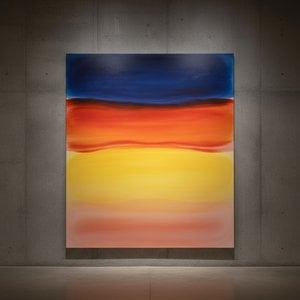
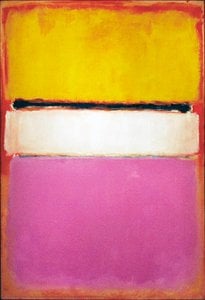
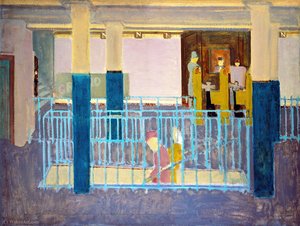
A Symphony in Color: Exploring Mark Rothko’s Untitled No. 1
The Rothko Chapel stands as an enduring testament to artistic vision and spiritual contemplation—a space deliberately designed to foster introspection amidst the grandeur of modern art. At its heart resides fourteen canvases by Mark Rothko, arguably his most iconic works, collectively known as “Black on Maroon” and “Black on Black.” These paintings are not merely decorative objects; they represent a profound engagement with existential questions concerning life, death, and the human condition.
- Subject Matter: Rothko’s approach eschews traditional representation. Instead of depicting recognizable figures or landscapes, he presents amorphous blocks of color—primarily shades of black, maroon, and yellow—that seem to bleed into one another. This deliberate abstraction prioritizes emotional resonance over visual accuracy.
- Style: The paintings embody Rothko’s signature style – Color Field Painting. Developed in the mid-1940s and 50s, this technique involves applying large areas of pigment to canvas without discernible brushstrokes or contours. This method aims to bypass conscious perception and tap into primal feelings.
Technique: Layers of Color and Subtle Texture
Rothko’s meticulous process involved layering thin washes of color onto the canvas, building up tonal variations that create a mesmerizing interplay of light and shadow. He utilized mineral pigments—specifically hematite and manganese dioxide—to achieve the deep maroon hues characteristic of “Black on Maroon.” These pigments were carefully mixed to produce subtle textural nuances – almost imperceptible ridges—that contribute to the overall visual experience. The artist’s insistence on achieving maximum luminosity was paramount; he painstakingly adjusted the varnish to maximize reflectivity, ensuring that each painting radiated an ethereal glow.
- Pigment Selection: Hematite and manganese dioxide were chosen for their ability to produce rich, saturated colors while maintaining a velvety surface texture.
- Varnish Application: Rothko applied multiple coats of varnish—specifically nitrocellulose—to enhance the luminosity and reflectivity of the pigment layers.
Historical Context: The Postwar Landscape of Emotion
Rothko’s work emerged from the aftermath of World War II, a period marked by disillusionment and uncertainty. Artists like Rothko sought to express profound psychological states—fear, grief, ecstasy—rather than documenting historical events. He drew inspiration from Eastern Orthodox spirituality, particularly the contemplative rituals of monastic life, which emphasized silence and inward focus. The Chapel itself was conceived as a space for spiritual pilgrimage, mirroring the artist’s desire to create art that transcends rational thought and connects directly with the viewer's subconscious.
Symbolism: Blocks of Color as Vessels of Emotion
The seemingly simple blocks of color in Rothko’s paintings are laden with symbolic significance. Scholars have interpreted them as representations of the divine—the infinite expanse of God’s presence—and as metaphors for human consciousness—the fragmented yet interconnected nature of our inner lives. The horizontal format of the canvases reinforces this sense of stillness and contemplation, inviting viewers to surrender to the emotional power of the artwork.
Emotional Impact: A Journey Into Inner Space
Ultimately, Rothko’s “Untitled No. 1” transcends mere visual perception; it compels us to confront fundamental questions about existence. The painting's hypnotic color palette and subtle textural variations induce a state of meditative calm—a willingness to accept the ambiguities of life without seeking definitive answers. Viewing this masterpiece is akin to embarking on an inner voyage, prompting reflection on themes of mortality, beauty, and the enduring quest for spiritual understanding.



![Untitled [recto] 1 — Mark Rothko](/media/artworks/images/full/46/d2/46d23fa609f94fdd8d6f18c3f7aca03d.JPG)
 Ordina la riproduzione
 Invia
Invia Condividi
 Dettagli

 Scarica
 Simili
 Radiografia
 Slideshow
 Scopri di più






































 L'opzione vetro è disponibile solo per dimensioni inferiori a 110 cm