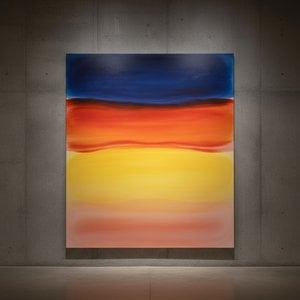
A Realm of Quiet Contemplation: Exploring Mark Rothko’s Abstract Expressionism
Mark Rothko (1903-1970) stands as one of the titans of American abstract expressionism, a movement that irrevocably altered the course of 20th-century art and continues to resonate with audiences today. While seemingly simple – vast canvases dominated by deep gray hues – Rothko’s paintings are profoundly complex explorations of color, form, and the human psyche. Born in Latvia and immigrating to Portland, Oregon, as a child, Rothko's formative years instilled within him an acute sensitivity to suffering, influencing his artistic vision throughout his career. He rejected organized religion after witnessing its impact on his father’s death, embarking on a path of uncompromising artistic integrity.
Deconstructing the Composition
Rothko’s signature technique—the “color field”—abandoned traditional representational imagery altogether. Instead, he employed rectangular blocks of color, often layered upon one another, creating immersive experiences for the viewer. These canvases eschewed focal points or discernible subjects; their power resided in the subtle variations within the monochromatic palette and the overall textural surface. The deliberate absence of brushstrokes or defined edges contributes to a sense of serenity and contemplation—a space designed to bypass intellect and tap directly into emotion. As Rothko himself eloquently stated, “I want people to experience something beyond sight.”
Technique & Materials
Rothko’s meticulous approach involved applying paint with rollers or brushes to achieve an exceptionally smooth surface. He painstakingly built up layers of pigment—typically oil or acrylic—to generate depth and luminosity within the color field. The selection of materials – canvas stretched tautly over a wooden frame – was crucial to conveying Rothko's artistic intent. Unlike many contemporaries who prioritized virtuoso brushwork, he sought to transcend technique and evoke an instinctive response from the viewer. This dedication to simplicity underscores his belief that art should communicate directly with the soul.
Historical Context & Artistic Evolution
Rothko emerged during a period of profound intellectual and cultural upheaval following World War II—a time marked by existential anxieties and a yearning for spiritual meaning. He initially experimented with figurative painting, influenced by Surrealism and mythology, before transitioning to abstraction in the mid-1940s. His groundbreaking color field paintings solidified his position as a leader within Abstract Expressionism alongside artists like Barnett Newman and Jackson Pollock—figures who challenged conventions of representation and championed spontaneity and emotional intensity. Rothko’s work reflects the broader anxieties of the era, grappling with themes of mortality and searching for transcendence beyond rational thought.
Symbolism & Emotional Impact
Despite his resistance to explicit interpretations of his paintings, Rothko's oeuvre is undeniably imbued with symbolic resonance. The dominant gray hues evoke feelings of quietude, melancholy, and introspection—a deliberate attempt to create “serious religious experiences.” By stripping away visual references, Rothko invites viewers to project their own emotions onto the canvas, fostering a deeply personal connection. His paintings are not merely decorative objects but portals into inner contemplation—a testament to his unwavering conviction that art possesses the capacity to transform consciousness.
Considerations for Collectors & Designers
- Interior Design: Rothko’s minimalist aesthetic lends itself beautifully to contemporary interiors, providing a grounding element or subtle accent against bolder color schemes.
- Color Palette: The grayscale palette complements Scandinavian design and creates calming atmospheres in living spaces.
- Emotional Atmosphere: Ideal for meditation rooms or areas intended for relaxation, Rothko’s paintings inspire contemplation and introspection.
- Scale & Placement: Large-scale Rothko canvases demand ample viewing distance—consider positioning them prominently in hallways or above fireplaces.
This artwork is more than just pigment on canvas; it's an invitation to engage with profound questions of existence and beauty—a legacy that continues to captivate artists and collectors alike.
Photo Description: --Overall Impression-- The artwork presents a large, rectangular canvas dominated by a single, deep gray color. It’s a minimalist piece that relies entirely on the absence of detail and the subtle variations within the grayscale tone. Compositionally, it's simple – a full-field application of paint with no discernible subject matter or focal point. There is no obvious texture visible; the surface appears smooth and uniform. The use of lines is non-existent, as there are no brushstrokes or defined edges. Shapes are basic rectangles, defining the canvas itself and the frame. Lighting is implied by the consistent tone across the entire image, suggesting even illumination. Perspective is nonexistent due to the lack of depth cues. Depth is completely absent. The subject matter is abstract; it’s a study in color and form rather than representation. Symbolic or emotional elements are minimal, primarily evoking feelings of quietude, contemplation, or perhaps melancholy through its somber hue. The style is minimalist and contemporary. The technique appears to be straightforward application of paint, likely with a brush or roller. Materials used are canvas and paint (likely oil or acrylic). --
Size: Unknown
Date: Unknown



 Anteprima in scala reale
 Passa alle stampe
 Condividi
 Condividi
 Dettagli
 Guida stampabile

 Scarica
 Articoli simili
 Radiografia
 Slideshow
 Statistiche

 Leggi tutto






































 L'opzione vetro è disponibile solo per dimensioni inferiori a 110 cm