Stampa giclée o su tela di qualità museale, con produzione rapida e diverse opzioni di finitura. ( Acquista il dipinto realizzato a mano Passa all'immagine digitale)





























Scegli tra le nostre dimensioni predefinite, che rispettano le proporzioni originali dell'opera d'arte.

Inserisci la larghezza e l'altezza desiderate, per adattarle alla tua cornice o alla tua parete. Una stampa può essere solo ritagliata, mai resa più grande dell'immagine originale; pertanto, un formato con una forma differente comporterà la perdita di una parte dell'opera. Ti invieremo un mockup digitale da approvare prima di procedere con la stampa. L'immagine mostrata in questa pagina non rappresenta il ritaglio reale — solo il mockup lo mostra.
Consegna in tutto il mondo () in 2 settimane invece delle normali 4/5 settimane. (8 Novembre)
Print sample
Dimensioni riproduzione
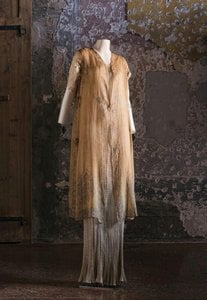
Mariano Fortuny’s “Print Sample,” created around 1905 and now meticulously reproduced, offers a captivating glimpse into the mind of a true artistic innovator. More than just a depiction of a solitary tree, this tempera on paper work embodies Fortuny's unique approach to color, light, and the evocative power of suggestion – hallmarks that would define his illustrious career as a painter, designer, and theatrical lighting pioneer. The painting’s deceptively simple composition immediately draws the eye, inviting contemplation over its subtle complexities.
The subject itself—a tree rendered in shades of warm orange—is imbued with an almost dreamlike quality. Three distinct circles punctuate the branches, their placement seemingly random yet contributing to a sense of balanced asymmetry. These aren’t merely decorative elements; they represent Fortuny's fascination with optics and his groundbreaking experiments in reflected light. He meticulously studied how light interacted with different surfaces, a principle he later applied revolutionarily to stage lighting design, creating seamless transitions between scenes within the opulent theaters of his time. The tree itself, bathed in an ethereal glow, feels both ancient and newly born, suggesting a timelessness that transcends its painted form.
Fortuny's style was characterized by a masterful blend of Orientalism, Symbolism, and a distinctly Venetian sensibility. He drew heavily from the rich artistic traditions of the East, particularly Persia and Morocco, incorporating intricate patterns and vibrant color palettes into his work. However, he never simply replicated these influences; instead, he filtered them through his own unique vision, creating something entirely new. “Print Sample” exemplifies this alchemy perfectly. The delicate layering of paint creates a remarkable sense of depth and texture, while the subtle shifts in tone evoke the warmth of sunlight filtering through leaves.
The technique employed is remarkably understated yet profoundly effective. Fortuny’s brushwork is loose and expressive, prioritizing atmosphere over precise detail. He skillfully utilizes glazing – applying thin layers of translucent paint to build up color and luminosity—to achieve a remarkable sense of realism without resorting to photographic accuracy. This approach aligns with his broader philosophy: to capture the *essence* of a subject rather than its literal representation.
Born in Reus, Spain, in 1871, Mariano Fortuny’s early life was marked by tragedy – the loss of his father, also a painter, at a young age. This event profoundly shaped his artistic trajectory, leading to a move to Paris where he immersed himself in the world of textiles and design. It was here that he began experimenting with innovative materials and techniques, ultimately pioneering the creation of luxurious fabrics inspired by historical costumes and exotic landscapes.
Fortuny’s contributions extended far beyond painting. He invented the “fortuny cyclorama dome,” a revolutionary stage lighting system that allowed for seamless transitions between scenes in theatrical productions. His treatise, "Eclairage Scenique," outlined his groundbreaking discoveries regarding reflected light, forever changing the landscape of theater design. “Print Sample” stands as a testament to this multifaceted genius – a small but potent example of an artist who seamlessly integrated art, fashion, and technology.
Beyond its technical brilliance, “Print Sample” resonates with viewers on a deeply emotional level. The solitary tree, bathed in golden light, evokes feelings of tranquility, contemplation, and perhaps even a touch of melancholy. It’s a symbol of resilience, rootedness, and the enduring beauty of nature—themes that have captivated artists for centuries. Fortuny's ability to imbue such a simple subject with such profound meaning is a testament to his artistic vision and his deep understanding of human psychology.
Reproductions of “Print Sample” offer an accessible way to experience the artistry of this remarkable painter. Whether adorning a wall in a contemporary interior or serving as a cherished piece within a collection, this evocative work continues to inspire and delight, reminding us of the power of art to transport us to another time and place.
"Print sample" è un'opera in WallArt.
La saturazione del colore di "Print sample" è Muted e la sua intensità è Monochromatic.
"Print sample" di Mariano Fortuny ha un formato Portrait. Il formato descrive le proporzioni della composizione.

Mariano Fortuny nacque nel 1838 a Reus (Tarragona), figlio d’arte: suo padre era il pittore catalano Marià Fortuny i Marsal, mentre sua madre, Cecilia de Madrazo, proveniva parimenti da una famiglia di artisti (era figlia di Federico de Madrazo e nipote di José de Madrazo). Rimasto orfano del padre all’età di tre anni, Mariano Fortuny si trasferì a Parigi con sua madre e nella capitale francese si accostò per la prima volta alla pittura.
Fortuny dimostrò fin dalla giovane età le sue straordinarie capacità artistiche, mostrando competenze in pittura, fotografia, scultura, architettura, incisione e teatrale scenotecnica. Le sue invenzioni rivoluzionarono il mondo del teatro design, creando soluzioni innovative per l’illuminazione indiretta.
Fortuny ottenne fama internazionale negli anni ’20 grazie alla collaborazione con artisti e personalità importanti come Richard Wagner, il cui opere ispirarono Fortuny a dipingere scene; la Scala di Milano, dove adattò il suo cyclorama dome per ampliare lo spazio teatrale e inventò un ventilatore aspirante per mantenere la tensione del tessuto; e altri grandi nomi della scena artistica internazionale.
Fortuny morì nel 1949 a Venezia, lasciando un patrimonio artistico ricco di innovazioni e influenze che ancora oggi vengono studiate e apprezzate dagli esperti d’arte. Il suo stile unico e la sua visione del mondo hanno ispirato numerosi artisti successivi.
È considerato uno dei più grandi maestri della pittura spagnola del XIX secolo e un vero punto di riferimento nella storia dell'arte europea.

1871 - 1949 , Spagna

Scopri la vera qualità museale delle stampe giclée tra pigmenti e carta fine art. Impara a distinguere l'eccellenza dal comune poster.

Trasforma i tuoi scatti più iconici in capolavori senza tempo. Con WahooArt, converti le tue immagini in stampe d'arte e dipinti a olio su misura. Scopri l'eccellenza artigianale per elevare il tuo stile di vita con opere che celebrano la tua eredità visiva.
 Anteprima in scala reale
 Invia
Invia Condividi
 Dettagli opera
 Guida
Guida

 Scarica
 Simili
 Radiografia
 Slideshow
 Domande e risposte
 Statistiche


 Espandi i dettagli









 L'opzione vetro è disponibile solo per dimensioni inferiori a 110 cm