Descrizione dell'opera
Marc Chagall’s “Inspiration”: A Symphony of Color and Memory
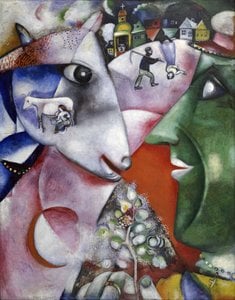
The painting "Inspiration," created by Marc Chagall in 1963, isn't merely an image; it’s a portal into the artist’s subconscious—a landscape sculpted from dreams and illuminated with the incandescent glow of remembered joy. Examining this masterpiece reveals layers of artistic intention that resonate far beyond its surface beauty.
Subject Matter and Composition
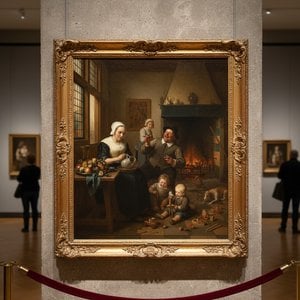
At first glance, “Inspiration” depicts a serene tableau: a woman seated at a window alongside her child. The figures are rendered in Chagall’s signature style—elongated forms, stylized faces, and an almost fantastical depiction of human anatomy—characteristic of his Vitebsk period. The composition is deliberately asymmetrical, drawing the eye upwards towards the window and emphasizing the connection between mother and child. Scattered throughout the scene are other individuals – a man standing near the window, adding to the sense of domestic tranquility. Notably, an apple rests prominently on the windowsill, a recurring symbol in Chagall’s oeuvre representing innocence and vitality.
Style and Technique: Vitebsk Surrealism
Chagall's approach aligns perfectly with Vitebsk Surrealism—a movement born from the fervor of artistic experimentation following the Second World War. He employs loose brushstrokes and vibrant color palettes, eschewing meticulous realism in favor of expressive abstraction. The artist utilizes a technique that blends observation with imagination, capturing not just what he sees but also what he feels—the emotional essence of his memories. Chagall’s distinctive use of color is particularly striking; blues and greens dominate the background, conveying a sense of calm and openness, while reds and yellows punctuate the scene, injecting warmth and energy into the composition. The artist skillfully blends opaque and transparent pigments to achieve depth and luminosity, creating an illusionistic effect that enhances the painting’s dreamlike quality.
Historical Context: Echoes of Vitebsk's Cultural Crossroads
“Inspiration” emerged from a pivotal moment in Chagall’s artistic life—a return to Vitebsk after his exile during Stalinist repression. The town itself served as an enduring inspiration for his art, embodying the confluence of Russian Orthodox faith and Jewish tradition. This duality is palpable in the painting's imagery: the towering churches juxtaposed with the bustling marketplace symbolize the artist’s engagement with both spiritual and social realities. Chagall’s work during this period reflects a profound desire to express the complexities of human experience—to grapple with themes of loss, displacement, and longing while simultaneously celebrating beauty and optimism.
Symbolism: Recurring Motifs and Their Significance
Beyond its immediate visual appeal, “Inspiration” is laden with symbolic meaning. The woman at the window represents motherhood and nurturing, while her child embodies innocence and future generations. The apple symbolizes purity and fecundity—a testament to Chagall’s fascination with folklore and mythology. Furthermore, the clock on the wall serves as a poignant reminder of time's relentless passage—a subtle commentary on mortality and the enduring power of memory. These motifs are interwoven throughout Chagall’s artistic vocabulary, reflecting his belief that art possesses the capacity to transcend temporal boundaries and communicate universal truths.
Emotional Impact: A Vision of Tranquility and Remembrance
Ultimately, “Inspiration” succeeds in conveying a profound emotional resonance—a feeling of warmth, tenderness, and contemplative serenity. The painting invites viewers into Chagall’s inner world, prompting reflection on themes of family, faith, and the beauty of fleeting moments. It's a testament to Chagall’s ability to transform personal experience into universal art—a timeless masterpiece that continues to captivate audiences with its ethereal charm and enduring spirit.



 Ordina la riproduzione
 Invia
Invia Condividi
 Dettagli

 Scarica
 Simili
 Radiografia
 Slideshow


 Scopri di più






































 L'opzione vetro è disponibile solo per dimensioni inferiori a 110 cm