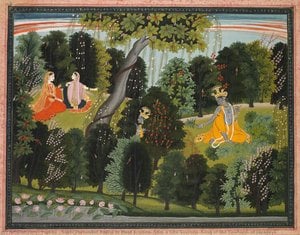
A Moment of Divine Intervention: ‘Manaku Releases the Demon Spies’
This captivating miniature painting, *Untitled (D2XACE)*, transports us to a pivotal scene from the epic Hindu tale of the Ramayana – specifically, the siege of Lanka. Created in 1725 by Manaku, a master artist from the Guler school of Pahari painting, this work isn’t merely an illustration; it's a meticulously crafted narrative frozen in time. Measuring 57 x 79 cm, the composition bursts with detail, depicting the moment Manaku releases the demon spies Shuka and Sarana, dispatched by Ravana to infiltrate Rama’s army. The foreground is dominated by a throng of demons, their forms varying in definition – a stylistic choice that emphasizes the sheer scale of Ravana's forces while focusing our attention on key figures within the scene. A formidable stone wall, complete with towers and gateways, anchors the composition, creating a sense of enclosure and impending conflict. Above, a balcony scene adds another layer to the narrative, hinting at courtly observation or divine intervention.
The Art of Pahari Miniature Painting
Manaku’s style is deeply rooted in the Pahari tradition – a school renowned for its delicate brushwork, vibrant yet nuanced color palettes, and intimate scale. Influenced by the declining Mughal Empire, Manaku skillfully blends Persian artistic conventions with indigenous Indian aesthetics. Notice the flattened perspective, characteristic of miniature painting; depth is achieved not through realistic spatial recession but through careful layering and overlapping forms. The artist employs precise lines to define details, while geometric shapes – squares, rectangles, and rounded figures – structure the composition. The technique itself is a testament to patience and skill, involving the application of thin washes of pigment (likely egg tempera) onto a prepared surface, building up form and luminosity gradually. The earthy tones punctuated by reds and golds create a warm, inviting atmosphere despite the scene’s inherent drama.
Symbolism & Historical Context
Beyond its aesthetic beauty, *Untitled (D2XACE)* is rich in symbolism. The depiction of demons and divine figures embodies the eternal struggle between good and evil – a central theme in Hindu mythology. Manaku's work provides valuable insight into the cultural and religious beliefs of 18th-century India. He lived during a period of political fragmentation, yet artistic innovation flourished within the independent hill states like Guler. Manaku’s rediscovery, largely thanks to scholars like B.N. Goswamy, highlights the importance of recognizing artists previously overshadowed by more famous contemporaries – in this case, his younger brother Nainsukh. This painting is not just a work of art; it's a historical document reflecting a specific time and place, offering a glimpse into the artistic landscape of Pahari painting.
Emotional Resonance & Collecting Considerations
The emotional tone of *Untitled (D2XACE)* is one of epic conflict tempered by spiritual significance. While depicting a moment of strategic release – the demons are being sent back to report on Rama’s forces – there's an underlying sense of anticipation and impending battle. The painting evokes a feeling of immersion within this ancient narrative, inviting contemplation on themes of duty, deception, and divine will. For collectors and interior designers, a high-quality reproduction of this work offers a unique opportunity to introduce a touch of refined elegance and cultural richness into any space. Its intricate details and harmonious color palette make it a versatile piece that complements both traditional and contemporary settings.



 Anteprima in scala reale
 Ordina la riproduzione dipinta a mano
 Condividi
 Condividi
 Dettagli

 Scarica
 Articoli simili
 Radiografia
 Slideshow
 Statistiche


 Leggi tutto






































 L'opzione vetro è disponibile solo per dimensioni inferiori a 110 cm