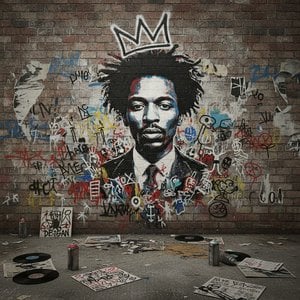
A Life Forged in Texture: The World of Julian Schnabel
Julian Schnabel emerged from the vibrant, often chaotic New York art scene of the 1980s as a force of nature, challenging conventions and redefining the possibilities of painting. Born in Brooklyn in 1951, his early life took an unexpected turn when his family relocated to Brownsville, Texas, in 1965—a formative experience that instilled within him a sense of outsider status and a fascination with raw, untamed environments. This duality – the urban grit of New York versus the expansive landscapes of the Texan borderlands – would become a recurring theme throughout his artistic journey. He pursued formal training at the University of Houston, but it was his audacious application to the Whitney Museum’s Independent Study Program—delivered between two slices of bread—that truly signaled his iconoclastic spirit and willingness to disrupt established norms. This gesture wasn't mere provocation; it was a statement about breaking down barriers and presenting art outside traditional frameworks.
The Rise of Neo-Expressionism and the ‘Plate Paintings’
Schnabel’s breakthrough arrived with his groundbreaking “plate paintings.” These weren’t canvases adorned with imagery, but rather assemblages built upon shattered ceramic plates, layered with plaster, wax, and a diverse array of materials—velvet, antlers, photographs, even shards of wood. The sheer physicality of these works was revolutionary; they were not simply *seen*, but experienced as sculptural objects demanding attention through their weight, texture, and scale.
Ornamental Despair,
The Student of Prague, and
Fakires exemplify this early period, showcasing a bold rejection of minimalist austerity in favor of maximalist expression. He wasn’t interested in pristine surfaces or intellectual detachment; he sought to convey emotion through tactile intensity and the visible evidence of creation—the cracks, fissures, and accumulated layers becoming integral to the artwork's narrative. This approach aligned him with the burgeoning Neo-Expressionist movement, a reaction against the conceptual rigor of the preceding decades, which prioritized subjective experience and emotional resonance. While his success was swift, it wasn’t without controversy; critics like Robert Hughes famously dismissed his work as bombastic and self-indulgent, comparing it unfavorably to physical displays of strength rather than artistic merit. Yet, Schnabel persevered, participating in pivotal exhibitions such as the Venice Biennale in 1980 and ‘A New Spirit in Painting’ at the Royal Academy of Arts in 1981, solidifying his position as a leading figure in the resurgence of painting. The deliberate fragmentation of porcelain—a technique borrowed from Surrealist artists like Kurt Schwitters—became Schnabel's signature style, symbolizing both destruction and rebirth.
Beyond the Canvas: A Cinematic Exploration
Schnabel’s creative ambition extended beyond the confines of the art world, leading him to a remarkably successful career in filmmaking. His directorial debut,
Basquiat (1996), was a poignant and visually arresting biopic of Jean-Michel Basquiat, capturing the energy and turmoil of the young artist’s life and work. This wasn't simply a biographical retelling; it was an immersive experience that conveyed the raw emotion and creative process behind Basquiat’s art. He followed this with
Before Night Falls (2000), an adaptation of Reinaldo Arenas’ autobiography, which garnered critical acclaim and won the Grand Jury Prize at the Venice Film Festival. This film, based on Arenas' own harrowing account of persecution and exile, utilized innovative visual techniques—particularly slow motion—to heighten emotional impact and explore themes of identity and artistic struggle. Schnabel’s meticulous attention to detail mirrored his approach to painting, demonstrating a consistent vision across different mediums. Finally,
The Diving Bell and the Butterfly (2007) cemented his reputation as a filmmaker capable of tackling complex subjects with empathy and artistry. Based on Jean-Dominique Bauby's autobiographical novel about surviving a stroke—a condition that left him unable to speak or move—the film employed groundbreaking CGI to reconstruct Bauby’s inner world, offering a profoundly moving portrayal of resilience and the transformative power of art.
Influences and Legacy: A Continuing Dialogue
Schnabel doesn't explicitly cite specific influences, but echoes of artists like Robert Rauschenberg – with his embrace of collage and found objects – can be discerned in his work. Both artists challenged traditional notions of artistic materials and embraced the detritus of everyday life as sources of creative inspiration. Schnabel’s willingness to experiment with scale, texture, and unconventional surfaces has profoundly influenced a generation of artists, encouraging them to push boundaries and explore new possibilities within painting and sculpture. His works are now held in major museum collections worldwide, including the Metropolitan Museum of Art, MoMA, the Whitney Museum, Tate Modern, and the Centre Pompidou—a testament to his enduring impact on contemporary art. Today, Julian Schnabel continues to work prolifically as both a painter and filmmaker, remaining a vital and provocative voice in the global art landscape. He embodies an unwavering commitment to artistic freedom and a relentless pursuit of innovation, ensuring his legacy will continue to inspire and challenge audiences for years to come.
- Born: 1951, Brooklyn, New York City
- Key Movement: Neo-Expressionism
- Notable Works: Plate Paintings, Basquiat (film), The Diving Bell and the Butterfly (film)



 Anteprima in scala reale
 Passa alle stampe
 Condividi
 Condividi
 Dettagli
 Guida stampabile

 Scarica
 Articoli simili
 Radiografia
 Slideshow
 Statistiche


 Leggi tutto






































 L'opzione vetro è disponibile solo per dimensioni inferiori a 110 cm