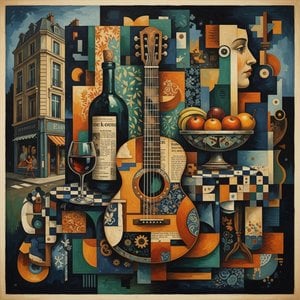
A Masterpiece of Geometric Harmony
In the pantheon of early twentieth-century modernism, few works capture the intellectual rigor and tactile beauty of Synthetic Cubism as exquisitely as Juan Gris’s Still Life with Checked Tablecloth. Created in 1915, this seminal painting serves as a profound meditation on the relationship between structure and surface. At first glance, the viewer is greeted by a rhythmic arrangement of everyday objects—a bowl of grapes, glassware, and printed materials—all resting upon a striking checkered tablecloth. However, beneath this seemingly domestic scene lies a complex architectural feat of color and form. Gris, with his unique background in engineering, approaches the canvas not merely as a surface for depiction, but as a space for construction, where overlapping planes and interlocking shapes create a sense of depth that defies the flatness of the medium.
The technique employed here is a hallmark of the Synthetic Cubist movement. Unlike the earlier Analytical phase, which often dissolved objects into monochromatic fragments, Gris utilizes larger, more legible geometric shapes to build his composition. The checkered pattern of the tablecloth acts as a structural grid, anchoring the floating elements and providing a visual pulse that vibrates across the canvas. Through the masterful use of muted tones punctuated by strategic highlights, the artist achieves a delicate balance between abstraction and reality. One can almost feel the texture of the paper and the weight of the glass, as Gris integrates typography and numerals into the very fabric of the painting, blurring the line between the physical world and the graphic language of modern life.
The Soul of Synthetic Cubism
To understand this work is to understand a pivotal moment in art history. Between 1915 and 1920, the art world underwent a radical transformation, moving away from the imitation of nature toward a celebration of the painted object itself. Still Life with Checked Tablecloth stands as a testament to this shift. The painting does not seek to replicate a window into another world; instead, it invites us to appreciate the beauty of the canvas as an autonomous entity. The way the light seems to catch the edge of a glass or the curve of a fruit is not a trick of realism, but a calculated use of color and shape designed to evoke a sensory response. This approach creates an atmosphere that is simultaneously cerebral and deeply inviting, making it a piece that rewards repeated, contemplative viewing.
For the discerning collector or interior designer, this artwork offers more than mere decoration; it provides a sophisticated focal point that bridges the gap between classical elegance and avant-garde energy. The composition’s inherent stability, provided by its geometric foundations, makes it an ideal centerpiece for contemporary spaces that value structural integrity and intellectual depth. Whether placed in a minimalist gallery setting or a richly textured study, the painting brings with it a sense of historical gravity and timeless aesthetic grace. Owning a high-quality reproduction of this Gris masterpiece allows one to inhabit the same world of rhythmic complexity and quiet beauty that defined the height of the Cubist revolution.



 Anteprima in scala reale
 Passa a Stampe
 Invia
Invia Condividi
 Dettagli opera

 Scarica immagine
 Simili
 Radiografia
 Slideshow
 Statistiche


 Espandi i dettagli






































 L'opzione vetro è disponibile solo per dimensioni inferiori a 110 cm