A Symphony of Geometry: The Essence of Juan Gris
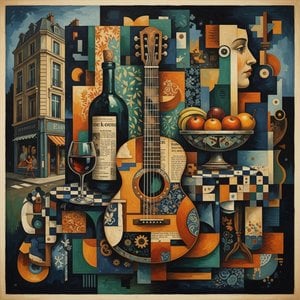
In the pantheon of early twentieth-century modernism, few names resonate with as much analytical precision and poetic grace as Juan Gris. His masterpiece, Guitar on the Table, created in 1913, serves as a breathtaking window into the heart of Synthetic Cubism. This oil on canvas work is not merely a depiction of an instrument; it is a profound exploration of how reality can be dismantled and reconstructed through the lens of geometric abstraction. As one contemplates this piece, the eye is immediately drawn to the central motif—a guitar that appears both solid and ephemeral, its form broken into a rhythmic dance of overlapping planes and intersecting lines. The painting captures a moment where the physical world dissolves into a sophisticated arrangement of shapes, inviting the viewer to participate in the intellectual reconstruction of the subject.
The technical mastery displayed in this work lies in Gris's ability to balance complexity with a restrained, almost meditative palette. Eschewing the chaotic fragmentation seen in earlier Analytic Cubism, Gris employs a harmonious blend of blues, browns, and whites, punctuated by subtle greens and intricate speckled patterns. These textures do more than provide visual interest; they create a tactile depth that mimics the grain of wood or the weave of fabric. The background, adorned with decorative motifs reminiscent of fine wallpaper or draped cloth, provides a soft counterpoint to the structural rigidity of the guitar. This interplay between the organic and the geometric, the flat and the dimensional, is what gives the composition its enduring vitality.
Historical Resonance and Interior Elegance
To possess or display a reproduction of Guitar on the Table is to bring a piece of art history into the contemporary living space. Created during the height of the Parisian avant-garde movement, this work stands as a testament to the era when artists like Picasso and Braque were redefining the very boundaries of sight. The painting carries with it the intellectual weight of the Museo Thyssen-Bornemisza, where such treasures are preserved, yet its aesthetic appeal is remarkably versatile for modern interior design. For the discerning collector or interior designer, this piece offers a sophisticated focal point that complements both minimalist contemporary settings and richly textured, classical environments.
Beyond its formal qualities, the painting evokes a sense of quiet introspection. The presence of secondary guitars and the subtle, abstracted figures in the periphery suggest a larger, bustling social scene—perhaps a Parisian café or a private studio—yet all is distilled into a singular, focused harmony. This creates an emotional impact of calm stability amidst complexity. Whether placed in a sunlit gallery or a moody, dimly lit study, Guitar on the Table acts as a conversation starter, prompting reflections on the nature of perception and the enduring beauty of structured abstraction. It is an investment in a legacy of innovation, offering a timeless elegance that transcends the decades.



 Anteprima in scala reale
 Passa a Stampe
 Invia
Invia Condividi
 Dettagli opera

 Scarica immagine
 Simili
 Radiografia
 Slideshow
 Statistiche


 Espandi i dettagli






































 L'opzione vetro è disponibile solo per dimensioni inferiori a 110 cm