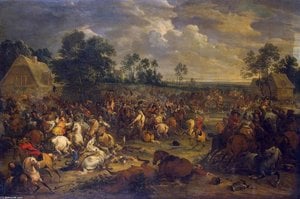
Battle by the Windmill di Joseph Parrocel, riproduzione di un dipinto a olio realizzato a mano da un maestro d'arte
Anteprima in scala reale Anteprima in AR Passa alle stampe Passa all'immagine digitale Invia
Dettagli opera Guida Aggiungi ai preferiti Scarica Simili Radiografia Slideshow Domande e risposte Presentation Statistiche

Battle by the Windmill Riproduzione di un dipinto a olio dipinto a mano

Dimensioni
38.0 x 63.0 cm

Experience the visceral chaos of Joseph Parrocel’s Baroque masterpiece Battle by the Windmill, a dramatic depiction of cavalry combat and intense movement that invites you to bring this historic energy into your collection.

Joseph Parrocel (1646-1704): Maestro del Barocco francese, celebre per i suoi affreschi di battaglia e paesaggi che hanno reso immortale il suo stile unico nel suo tempo.

Riproduzione a olio fatta a mano

Olio su tela dipinto a mano nelle tue dimensioni e con la tua cornice, realizzato su ordinazione dai nostri artisti. ( Passa alle stampe Passa all'immagine digitale)

Corner sample of the P118B picture frame: polistirene stampato, 5 cm wide and 3 cm thick
P118B €10
Corner sample of the P118H picture frame: polistirene stampato, 5 cm wide and 3 cm thick
P118H €10
Corner sample of the P118W picture frame: polistirene stampato, 5 cm wide and 3 cm thick
P118W €10
Corner sample of the P438Z picture frame: polistirene stampato, 5.5 cm wide and 3.5 cm thick
P438Z €10
Corner sample of the P508JH picture frame: polistirene stampato, 7 cm wide and 3.5 cm thick
P508JH €12
Corner sample of the P508YH picture frame: polistirene stampato, 7 cm wide and 3.5 cm thick
P508YH €12
Corner sample of the P805H picture frame: polistirene stampato, 5 cm wide and 3.5 cm thick
P805H €10
Corner sample of the P805Z picture frame: polistirene stampato, 5 cm wide and 3.5 cm thick
P805Z €10
Corner sample of the P919BZ picture frame: polistirene stampato, 7 cm wide and 3.5 cm thick
P919BZ €10
Corner sample of the P919G picture frame: polistirene stampato, 7 cm wide and 3.5 cm thick
P919G €10
Corner sample of the P919XJ picture frame: polistirene stampato, 7 cm wide and 3.5 cm thick
P919XJ €10
Corner sample of the P959ZH picture frame: polistirene stampato, 5 cm wide and 3 cm thick
P959ZH €10
Corner sample of the P968JZ picture frame: polistirene stampato, 6 cm wide and 4 cm thick
P968JZ €12
Corner sample of the W106C picture frame: legno massello, 5 cm wide and 3 cm thick
W106C €8
Corner sample of the W218G picture frame: legno massello, 5 cm wide and 3 cm thick
W218G €10
Corner sample of the W218JH picture frame: legno massello, 5 cm wide and 3 cm thick
W218JH €8
Corner sample of the W218Y picture frame: legno massello, 5 cm wide and 3 cm thick
W218Y €10
Corner sample of the W307PJ picture frame: legno massello, 6 cm wide and 3 cm thick
W307PJ €10
Corner sample of the W316G picture frame: legno massello, 6 cm wide and 3 cm thick
W316G €10
Corner sample of the W316PJ picture frame: legno massello, 6 cm wide and 3 cm thick
W316PJ €8
Corner sample of the W316Y picture frame: legno massello, 6 cm wide and 3 cm thick
W316Y €10
Corner sample of the W398PJ picture frame: legno massello, 5 cm wide and 3 cm thick
W398PJ €8
Corner sample of the W4111J picture frame: legno massello, 6.5 cm wide and 3.5 cm thick
W4111J €10
Corner sample of the W500HY picture frame: legno massello, 7 cm wide and 5 cm thick
W500HY €15
Corner sample of the W500JH picture frame: legno massello, 7 cm wide and 5 cm thick
W500JH €15
Corner sample of the W692G picture frame: legno massello, 8 cm wide and 4 cm thick
W692G €12
Corner sample of the W849H picture frame: legno massello, 5 cm wide and 3 cm thick
W849H €8
Corner sample of the W940BG picture frame: legno massello, 7.5 cm wide and 4.5 cm thick
W940BG €15
Corner sample of the W953PJ picture frame: legno massello, 6 cm wide and 3.5 cm thick
W953PJ €8

Formato standard
su misura
CM
INCH

Scegli tra le nostre dimensioni predefinite, che rispettano le proporzioni originali dell'opera d'arte.

larghezza
altezza

Inserisci la larghezza e l'altezza desiderate, per adattarle alla tua cornice o alla tua parete. Trattandosi di un'opera dipinta a mano, in caso di dimensioni con un formato differente, l'artista può estendere leggermente il dipinto oltre i bordi dell'immagine o ritagliare una piccola parte — la scelta spetta a te. Ti invieremo un mockup digitale da approvare prima che la realizzazione abbia inizio. L'immagine mostrata in questa pagina non rappresenta il risultato finale — solo il mockup lo fa.

Esempi di ciò che può essere modificato: sostituire il volto con una foto del cliente; aggiungere un animale domestico (ad esempio, sostituire un gatto con un cane); inserire un messaggio nascosto nello sfondo; cambiare il paesaggio o gli elementi dello sfondo.
Dopo l'ordine, il team di WahooArt.com contatterà il cliente via e-mail per ricevere le istruzioni e fornirà un'anteprima del mockup

Consegna in tutto il mondo () in 3/4 settimane anziché nelle normali 5 settimane. (7 Novembre). Nessun compromesso sulla qualità.

Spedizione espressa gratuita in tutto il mondo
Tela in lino di alta qualità
Assicurazione completa sulla spedizione
Garanzia di rimborso dei dazi doganali
Garanzia di fedeltà cromatica assoluta
Politica di reso entro 100 giorni (solo per difetti di fabbricazione)
Garanzia di rimborso al 100%
Offerta per acquisti multipli

Prezzo totale

€ 243

Battle by the Windmill

Tecnica di riproduzione

Dimensioni riproduzione

-

Prezzo finale calcolato

€ 243

Informazioni rapide

  • Dimensions: 38 x 63 cm
  • Medium: Oil Painting
  • Influences: Classical Art
  • Artistic style: Heroic
  • Notable elements or techniques: Dynamic battle scenes, Realistic style

Quiz d'arte

Per ogni domanda è presente una sola risposta corretta.

Domanda 1:
What is the primary subject matter depicted in "Battle by the Windmill"?
Domanda 2:
What artistic style characterizes "Battle by the Windmill"?
Domanda 3:
Where was "Battle by the Windmill" primarily commissioned to decorate?
Domanda 4:
What prominent architectural element is featured prominently in the background of "Battle by the Windmill", contributing to its visual impact?
Domanda 5:
What color palette dominates the painting's overall mood and atmosphere?

Battle by the Windmill: A Baroque Masterpiece of Conflict and Resilience

Joseph Parrocel’s “Battle by the Windmill” stands as a testament to the turbulent spirit of the French Baroque era, capturing not merely a military skirmish but also the profound psychological drama inherent in moments of decisive confrontation. Painted circa 1680-1704, this monumental canvas embodies the grandeur and dynamism championed by Louis XIV’s court, reflecting his ambition to solidify royal authority through spectacular displays of power and artistry. The artwork's commission stemmed from a desire to commemorate a pivotal victory – the Battle of Windmill Point – securing Canada’s independence from British rule during the Upper Canada Rebellion.
  • Subject Matter: The painting depicts a chaotic battlefield scene centered around Windmill Point, a strategic location overlooking the St. Lawrence River. Figures engaged in hand-to-hand combat dominate the foreground, showcasing both mounted warriors and infantry soldiers wielding swords, spears, and shields with ferocious determination.
  • Style & Technique: Parrocel’s masterful execution exemplifies Baroque realism, prioritizing dramatic composition and expressive brushwork over idealized beauty. He employs a bold chiaroscuro technique—the interplay of light and shadow—to heighten the sense of tension and immediacy, immersing viewers in the visceral experience of battle. Thick impasto strokes contribute to textural richness, conveying the physicality of movement and exertion.
  • Historical Context: The Battle of Windmill Point was a crucial moment in Canadian history, marking the culmination of a rebellion fueled by aspirations for republican liberty. Parrocel’s depiction reflects the anxieties surrounding royal rule and the fervent desire for self-governance prevalent throughout Europe at the time. It aligns with broader artistic trends celebrating military heroism and commemorating triumphs against formidable adversaries.
  • Symbolism: The prominent windmill serves as a powerful visual symbol—representing resilience, steadfastness, and the enduring spirit of resistance. Its towering presence anchors the composition, emphasizing the importance of defense and unwavering resolve amidst adversity. The figures’ postures convey courage and determination, embodying the ideals of nobility and martial prowess.
  • Emotional Impact: “Battle by the Windmill” transcends mere visual representation; it evokes a profound emotional response in the viewer. The painting captures the terror and exhilaration of combat, conveying the psychological strain endured by soldiers facing imminent danger. Yet, simultaneously, it celebrates victory—affirming faith in human fortitude and commemorating triumph over oppression.
The artwork’s enduring appeal lies in its ability to transport viewers back to a bygone era, prompting contemplation on themes of courage, duty, and the transformative power of artistic expression. Its meticulous detail and dramatic flair continue to inspire admiration among art historians and collectors alike—a lasting legacy of Joseph Parrocel's unparalleled skill as a painter and chronicler of his time.

Domande e risposte

Quale formato di stampa di "Battle by the Windmill" di Joseph Parrocel si adatta meglio alla stanza consigliata?

Per un Living Room, si consiglia di stampare "Battle by the Windmill" con una dimensione di Small.

Qual è la tonalità dominante di "Battle by the Windmill" di Joseph Parrocel?

La tonalità dominante di "Battle by the Windmill" di Joseph Parrocel è Ochre to Sepia, un colore che costituisce il tono di fondo dell'intera tavolozza.

Chi è l'artista dietro "Battle by the Windmill"?

"Battle by the Windmill" è stata creata da Joseph Parrocel. Le informazioni contenute in questa pagina descrivono l'opera originale di Joseph Parrocel.


Biografia dell'artista

Joseph Parrocel: A Titan of Baroque Battle Painting

Joseph Parrocel (1646 – 1704) stands as a monumental figure in the history of French Baroque art, renowned primarily for his dramatic depictions of military confrontations—a genre he elevated to unparalleled heights of expressive power and technical virtuosity. Born in Brignoles, Provence, into a family deeply rooted in artistic tradition—a lineage stretching back to Georges Parrocel (c. 1540-1614)—his early life foreshadowed his destined path as a painter of distinction. The untimely death of his father in 1660 propelled him toward Marseille, where he honed his craft amidst the vibrant artistic milieu of the Mediterranean port city and quickly gained recognition for capturing the fervor of Saint Anthony’s Feast Day celebrations.

From Marseille to Rome: Artistic Apprenticeship and Early Influences

His ambition extended beyond provincial acclaim; Parrocel embarked on a transformative journey to Rome in 1675, seeking mentorship under Jacques Courtois—the “Bourguignon”—a celebrated battle painter whose stylistic innovations profoundly impacted the young artist’s artistic sensibilities. This formative period witnessed Parrocel immersing himself in the artistic currents of the papal court and absorbing the lessons imparted by Salvator Rosa, a precursor to Romanticism who championed emotional intensity and psychological depth. The influence of Rosa is palpable in Parrocel's later works, particularly his landscapes imbued with melancholic beauty and dramatic lighting—a testament to the enduring power of artistic dialogue across generations.

Royal Patronage and Architectural Grandeur

Parrocel’s fortunes swiftly ascended as he secured prestigious commissions from Louis XIV, cementing his position among France’s most esteemed artists. Notably, Louvois, Secretary of State for War, recognized Parrocel's exceptional talent and entrusted him with decorating the dining hall of Les Invalides—a monumental undertaking that showcased his mastery of fresco painting and solidified his reputation as a champion of royal grandeur. Furthermore, he collaborated on the decoration of Marly and Versailles, contributing to the opulent aesthetic of Louis XIV’s court and shaping the visual landscape of an era defined by theatrical spectacle and imperial ambition. His involvement in the Gobelins Manufactory project—producing twelve tapestries depicting scenes from Virgil's *Aeneas*—demonstrates his commitment to elevating artistic expression through collaborative endeavors and underscores his role as a pivotal figure in French cultural history.

A Legacy of Dynamic Composition and Vivid Color

Joseph Parrocel’s distinctive style—characterized by bold brushstrokes, luminous color palettes, and an unwavering focus on capturing the dynamism of battle—established him as a singular voice within the Baroque tradition. Unlike Adam Frans van der Meulen, his contemporary academician rival, Parrocel eschewed meticulous detail in favor of expressive gesture and emotional resonance—a stylistic choice that continues to captivate viewers today. His output encompassed over ninety prints and engravings, many now housed in the Louvre, ensuring that his artistic vision persists as a beacon of Baroque innovation and grandeur. He bequeathed to posterity not merely images but an indelible impression of an era consumed by heroic ambition and artistic fervor—a legacy worthy of enduring admiration.
Joseph Parrocel

Joseph Parrocel

1646 - 1704 , Francia

Dettagli rapidi

  • Artistic Movement Or Style: Barocco
  • Artists Who Influenced This Artist:
    • Jacques Courtois
    • Salvator Rosa
  • Date Of Birth: 1646
  • Date Of Death: 1704
  • Full Name: Joseph Parrocel
  • Nationality: Francese
  • Notable Artworks:
    • Battaglia
    • Carica di Cavalleria
    • Alessandro Magno
  • Place Of Birth: Brignoles, Francia