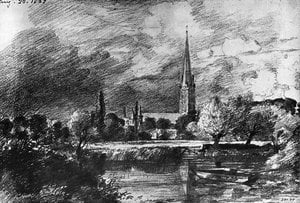
A Boat Passing a Lock: Constable’s Romantic Vision
John Constable’s
A Boat Passing a Lock stands as an emblem of Romanticism—a movement that prioritized emotion and imagination over rational observation. Painted in 1826, this monumental oil canvas captures the essence of Constable’s profound connection to the English landscape, specifically the River Stour near Dedham Vale. More than just a depiction of a rural scene, it's an exploration of light, atmosphere, and the sublime—concepts central to Romantic thought.
Style and Composition: Pioneering Atmospheric Perspective
Constable revolutionized painting technique by embracing what he termed “atmospheric perspective.” Unlike preceding artists who meticulously rendered every detail, Constable sought to convey the feeling of a place rather than its literal appearance. This is brilliantly achieved in
A Boat Passing a Lock through the masterful use of color and tonal gradation. The hazy sky dominates the composition—a deliberate choice that reflects Constable’s fascination with meteorological phenomena and his belief in their influence on human perception. The low horizon line amplifies this sense of grandeur, drawing the viewer's eye upwards into the expansive heavens.
Historical Context: Embracing Emotion and Nature
The Romantic era arose as a reaction against Enlightenment ideals—a rejection of reason and order in favor of intuition and feeling. Artists like Constable responded to the burgeoning interest in scientific observation by simultaneously elevating emotion and celebrating the beauty of untamed nature. The painting reflects the broader cultural preoccupation with spirituality and contemplation, mirroring the Victorian fascination with pastoral landscapes and idealized visions of rural life. It’s a testament to Constable's conviction that art should inspire awe and wonder—a sentiment powerfully conveyed through his depiction of the dramatic interplay between light and cloud formations.
Symbolism: The Lock as Metaphor for Transition
Beyond its aesthetic qualities,
A Boat Passing a Lock carries symbolic weight. The lock itself represents a point of transition—the passage from one state to another, whether literal or metaphorical. Constable’s careful attention to detail—the weathered stone walls, the glistening water surface, and the solitary boatman—suggests an exploration of themes like mortality, change, and the enduring power of tradition.
Reproductions: Bringing Constable's Vision Home
At
WahooArt.com, we offer exceptional reproductions of
A Boat Passing a Lock crafted by skilled artists using traditional oil painting techniques. These reproductions capture the luminosity and textural richness of Constable’s original masterpiece—allowing you to experience its beauty and emotional depth in your own home or office. Explore
WahooArt.com for a stunning high-resolution image and discover more about Constable’s legacy on
WahooArt.com. Consider complementing your decor with other Romantic paintings by Turner or Friedrich—available exclusively at WahooArt.com. Visit
WahooArt.com to learn more about Christchurch Mansion and its remarkable collection of artworks!
Domande e risposte
Qual è l'uso consigliato per una stampa di "Una Barca Che Passa Una Sega"?
Una riproduzione di "Una Barca Che Passa Una Sega" di John Constable è consigliata per Accento cromatico. Questo suggerimento deriva dal soggetto, dall'atmosfera e dai colori dell'opera.
È disponibile un download ad alta risoluzione di "Una Barca Che Passa Una Sega"?
Per ottenere un file digitale di "Una Barca Che Passa Una Sega" di John Constable, ordina download di un'immagine digitale ad alta risoluzione nella sua pagina Immagine Digitale.
Qual è la dimensione di stampa consigliata per "Una Barca Che Passa Una Sega" di John Constable?
La dimensione di stampa consigliata per "Una Barca Che Passa Una Sega" di John Constable è Large.



 Anteprima in scala reale
 Ordina la riproduzione dipinta a mano
 Condividi
 Condividi
 Dettagli
 Guida stampabile

 Scarica
 Articoli simili
 Radiografia
 Slideshow
 Statistiche
 Leggi tutto






































 L'opzione vetro è disponibile solo per dimensioni inferiori a 110 cm