Introduction to John Constable and the Romantic Movement
John Constable, an English landscape painter born in Suffolk, was a key figure in the Romantic movement. He is celebrated for his revolutionary approach to landscape painting, which he imbued with emotional depth and personal affection. His works often depicted scenes from “Constable Country,” the area surrounding his home (
John Constable: Flatford Mill from the Tow Path,
John Constable: Ann and Mary Constable,
John Constable: Tree Trunks). The Romantic movement, which emerged in the late 18th century, emphasized emotion, individualism, and the beauty of nature. It stood in contrast to the Enlightenment's focus on reason and order (
John Robert Cozens: Between Chamonix and Martigny).
Constable’s artistic vision was profoundly influenced by the writings of William Wordsworth and Samuel Taylor Coleridge—poets who championed the sublime experience of encountering nature. He rejected the academic conventions of his time, prioritizing direct observation and capturing fleeting moments of beauty rather than idealized representations. This commitment to authenticity became a hallmark of his style and cemented his place as one of the most important landscape painters of the Romantic era.
Water Meadows Near Salisbury: A Masterpiece of Romanticism
Among Constable’s most renowned works is
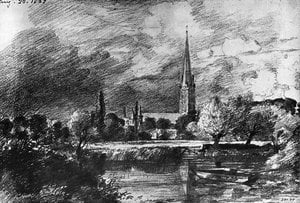
Water Meadows Near Salisbury, a captivating oil painting that embodies the essence of the Romantic movement. This masterpiece, which measures 50 x 64 cm, showcases Constable’s exceptional talent for capturing the beauty and emotion of the natural world. It exemplifies the Romantic preoccupation with portraying landscapes as they appeared to the human eye—a deliberate rejection of artistic conventions that favored geometric precision and idealized forms.
The Scene: Water Meadows Near Salisbury
Set in the picturesque countryside near Salisbury, England,
Water Meadows Near Salisbury features a serene river winding through lush meadows. The scene is bathed in soft sunlight, casting long shadows and creating a sense of depth and tranquility. Constable meticulously rendered the textures of grass, water, and foliage—a technique that would become known as “atmospheric perspective”—to convey the illusion of distance and heighten the emotional impact of the painting.
Constable's Approach: A Personal Touch
Constable’s approach to landscape painting was deeply personal. He sought not merely to depict the physical aspects of a scene but also to convey its emotional essence. In
Water Meadows Near Salisbury, he achieves this through his use of color, light, and texture. He employed a palette dominated by muted greens and blues—colors that reflected the prevailing atmospheric conditions—to evoke feelings of peace and contemplation. The artist’s brushstrokes were loose and expressive, capturing the dynamism of the natural world rather than striving for photographic accuracy.
The Legacy of John Constable and Water Meadows Near Salisbury
Constable's work has had a lasting impact on the art world. His innovative approach to landscape painting inspired future generations of artists, including the Barbizon school in France. Today,
Water Meadows Near Salisbury remains a cherished example of Romanticism and a testament to Constable’s extraordinary talent. It continues to resonate with viewers who appreciate its sublime beauty and profound emotional depth—a timeless celebration of the English countryside and the power of artistic observation.
## Experience the Beauty of Water Meadows Near Salisbury with WahooArt
At
WahooArt, we are proud to offer high-quality handmade oil painting reproductions of John Constable's masterpiece,
Water Meadows Near Salisbury. Our skilled artists meticulously recreate each detail, ensuring that every reproduction captures the beauty and emotion of the original work. To learn more about our reproductions or to place an order, visit us at
WahooArt. Experience the timeless beauty of John Constable's masterpiece with a handmade oil painting reproduction from WahooArt.



 Anteprima in scala reale
 Ordina la riproduzione dipinta a mano
 Condividi
 Condividi
 Dettagli

 Scarica
 Articoli simili
 Radiografia
 Slideshow
 Statistiche

 Leggi tutto






































 L'opzione vetro è disponibile solo per dimensioni inferiori a 110 cm