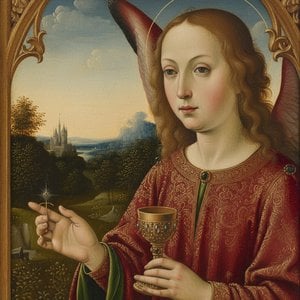
Jan van Eyck: The Architect of Detail
Jan van Eyck ( c. before 1390 – 9 July 1441) stands as one of the towering figures of the Early Netherlandish painting movement, a period that irrevocably transformed European art and visual culture. Often hailed as “the inventor of oil-painting,” his legacy extends far beyond mere technical innovation; he fundamentally reshaped artistic expression by prioritizing meticulous observation and rendering unparalleled realism—a feat achieved through groundbreaking advancements in pigment preparation and application.
Born around 1390 in Maastricht, Limburg (then Maaseyck), Van Eyck’s early life remains shrouded in obscurity. However, his burgeoning talent quickly propelled him into the orbit of artistic patronage, securing commissions from influential rulers like John III the Pitiless and Philip the Good—positions that afforded him considerable prestige and resources. His involvement in diplomatic missions underscored not only his artistic prowess but also his intellectual curiosity and trustworthiness.
The pinnacle of Van Eyck’s career arrived with his service to Philip the Good, who recognized his genius and entrusted him with overseeing monumental projects – most notably the Ghent Altarpiece—a collaborative effort that cemented his reputation as a master craftsman and visionary artist. This ambitious undertaking exemplifies his mastery of oil painting technique and his ability to convey profound spiritual emotion.
The Ghent Altarpiece: A Symphony of Light and Texture
Completed between 1432 and 1439, the Ghent Altarpiece—now housed in St Bavo’s Cathedral in Ghent—represents Van Eyck's magnum opus. It is a breathtaking testament to his artistic skill and an unparalleled achievement in visual storytelling. The altarpiece depicts scenes from the life of Christ, interwoven with intricate depictions of saints and donors—a masterful combination of narrative clarity and textural richness.
What distinguishes the Ghent Altarpiece from its contemporaries is Van Eyck’s revolutionary use of oil paint—a medium that allowed him to achieve luminosity and depth previously unattainable. His meticulous layering of glazes created an astonishing illusion of three-dimensionality, capturing subtle nuances of light and shadow with breathtaking accuracy. The resulting surface possesses a velvety smoothness—a hallmark of Van Eyck's technique—that continues to inspire admiration among art historians and connoisseurs.
Beyond Technique: Symbolism and Emotional Resonance
However, Van Eyck’s artistic genius transcends mere technical prowess; it resides in his profound understanding of symbolism and his ability to evoke powerful emotions. Each element within the Ghent Altarpiece—from the drapery folds to the facial expressions—is imbued with meaning—reflecting theological concepts and conveying spiritual aspirations.
The altarpiece’s central panel portrays Christ Pantocrator—the “Lord Almighty”—a figure of serene majesty bathed in radiant light. This depiction embodies Christian theology's assertion that God reigns supreme over all creation, radiating divine grace and compassion. The meticulous detail with which Van Eyck rendered Christ’s robe and halo underscores his unwavering commitment to realism—a stylistic choice that simultaneously elevates the image aesthetically and reinforces its spiritual significance.
Legacy: Shaping Artistic Vision
Jan van Eyck's influence on subsequent generations of artists is undeniable. His pioneering use of oil paint irrevocably altered the trajectory of European painting, establishing a new standard for realism and luminosity—a legacy that continues to resonate throughout art history. He remains an exemplar of artistic innovation and emotional depth—a testament to the transformative power of observation and meticulous craftsmanship.
His enduring fascination stems from his ability to capture not merely what is seen but also what is felt—a feat achieved through a masterful blend of technical virtuosity and symbolic insight. Van Eyck’s contribution to Early Netherlandish painting cemented his place as one of the most celebrated artists of his era, inspiring countless imitators and shaping the artistic landscape for centuries to come.



 Anteprima in scala reale
 Acquista il dipinto realizzato a mano
 Invia
Invia Condividi
 Dettagli opera

 Scarica immagine
 Simili
 Radiografia
 Slideshow
 Statistiche

 Espandi i dettagli






































 L'opzione vetro è disponibile solo per dimensioni inferiori a 110 cm