A Window Into Dutch Golden Age Tranquility
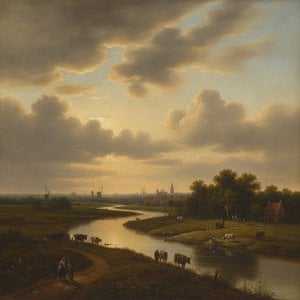
Jan van der Heyden’s “View of Delft with Old Church,” completed in 1670, stands as a cornerstone of Dutch Baroque painting and an enduring emblem of serene urban beauty. More than just a picturesque depiction of the city’s canals and rooftops, it embodies the intellectual and artistic fervor that characterized the Dutch Golden Age—a period marked by unprecedented prosperity, scientific advancement, and artistic innovation. As one gazes upon this masterpiece, they are transported to a time when the rhythmic pulse of maritime commerce met the quiet dignity of architectural grandeur. The painting captures a moment of suspended animation, where the bustling life of the canal is frozen in a state of eternal grace.
The composition is a masterclass in perspective and structural balance. Van der Heyden employs a pyramidal composition, a technique that skillfully directs the viewer's eye upward toward the towering, iconic spire of St. Bavold’s Church. This architectural giant dominates the skyline, acting as an anchor for the entire scene. The artist’s meticulous attention to detail allows every brick, every ripple in the canal water, and every distant silhouette to emerge with startling clarity. Through his use of oil on canvas, Van der Heyden achieves a luminous quality, where light does not merely sit upon the surface but seems to emanate from within the very textures of the buildings and the reflective depths of the water.
The Intersection of Engineering and Artistry
To understand this work, one must understand the man behind the brush. Jan van der Heyden was far more than a painter; he was a visionary engineer whose contributions to firefighting technology revolutionized urban safety. This pragmatic, scientific mind is precisely what gives his landscapes such profound realism. His ability to render the structural integrity of Delft’s architecture reflects an eye trained in precision and observation. There is a palpable sense of order and civic pride woven into the fabric of the painting. The presence of figures strolling near the water and a small dog wandering through the scene adds a layer of human warmth, suggesting that this is not merely a study of stone and water, but a celebration of lived experience.
The symbolism within the piece speaks to the core values of seventeenth-century Dutch society. The church, with its prominent clock tower, serves as a symbol of both faith and the steady passage of time, while the vibrant canal scene celebrates the commercial vitality that fueled the nation's wealth. For the modern collector or interior designer, this artwork offers more than just aesthetic beauty; it provides a sense of historical continuity and stability. The subdued tones and atmospheric depth make it an exquisite centerpiece for any sophisticated space, inviting contemplation and evoking a profound sense of peace. It is a rare treasure that captures the soul of a city, making it an essential acquisition for those who appreciate the intersection of technical mastery and emotional resonance.



 Anteprima in scala reale
 Ordina la riproduzione dipinta a mano
 Condividi
 Condividi
 Dettagli
 Guida
Guida

 Scarica
 Articoli simili
 Radiografia
 Slideshow
 Statistiche


 Leggi tutto






































 L'opzione vetro è disponibile solo per dimensioni inferiori a 110 cm