A Theater of Justice: The Soul of Daumier’s Realism
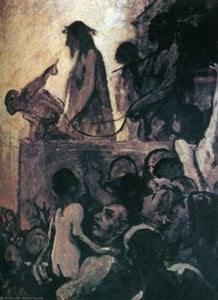
In the quiet, somber depths of Honoré Daumier’s "The Defender," created around 1865, we are not merely spectators to a courtroom scene, but witnesses to a profound human drama. This masterful work, a cornerstone of the Realist movement, eschews the polished romanticism of its era to present an unflinching look at the psychological weight of the legal system. The composition immediately draws the eye toward a central, electric tension: a lawyer, captured in a moment of fervent advocacy, gestures with an outstretched arm that seems to vibrate with conviction. Beside him sits a woman, her posture etched with the heavy mantle of anxiety and dread. Through this intimate encounter, Daumier transcends simple reportage, inviting us into a space where the stakes are nothing less than human liberty and dignity.
The technical brilliance of "The Defender" lies in its ability to sculpt emotion through line and tone. Utilizing the lithographic medium, Daumier employs a sophisticated interplay of hatching and cross-hatching to breathe life into the figures. The lawyer’s hand and forearm are rendered with dynamic, expressive strokes that convey the urgency of his plea, while the subtle textures of the paper create a sense of atmospheric depth. The color palette is intentionally restrained—a melancholic symphony of browns, grays, beiges, and blacks. This monochromatic approach does not diminish the work; rather, it heightens the gravity of the scene, stripping away distractions to focus our attention on the raw, unadorned truth of the subjects' expressions.
Historical Echoes and Symbolic Depth
To understand "The Defender" is to understand the turbulent heart of 19th-century France. Daumier lived through the social upheavals of the Second Empire, a period where he used his sharpened satirical wit to expose the hypocrisies of the political and judicial elite. This artwork serves as a silent but powerful critique of the legal apparatus; it questions the impartiality of justice and highlights the vulnerability of the individual caught within its gears. The blurred, indistinct crowd in the background acts as a haunting symbol of the impersonal nature of the law—a sea of onlookers whose presence provides context but offers no sanctuary to the accused.
Every element of the piece is steeped in symbolic resonance. The woman’s averted gaze and hunched shoulders are masterclasses in conveying silent suffering, making her a universal icon of those facing judgment. For the discerning collector or interior designer, this piece offers more than just aesthetic beauty; it provides a profound intellectual anchor for a space. A high-quality reproduction of "The Defender" brings with it an aura of historical significance and emotional complexity, making it an ideal centerpiece for a study, a library, or a gallery wall where one wishes to evoke themes of resilience, truth, and the enduring human spirit.



 Anteprima in scala reale
 Passa a Stampe
 Invia
Invia Condividi
 Dettagli opera

 Scarica immagine
 Simili
 Radiografia
 Slideshow
 Statistiche


 Espandi i dettagli






































 L'opzione vetro è disponibile solo per dimensioni inferiori a 110 cm