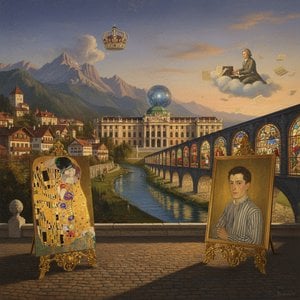
Junius: A Symbolist Vision of Power and Reflection
Gustav Klimt’s “Junius,” created in 1896 during his formative years as a Symbolist painter, stands as a cornerstone of Viennese Art Nouveau and embodies the movement's fascination with mythology, spirituality, and psychological depth. Measuring 41 x 31 cm, this chalk drawing isn’t merely an image; it’s a carefully constructed allegory designed to provoke contemplation on themes of authority, femininity, and inner turmoil—elements characteristic of Klimt’s artistic explorations during the late Victorian era.
The Painting: A Glimpse into Symbolism
“Junius” depicts two figures intertwined in a stylized embrace, dominated by opulent ornamentation reflecting Klimt's signature style. One figure, positioned slightly lower than the other, gazes downwards—a gesture laden with significance that invites viewers to consider introspection and contemplation. The composition deliberately eschews realism, prioritizing symbolic representation over accurate depiction of form. This stylistic choice aligns perfectly with Symbolism’s rejection of naturalistic observation in favor of conveying emotional truths through abstracted imagery. Klimt's meticulous attention to detail—evident in the intricate patterns adorning both figures—underscores his commitment to crafting artworks that resonate on a profound level.
Symbolic Elements
The central motif is undoubtedly the crowns worn by each figure, representing power and nobility. However, Klimt imbues these symbols with deeper meaning beyond mere status; they symbolize spiritual enlightenment and connection to divine forces – concepts prevalent in Symbolist thought. The downward gaze of the lower figure speaks volumes about psychological complexity, suggesting a preoccupation with inner thoughts and emotions rather than outward appearances. These visual cues contribute to the painting’s enigmatic aura, prompting viewers to interpret its symbolism according to their own perspectives. Klimt skillfully utilizes color—primarily gold—to heighten the sense of grandeur and luminosity, reinforcing the artwork's symbolic resonance.
Artistic Influences and Style
Klimt’s artistic vision was profoundly shaped by Symbolism alongside Art Nouveau, movements that championed decorative arts and explored dreamlike landscapes and fantastical narratives. The influence of Japanese art is palpable in Klimt’s use of flattened perspectives and stylized ornamentation—techniques borrowed from Ukiyo-e prints to create a visual language distinct from academic conventions. “Junius” exemplifies Klimt's mastery of technique, demonstrating his ability to blend intricate patterns with subtle tonal variations to achieve remarkable textural depth. This meticulous craftsmanship elevates the painting beyond mere decoration, transforming it into an emotionally charged statement about human experience.
Relevance in Modern Times
Despite its creation over a century ago, “Junius” retains considerable relevance today due to its timeless exploration of psychological themes and its masterful execution. Klimt’s work continues to inspire artists and designers alike, serving as a reminder that art can transcend temporal boundaries and communicate universal truths about human consciousness. Its enduring appeal lies in its ability to provoke contemplation on questions of identity, spirituality, and the complexities of interpersonal relationships—themes that remain pertinent in contemporary culture.
Experience the beauty of art with WahooArt.com's handmade oil painting reproductions.
Domande e risposte
Qual è la spiegazione relativa allo stato del copyright di "Junius" di Gustav Klimt?
"Junius" di Gustav Klimt è di di pubblico dominio - il copyright è scaduto. La durata del copyright decorre dalla morte dell'artista, avvenuta nel 1918.
I colori di "Junius" di Gustav Klimt sono vivaci o tenui?
"Junius" di Gustav Klimt presenta una saturazione di Colori delicati e un'intensità di Equilibrato.
Dove si consiglia di esporre il formato Orientamento verticale di "Junius"?
Il formato (Orientamento verticale) e l'ambiente consigliato (Lobby d'hotel) sono i due dettagli di posizionamento registrati per "Junius" di Gustav Klimt.



 Anteprima in scala reale
 Acquista il dipinto realizzato a mano
 Invia
Invia Condividi
 Dettagli opera
 Guida
Guida

 Scarica
 Simili
 Radiografia
 Slideshow
 Q&A
Q&A Statistiche


 Espandi i dettagli






































 L'opzione vetro è disponibile solo per dimensioni inferiori a 110 cm