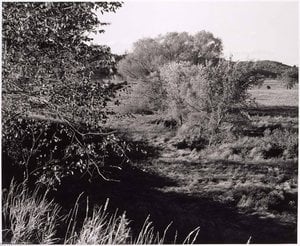
Grayson Mathews: Weaver of Shadows and the American West
Grayson Mathews (1948-2007) wasn’t merely a photographer; he was an archaeologist of feeling, a chronicler of forgotten landscapes, and a master of subtly unsettling beauty. His work, often dismissed as simply “western photography,” reveals a deeply layered exploration of American identity, memory, and the haunting resonance of place. Born in Eugene, Oregon, into a family steeped in artistic tradition – his mother was a painter, his father a sculptor – Mathews inherited an appreciation for visual storytelling that would profoundly shape his career. He initially studied at the San Francisco Art Institute, honing his technical skills while absorbing the influences of documentary photography and surrealism, laying the groundwork for his distinctive style.
Mathews’s artistic journey truly began with a National Endowment for the Arts Fellowship in 1971, granting him the freedom to document the world of professional rodeo. This wasn't a celebration of spectacle; rather, it was an investigation into the lives of cowboys – their loneliness, their grit, and the precariousness of their existence against the vast, indifferent backdrop of the American West. The resulting images, characterized by stark contrasts, muted colors, and carefully composed figures, captured a poignant sense of isolation and resilience. These early works established his signature style: a deliberate blurring of reality and dream, where familiar landscapes held an unsettling quality, hinting at hidden narratives and unspoken anxieties. He frequently employed a large format camera, allowing for meticulous detail and a deep connection to the subjects he photographed.
Following the rodeo project, Mathews continued to explore diverse themes through his lens. He documented the transformation of the Klamath Basin landscape in Oregon, capturing both its natural beauty and the impact of human activity – irrigation projects, logging operations, and the slow erosion of traditional ways of life. His work during this period became increasingly symbolic, utilizing recurring motifs like masks, children, and decaying structures to evoke a sense of loss and nostalgia. The influence of Surrealism is particularly evident in these later pieces, where familiar objects are presented in unexpected contexts, prompting viewers to question their assumptions about reality. He also taught photography at various institutions, including Central Texas College, where he found inspiration in the diverse cultures and landscapes of the American South.
The Language of Masks and Children
A defining characteristic of Mathews’s oeuvre is his consistent use of masks and children. These recurring elements aren't simply decorative; they function as potent symbols representing vulnerability, identity, and the fragility of memory. Masks, often worn by figures in his photographs, obscure faces, suggesting a detachment from reality or a deliberate attempt to conceal one’s true self. Children, frequently depicted in precarious situations – playing amidst ruins, exploring abandoned buildings – embody innocence and the potential for both beauty and destruction. These motifs intertwine throughout his body of work, creating a hauntingly consistent visual language.
Consider, for example, “Untitled (Children in Plastic Tent).” The image depicts two young children huddled within a makeshift shelter constructed from plastic sheeting, evoking a sense of displacement and vulnerability. The stark lighting and the unsettling juxtaposition of childhood innocence with the harshness of their surroundings amplify the emotional impact. Similarly, "Untitled (Pacific Finance Building)" presents a ghostly figure standing before an imposing skyscraper, symbolizing the encroachment of modernity upon the natural world. These images aren’t simply snapshots; they are carefully constructed narratives designed to provoke contemplation and elicit a visceral response.
Texas Roots and Smithsonian Recognition
While Mathews spent significant periods in Oregon and California, he maintained strong ties to Texas, where his family had deep roots. His photographs of rodeo cowboys in Texas were particularly evocative, capturing the rugged individualism and stoic resilience of these working-class heroes. He developed a keen eye for detail, meticulously documenting the textures of denim, leather, and dust, creating images that felt both authentic and timeless.
In 2007, Grayson Mathews’s work received significant recognition when it was included in the permanent collection of the Smithsonian American Art Museum. This prestigious honor validated his artistic vision and cemented his place as a major figure in contemporary American photography. The Smithsonian's selection underscored the depth and complexity of his oeuvre, demonstrating that his work transcends simple genre classifications and speaks to universal themes of identity, memory, and the human condition.
Legacy and Continuing Resonance
Grayson Mathews’s untimely death in 2007 left a void in the world of photography. However, his legacy continues to resonate through his hauntingly beautiful images. His work invites viewers to look beyond the surface, to question their assumptions about reality, and to contemplate the hidden narratives embedded within the landscapes and faces he captured. His photographs are not merely representations of places; they are portals into a realm of emotion, memory, and symbolism—a testament to the power of photography as a means of exploring the complexities of the human experience.
Further research can be found at the University of Oregon Libraries Special Collections & University Archives: https://researchguides.uoregon.edu/photographs/grayson-mathews



 Anteprima in scala reale
 Passa alle stampe
 Condividi
 Condividi
 Dettagli
 Guida
Guida

 Scarica
 Articoli simili
 Radiografia
 Slideshow
 Statistiche
 Leggi tutto