A Portrait of Industry and Ambition: Gilbert Stuart’s William Woollett
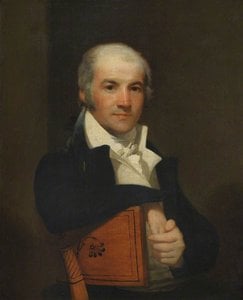
Gilbert Stuart's "Portrait of William Woollett," painted in 1783, is more than just a likeness; it’s a carefully constructed tableau of the burgeoning British art world and the ambitions of its most talented engravers. The painting captures Woollett, a prominent figure known for his intricate prints of historical scenes, seated at a richly appointed table, meticulously engaged in his craft. Stuart masterfully utilizes light and shadow to draw the viewer's eye across the composition, highlighting both Woollett’s focused concentration and the opulence surrounding him.
The style is firmly rooted in Neoclassicism, a movement that sought inspiration from the art of ancient Greece and Rome. However, Stuart infuses this classical framework with a distinctly English sensibility – evident in the formal arrangement of the figures, the restrained palette dominated by warm browns, creams, and subtle blues, and the overall sense of dignified composure. The composition is balanced and symmetrical, reflecting an appreciation for order and harmony, hallmarks of Neoclassical aesthetics. Stuart’s skill lies not just in replicating Woollett's appearance but in conveying his character – a man dedicated to his profession, possessing both intellect and a certain quiet self-assurance.
The Engraver’s Studio: A Symbol of Skill and Status
Woollett’s studio is presented as a microcosm of artistic achievement. The table before him isn't merely a workspace; it’s laden with symbols of his profession. A partially completed print, presumably depicting Benjamin West’s “The Death of General Wolfe,” lies open, demonstrating the subject matter he’s currently working on. A bowl containing writing implements and ink suggests the intellectual labor involved in creating these detailed engravings. The inclusion of a green cloth beneath the table adds a touch of luxury and reinforces the idea that Woollett's work is valued and appreciated.
The background, though somewhat indistinct, hints at a comfortable domestic setting – a glimpse of a room filled with books and perhaps other artistic endeavors. This suggests not only Woollett’s success but also his status within society. Engraving was a highly skilled trade in the 18th century, requiring years of training and meticulous attention to detail. Stuart's portrait elevates Woollett beyond a mere craftsman; he becomes an emblem of artistic excellence and a respected member of the cultural elite.
A Window into the Age of Enlightenment
"Portrait of William Woollett" offers a fascinating glimpse into the intellectual and artistic climate of the late 18th century. The painting reflects the values of the Age of Enlightenment – a period characterized by reason, scientific inquiry, and a renewed interest in classical antiquity. Woollett’s dedication to his craft embodies the Enlightenment ideal of pursuing knowledge and mastering one's skills. Furthermore, the commission itself speaks volumes about the patronage system that supported artists during this era, demonstrating how wealthy individuals and institutions invested in artistic endeavors.
The painting’s provenance – displayed initially at the Society of Artists exhibition and later residing in Boydell’s Shakespeare Gallery – underscores its importance within the art world. It wasn't simply a private commission; it was a public statement, showcasing Woollett’s talent and contributing to the vibrant artistic scene of London. The fact that it eventually found its home in the National Gallery testifies to its enduring quality and historical significance.
Capturing Character: Stuart’s Technique
Stuart's masterful technique is evident in every brushstroke. He employs a subtle, almost velvety texture, achieved through careful layering of paint – a characteristic of his style known as “impasto.” The lighting is particularly effective, creating a sense of depth and volume while simultaneously highlighting Woollett’s features. Note the way Stuart captures the glint of light on Woollett's turban, adding a touch of drama to the composition.
Furthermore, Stuart skillfully uses color to convey mood and atmosphere. The muted palette contributes to the painting’s overall sense of quiet dignity and intellectual seriousness. The artist’s ability to capture not just Woollett’s physical appearance but also his personality – a man of focus, dedication, and quiet confidence – is what truly elevates this portrait beyond a mere likeness. It's a testament to Stuart’s artistic genius and his profound understanding of human character.
Domande e risposte
Cosa accomuna "William Woollett" al resto della produzione di Gilbert Stuart?
"William Woollett" condivide con le altre opere di Gilbert Stuart lo stile Neoclassicism e i temi ricorrenti: neoclassical ideals, british portraiture, 18th-century social hierarchy, woollett’s engraving, west’s influence, stuart's career progression”, national gallery acquisition”.
Chi è l'artista dietro "William Woollett"?
"William Woollett" è stata creata da Gilbert Stuart. Le informazioni contenute in questa pagina descrivono l'opera originale di Gilbert Stuart.
Quanti anni aveva Gilbert Stuart quando è stata creata "William Woollett"?
Gilbert Stuart ha realizzato "William Woollett" all'età di 28. L'artista è nato nel 1755 e l'opera è datata 1783.
Dove posso vedere l'originale "William Woollett" di Gilbert Stuart?
Puoi ammirare l'originale "William Woollett" presso il Tate Gallery, Londra, Regno Unito.
In che modo "William Woollett" bilancia luci e ombre?
"William Woollett" ha una luminosità complessiva di deep_shadow, con una luminanza pari a Dark.
È disponibile un download per "William Woollett"?
È disponibile un download per "William Woollett": la pagina Scarica dell'opera offre download di un'immagine digitale ad alta risoluzione.
In che anno è stata creata "William Woollett" di Gilbert Stuart?
La creazione di "William Woollett" di Gilbert Stuart risale al 1783.



 Anteprima in scala reale
 Ordina la riproduzione dipinta a mano
 Condividi
 Condividi
 Dettagli
 Guida stampabile

 Scarica
 Articoli simili
 Radiografia
 Slideshow
 Statistiche


 Leggi tutto






































 L'opzione vetro è disponibile solo per dimensioni inferiori a 110 cm