x
Anteprima in scala realeAnteprima in scala reale Anteprima ARAnteprima AR Acquista stampa Acquista stampaAcquista immagine Acquista immagine InviaInvia
Dettagli operaDettagli opera Aggiungi ai preferiti Aggiungi ai preferiti Scarica immagineScarica immagine SimiliSimili RadiografiaRadiografia SlideshowSlideshow


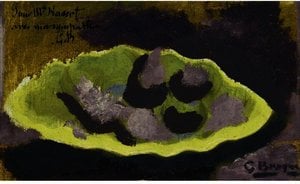
The Green Apples

Georges Braque’s masterful Cubist still life captures the essence of form and texture—green apples arranged in a dynamic circle alongside a lemon—reflecting the groundbreaking artistic innovations of the early 20th century. Explore this iconic piece and bring its timeless beauty into your home.

Esplora la vita e l'arte di Georges Braque (1882-1963), una figura chiave della pittura del XX secolo. Pioniere del Cubismo insieme a Picasso, noto per il Fauvismo, il collage e forme geometriche innovative. Scopri la sua eredità su WahooArt!

Riproduzione a olio fatta a mano

Olio su tela dipinto a mano nelle tue dimensioni e con la tua cornice, realizzato su ordinazione dai nostri artisti. (Acquista stampa Acquista stampaAcquista immagine Acquista immagine)

P118B $10
P118H $10
P118W $10
P438Z $10
P508JH $12
P508YH $12
P805H $10
P805Z $10
P919BZ $10
P919G $10
P919XJ $10
P959ZH $10
P968JZ $12
W106C $8
W218G $10
W218JH $8
W218Y $10
W307PJ $10
W316G $10
W316PJ $8
W316Y $10
W398PJ $8
W4111J $10
W500HY $15
W500JH $15
W692G $12
W849H $8
W940BG $15
W953PJ $8

Formato standard
su misura
CM
INCH

Scegli tra le nostre dimensioni predefinite, che rispettano le proporzioni originali dell'opera d'arte.

larghezza
altezza

È possibile inserire dimensioni personalizzate per adattare l'opera a una cornice o a uno spazio specifico. Se la dimensione selezionata non corrisponde alle proporzioni dell'immagine originale, provvederemo a ritagliare l'opera o a estendere il dipinto con elementi aggiuntivi dipinti a mano. Un mockup digitale ti sarà inviato per approvazione prima dell'inizio della produzione.
Si prega di notare che l'anteprima a schermo non riflette il ritaglio o l'estensione effettivi. Solo il mockup mostrerà accuratamente la composizione finale.
Sebbene siano disponibili dimensioni personalizzate, consigliamo di selezionare una dimensione dall'elenco predefinito per preservare le proporzioni originali.

Esempi di ciò che può essere modificato: sostituire il volto con una foto del cliente; aggiungere un animale domestico (ad esempio, sostituire un gatto con un cane); inserire un messaggio nascosto nello sfondo; cambiare il paesaggio o gli elementi dello sfondo.
Dopo l'ordine, il team di WahooArt.com contatterà il cliente via e-mail per le istruzioni e fornirà un'anteprima del mockup

Consegna in tutto il mondo () in 3/4 settimane anziché nelle normali 5 settimane. (4 Settembre). Nessun compromesso sulla qualità.

why_choose_icon
Spedizione espressa gratuita in tutto il mondo
why_choose_icon
Tela in lino di alta qualità
why_choose_icon
Assicurazione completa sulla spedizione
why_choose_icon
Garanzia di rimborso dei dazi doganali
why_choose_icon
Garanzia di fedeltà cromatica
why_choose_icon
Politica di reso entro 60 giorni (solo per difetti di fabbricazione)
why_choose_icon
Garanzia di rimborso al 100%
why_choose_icon
Offerta per acquisti multipli

Prezzo totale

$ 272

reproduction

The Green Apples

Tecnica di riproduzione

Dimensioni riproduzione

-

Prezzo totale calcolato

$ 272

Informazioni rapide

  • Artistic style: Analytical Cubism
  • Artist: Georges Braque
  • Location: Private Collection
  • Medium: Oil on canvas
  • Notable elements or techniques: Geometric abstraction
  • Movement: Cubism

Quiz d'arte

Per ogni domanda è presente una sola risposta corretta.

Domanda 1:
Georges Braque is best known for his contribution to which artistic movement?
Domanda 2:
The painting depicts a still life featuring what prominent objects?
Domanda 3:
What artistic technique is primarily employed in 'The Green Apples' to create a sense of fractured perspective?
Domanda 4:
The painting's muted color palette contributes to what overall mood or atmosphere?

A Quiet Revolution in Form: Decoding Braque’s The Green Apples

In the quietude of Georges Braque’s 1912 masterpiece, The Green Apples, one finds far more than a simple arrangement of fruit upon a table. At first glance, the viewer is met with a deceptively humble tableau: a collection of verdant apples resting on a plate, accompanied by a bowl and a subtle hint of a lemon. Yet, to look closer is to enter the very heart of the Cubist revolution. This work serves as a profound exploration of visual perception, where the boundaries between object and space begin to dissolve. Braque does not merely present a still life; he invites us into a meditative study of how light, mass, and geometry intersect to create a new reality.

The technique employed here is a masterclass in the analytical approach that defined Braque’s pivotal period. Moving away from the vibrant, emotive outbursts of his Fauvist beginnings, Braque adopts a muted, sophisticated palette dominated by earthy greens, deep browns, and soft ochres. This deliberate restraint prioritizes tonal harmony over mere spectacle, allowing the viewer to focus on the structural rhythm of the composition. Through the use of fragmentation and multiple simultaneous viewpoints, the artist deconstructs the traditional illusion of depth. The apples are not merely painted; they are reconstructed through geometric abstraction, challenging the eye to piece together a fragmented world that exists beyond a single, static perspective.

Historical Resonance and Symbolic Depth

To understand The Green Apples, one must consider the turbulent era from which it emerged. Painted during the height of the Cubist movement alongside his legendary collaborator Pablo Picasso, this work reflects a broader intellectual shift in early 20th-century Europe. As the world faced the complexities of rapid industrialization and the looming shadows of global conflict, artists like Braque sought to dismantle conventional notions of perspective. The painting acts as a blueprint for modern vision, stripping away the superficiality of representation to find the structural truth beneath. It is an era where the mirror of art was shattered, and Braque was one of the primary architects of its reconstruction.

Beyond its formal brilliance, the composition is rich with subtle symbolic resonance. The circular arrangement of the apples serves as a recurring motif for Braque, suggesting themes of wholeness, continuity, and the cyclical nature of time. This sense of stability is punctuated by the sharp, acidic brightness of the lemon on the left, a small but vital disruption that prevents the tonal balance from becoming too static. Even the partially obscured chair in the background provides an anchor of domesticity, grounding the abstract experimentation in a recognizable, human space. For the collector or designer, this piece offers a sophisticated balance of intellectual rigor and domestic warmth.

An Essential Addition to the Modern Interior

For those seeking to curate a space defined by elegance and contemplation, The Green Apples offers an unparalleled emotional impact. It evokes a mood of quiet meditation—a sanctuary of thought in an increasingly loud world. The painting’s ability to command attention through subtlety rather than volume makes it an ideal centerpiece for high-end interiors, whether placed in a minimalist gallery setting or a richly textured study. Its muted tones and organic forms harmonize effortlessly with contemporary decor, providing a sense of historical depth and artistic prestige.

Owning a high-quality reproduction of this work is more than an aesthetic choice; it is an invitation to engage with the very foundations of modern art. It allows the presence of Braque’s revolutionary spirit to inhabit a room, offering daily inspiration through its complex interplay of light and form. Whether you are an art historian captivated by its Cubist lineage or an interior designer looking for a piece that embodies timeless sophistication, The Green Apples remains a profound testament to the power of seeing the world anew.


Biografia dell'artista

**primi anni di vita e formazione**

Georges Braque, un illustre pittore francese, collageur, disegnatore, stampatore e scultore, nacque il 13 maggio 1882 ad Argenteuil, Val-d'Oise. È cresciuto a Le Havre e inizialmente si è formato per diventare pittore di facciate e decoratore come suo padre e nonno. Tuttavia, le inclinazioni artistiche di Braque lo hanno portato a studiare pittura all’École des Beaux-Arts a Le Havre dal 1897 al 1899.

**evoluzione artistica e fauvismo**

Nel 1902, dopo aver completato il suo apprendistato con un decoratore a Parigi, Braque ha frequentato l'Académie Humbert fino al 1904. Questo periodo ha segnato la sua introduzione al fauvismo, uno stile caratterizzato da colori vivaci e risposte emotive. Influenzato dalle opere di Henri Matisse e André Derain, Braque ha adottato un approccio fauvista, come si può vedere nel suo dipinto La Pazienza (fauvismo, olio su tela).

**contributo al cubismo**

La collaborazione di Braque con Pablo Picasso dal 1908 al 1912 ha portato allo sviluppo del cubismo. Le loro opere cubiste analitiche, come Georges Braque: La Pazienza e Pablo Picasso: Clarinet(cubismo analitico, olio su tela), sono oggi considerate pietre miliari della storia dell'arte.

**eredità e opere notevoli**

* Le Case all’Éstaque: una testimonianza dell'uso innovativo di geometria e prospettiva simultanea da parte di Braque. * La Pazienza(fauvismo, olio su tela): dimostra lo stile fauvista di Braque. * Clarinet(cubismo analitico, olio su tela): un'opera cubista collaborativa con Picasso.

**musei e collezioni**

* Musée d’Orsay: presenta una vasta collezione di arte impressionista e post-impressionista, inclusi lavori di Braque. * Musée de l’Orangerie: espone una vasta gamma di opere d'arte, inclusi quelle di Braque e altri artisti notevoli. **Lo stile innovativo di Georges Braque e la sua collaborazione con Pablo Picasso continuano a ispirare artisti e appassionati d'arte.**
Georges Braque

Georges Braque

1882 - 1963 , Francia

Dati rapidi

  • Artisti Influenti:
    • Henri Matisse
    • André Derain
    • Paul Cézanne
  • Artisti Influenzati: ['Pablo Picasso']
  • Data Di Nascita: 13 maggio 1882
  • Luogo Di Nascita: Argenteuil, Francia
  • Movimento Artistico: Cubismo, Fauvismo
  • Nazionalità: Francese
  • Nome Completo: Georges Braque
  • Opere Notevoli:
    • Case a L'Estaque
    • La Pazienza (fauvista)
    • Chitarra, Frutta e Brocca
    • Natura morta con Bass
Esplora le opere d'arte organizzate per temi, stili e caratteristiche.