Anteprima in scala reale Prova in AR Ordina la riproduzione dipinta a mano Passa all'immagine digitale Condividi
Dettagli Guida stampabile Aggiungi ai preferiti Scarica Articoli simili Radiografia Slideshow Statistiche

Pedestal Table

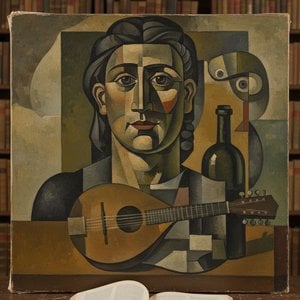
Experience Georges Braque’s ‘Pedestal Table,’ a pivotal 1911 Cubist masterpiece. This hand-painted reproduction captures the artist's innovative use of form and space, showcasing a unique art decoration.

Esplora la vita e l'arte di Georges Braque (1882-1963), una figura chiave della pittura del XX secolo. Pioniere del Cubismo insieme a Picasso, noto per il Fauvismo, il collage e forme geometriche innovative. Scopri la sua eredità su WahooArt!

L'opera d'arte visualizzata in questa pagina è protetta dalle leggi sul diritto d'autore, il che significa che non possiamo legalmente creare o vendere una riproduzione identica. Tale protezione è garantita da accordi internazionali quali la Convenzione di Berna e dalle leggi nazionali, incluse quelle stabilite da Legge sul copyright degli Stati Uniti - Titolo 17. Tutti i diritti riservati. Le immagini presenti su questo sito sono protette da copyright e non possono essere riprodotte o utilizzate senza l'autorizzazione scritta di WahooArt.com o dei rispettivi proprietari del copyright.

Questo metodo è pienamente conforme alle normative sul diritto d'autore poiché non prevede la copia o la duplicazione dell'opera protetta. Si tratta invece di una rielaborazione creativa: un nuovo dipinto che trae ispirazione dall'originale, senza tuttavia esserne identico.

Giclée / Stampe d'arte

Stampa giclée o su tela di qualità museale, con produzione rapida e diverse opzioni di finitura. ( Ordina la riproduzione dipinta a mano Passa all'immagine digitale)

Corner sample of the P118B picture frame: polistirene stampato, 5 cm wide and 3 cm thick
P118B €10
Corner sample of the P118H picture frame: polistirene stampato, 5 cm wide and 3 cm thick
P118H €10
Corner sample of the P118W picture frame: polistirene stampato, 5 cm wide and 3 cm thick
P118W €10
Corner sample of the P438Z picture frame: polistirene stampato, 5.5 cm wide and 3.5 cm thick
P438Z €10
Corner sample of the P508JH picture frame: polistirene stampato, 7 cm wide and 3.5 cm thick
P508JH €12
Corner sample of the P508YH picture frame: polistirene stampato, 7 cm wide and 3.5 cm thick
P508YH €12
Corner sample of the P805H picture frame: polistirene stampato, 5 cm wide and 3.5 cm thick
P805H €10
Corner sample of the P805Z picture frame: polistirene stampato, 5 cm wide and 3.5 cm thick
P805Z €10
Corner sample of the P919BZ picture frame: polistirene stampato, 7 cm wide and 3.5 cm thick
P919BZ €10
Corner sample of the P919G picture frame: polistirene stampato, 7 cm wide and 3.5 cm thick
P919G €10
Corner sample of the P919XJ picture frame: polistirene stampato, 7 cm wide and 3.5 cm thick
P919XJ €10
Corner sample of the P959ZH picture frame: polistirene stampato, 5 cm wide and 3 cm thick
P959ZH €10
Corner sample of the P968JZ picture frame: polistirene stampato, 6 cm wide and 4 cm thick
P968JZ €12
Corner sample of the W106C picture frame: legno massello, 5 cm wide and 3 cm thick
W106C €8
Corner sample of the W218G picture frame: legno massello, 5 cm wide and 3 cm thick
W218G €10
Corner sample of the W218JH picture frame: legno massello, 5 cm wide and 3 cm thick
W218JH €8
Corner sample of the W218Y picture frame: legno massello, 5 cm wide and 3 cm thick
W218Y €10
Corner sample of the W307PJ picture frame: legno massello, 6 cm wide and 3 cm thick
W307PJ €10
Corner sample of the W316G picture frame: legno massello, 6 cm wide and 3 cm thick
W316G €10
Corner sample of the W316PJ picture frame: legno massello, 6 cm wide and 3 cm thick
W316PJ €8
Corner sample of the W316Y picture frame: legno massello, 6 cm wide and 3 cm thick
W316Y €10
Corner sample of the W398PJ picture frame: legno massello, 5 cm wide and 3 cm thick
W398PJ €8
Corner sample of the W4111J picture frame: legno massello, 6.5 cm wide and 3.5 cm thick
W4111J €10
Corner sample of the W500HY picture frame: legno massello, 7 cm wide and 5 cm thick
W500HY €15
Corner sample of the W500JH picture frame: legno massello, 7 cm wide and 5 cm thick
W500JH €15
Corner sample of the W692G picture frame: legno massello, 8 cm wide and 4 cm thick
W692G €12
Corner sample of the W849H picture frame: legno massello, 5 cm wide and 3 cm thick
W849H €8
Corner sample of the W940BG picture frame: legno massello, 7.5 cm wide and 4.5 cm thick
W940BG €15
Corner sample of the W953PJ picture frame: legno massello, 6 cm wide and 3.5 cm thick
W953PJ €8

Standard
personalizzato
CM
INCH

Scegli tra le nostre dimensioni predefinite, che rispettano le proporzioni originali dell'opera d'arte.

larghezza
altezza

Inserisci la larghezza e l'altezza desiderate, per adattarle alla tua cornice o alla tua parete. Una stampa può essere solo ritagliata, mai resa più grande dell'immagine originale; pertanto, un formato con una forma differente comporterà la perdita di una parte dell'opera. Ti invieremo un mockup digitale da approvare prima di procedere con la stampa. L'immagine mostrata in questa pagina non rappresenta il ritaglio reale — solo il mockup lo mostra.

Consegna in tutto il mondo () in 2 settimane invece delle normali 4/5 settimane. (22 Ottobre)

Spedizione espressa gratuita in tutto il mondo
Tela in lino di alta qualità
Assicurazione completa sulla spedizione
Garanzia di rimborso dei dazi doganali
Garanzia di perfetta fedeltà cromatica
Politica di reso entro 100 giorni (solo per difetti di fabbricazione)
Garanzia di rimborso al 100%
Sconto per acquisti multipli

Prezzo totale

€ 60

Pedestal Table

Giclée / Stampe d'arte

Dimensioni della riproduzione

-

Prezzo totale

€ 60

Dettagli rapidi

  • Artist: Georges Braque
  • Year: 1911
  • Subject or theme: Still life, interior
  • Medium: Painting
  • Dimensions: 116 x 81 cm
  • Notable elements: Horse statue, guitar

Quiz d'arte

Per ogni domanda è presente una sola risposta corretta.

Domanda 1:
What artistic movement is most closely associated with Georges Braque’s ‘Pedestal Table’?
Domanda 2:
The image depicts a scene featuring a man and a horse statue. What is the primary significance of the pedestal in this composition?
Domanda 3:
Based on the description, what style of art is evident in ‘Pedestal Table’?
Domanda 4:
In the context of Braque's career, what was his early training primarily focused on?

Georges Braque’s ‘Pedestal Table’: A Fragmented World of Form and Perception

Georges Braque's “Pedestal Table,” painted in 1911, is not merely a depiction of an object; it’s a carefully constructed puzzle for the viewer, a window into the nascent world of Analytical Cubism. This work, housed within the Kunstmuseum Basel, immediately captivates with its fragmented forms and deliberate ambiguity, inviting us to actively participate in reconstructing the scene before us. The painting presents a man seated at a table, a horse statue looming in the background, and a sense of contained chaos—a visual embodiment of the era’s shifting perceptions of reality.

Braque's choice of subject matter – a simple pedestal table – is itself significant. Pedestals, as our research reveals (linked here: Wikipedia Search), traditionally elevate and support objects, providing stability and grounding. However, in Braque’s painting, the pedestal becomes a fractured element, dissected and reassembled into geometric planes. This disruption of traditional spatial relationships is a hallmark of Cubism, reflecting a desire to move beyond single viewpoints and represent an object from multiple perspectives simultaneously. The table itself isn't rendered as a solid, unified form; instead, it’s broken down into interlocking facets, suggesting its inherent instability and the subjective nature of observation.

Analytical Cubism: Deconstructing Reality

Painted during the period of Analytical Cubism – roughly 1908-1912 – “Pedestal Table” exemplifies the movement's core principles. This phase, developed in close collaboration with Pablo Picasso, focused on reducing objects to their fundamental geometric components. Braque’s palette is deliberately muted, dominated by browns, ochres, and grays, creating a sense of somberness and introspection. The artist employs a meticulous technique, applying paint in thin, overlapping layers – a characteristic of Analytical Cubism – to build up the complex network of planes and angles that define each element. The use of monochromatic tones further emphasizes the deconstruction of form, stripping away any illusion of depth or three-dimensionality.

Further insight into Braque’s approach can be found in articles like Georges Braque: Pioneering Cubism & the Evolution of Modern Form, which details his experimentation with color and form during this pivotal period. The artist’s meticulous attention to detail, combined with a radical departure from traditional representation, established Analytical Cubism as a groundbreaking movement that profoundly influenced the course of 20th-century art.

Symbolic Layers and Emotional Resonance

Beyond its formal innovations, “Pedestal Table” invites speculation about its symbolic meaning. The presence of the horse statue, a recurring motif in Braque’s work (linked here: Wikipedia Search), could represent power, strength, or even vulnerability – themes often explored within the context of the era's social and political landscape. The guitar held by the seated figure might symbolize creativity, contemplation, or perhaps a moment of quiet reflection amidst the intellectual ferment of Parisian artistic circles. The inclusion of books and letters suggests an engagement with knowledge, ideas, and communication—elements central to the burgeoning modern world.

Despite its fragmented composition, “Pedestal Table” evokes a sense of contained energy and subtle drama. The interplay of light and shadow, combined with the carefully arranged planes, creates a visual rhythm that draws the eye across the canvas. It’s a painting that rewards careful observation, inviting us to decipher its complex layers of meaning and appreciate Braque's masterful manipulation of form and space. Reproductions of this work, like our high-quality hand-painted versions (viewable here: Pedestal Table, Kunstmuseum Basel and Pedestal Table 1), offer a unique opportunity to experience the power and beauty of this seminal Cubist masterpiece in your own home.

A Collector’s Perspective: Braque's Legacy

Georges Braque (1882-1963) remains one of the most influential figures in modern art. His contributions to Cubism, alongside Picasso, fundamentally altered our understanding of representation and paved the way for subsequent artistic movements. Exploring his oeuvre – from iconic works like “Houses at L’Estaque” (Georges Braque) – reveals a sustained commitment to experimentation, innovation, and a profound engagement with the complexities of the modern world. Investing in a reproduction of "Pedestal Table" is not simply acquiring an image; it’s connecting with a pivotal moment in art history and celebrating the genius of a true visionary.

Domande e risposte

In che modo "Pedestal Table" di Georges Braque collega Analytical Cubism al paese d'origine dell'artista?

"Pedestal Table" è stata creata da Georges Braque, nato in Francia, all'interno del movimento Analytical Cubism. L'origine dell'artista lega l'opera al Analytical Cubism così come praticato dagli artisti di Francia.

Qual è la luminosità di "Pedestal Table" di Georges Braque?

"Pedestal Table" di Georges Braque ha una luminanza di Gentle Luminance. La luminanza descrive quanta luce sembrano riflettere i colori.

"Pedestal Table" di Georges Braque è un dipinto, un disegno o una stampa?

Nel catalogo, "Pedestal Table" di Georges Braque è classificato come WallArt. La categoria aiuta a trovare opere simili.


Biografia dell'artista

**primi anni di vita e formazione**

Georges Braque, un illustre pittore francese, collageur, disegnatore, stampatore e scultore, nacque il 13 maggio 1882 ad Argenteuil, Val-d'Oise. È cresciuto a Le Havre e inizialmente si è formato per diventare pittore di facciate e decoratore come suo padre e nonno. Tuttavia, le inclinazioni artistiche di Braque lo hanno portato a studiare pittura all’École des Beaux-Arts a Le Havre dal 1897 al 1899.

**evoluzione artistica e fauvismo**

Nel 1902, dopo aver completato il suo apprendistato con un decoratore a Parigi, Braque ha frequentato l'Académie Humbert fino al 1904. Questo periodo ha segnato la sua introduzione al fauvismo, uno stile caratterizzato da colori vivaci e risposte emotive. Influenzato dalle opere di Henri Matisse e André Derain, Braque ha adottato un approccio fauvista, come si può vedere nel suo dipinto La Pazienza (fauvismo, olio su tela).

**contributo al cubismo**

La collaborazione di Braque con Pablo Picasso dal 1908 al 1912 ha portato allo sviluppo del cubismo. Le loro opere cubiste analitiche, come Georges Braque: La Pazienza e Pablo Picasso: Clarinet(cubismo analitico, olio su tela), sono oggi considerate pietre miliari della storia dell'arte.

**eredità e opere notevoli**

* Le Case all’Éstaque: una testimonianza dell'uso innovativo di geometria e prospettiva simultanea da parte di Braque. * La Pazienza(fauvismo, olio su tela): dimostra lo stile fauvista di Braque. * Clarinet(cubismo analitico, olio su tela): un'opera cubista collaborativa con Picasso.

**musei e collezioni**

* Musée d’Orsay: presenta una vasta collezione di arte impressionista e post-impressionista, inclusi lavori di Braque. * Musée de l’Orangerie: espone una vasta gamma di opere d'arte, inclusi quelle di Braque e altri artisti notevoli. **Lo stile innovativo di Georges Braque e la sua collaborazione con Pablo Picasso continuano a ispirare artisti e appassionati d'arte.**
Georges Braque

Georges Braque

1882 - 1963 , Francia

Informazioni rapide

  • Artisti Influenti:
    • Henri Matisse
    • André Derain
    • Paul Cézanne
  • Artisti Influenzati: ['Pablo Picasso']
  • Data Di Nascita: 13 maggio 1882
  • Luogo Di Nascita: Argenteuil, Francia
  • Movimento Artistico: Cubismo, Fauvismo
  • Nazionalità: Francese
  • Nome Completo: Georges Braque
  • Opere Notevoli:
    • Case a L'Estaque
    • La Pazienza (fauvista)
    • Chitarra, Frutta e Brocca
    • Natura morta con Bass
Esplora le opere d'arte organizzate per temi, stili e caratteristiche.