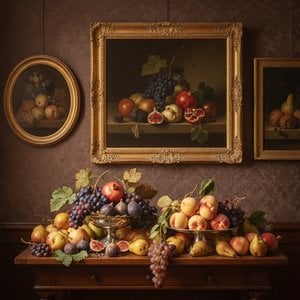
The Quiet Revolution: An Introduction to Braque's Still Life
Georges Braque’s “Mandolin, Glass, Pot and Fruit” – a deceptively simple composition of a mandolin, a glass, a pot, and scattered apples – is far more than the sum of its parts. Painted in 1927 during his pivotal period within Cubism, this work represents a radical departure from traditional representation, offering instead a fragmented, multi-faceted exploration of form, space, and perception. It’s a window into Braque's intellectual and artistic journey, a moment where the established rules of painting were deliberately dismantled to reveal a new way of seeing – and depicting – the world. The piece isn’t merely a depiction of objects; it’s an invitation to engage in a visual puzzle, demanding that we actively reconstruct the scene within our own minds.

Cubism’s Deconstruction: Breaking Down the Familiar
Braque's work in this period is inextricably linked to the development of Cubism alongside Pablo Picasso. Rather than striving for a single, fixed viewpoint, they sought to capture an object from multiple perspectives simultaneously. “Mandolin, Glass, Pot and Fruit” exemplifies this approach brilliantly. The mandolin, rendered with sharp angles and geometric planes, seems to emerge from several positions at once; the glass reflects distorted fragments of the surrounding space, while the fruit appears both solid and ephemeral. This fragmentation isn’t arbitrary; it's a deliberate strategy to challenge our conventional understanding of depth and perspective – core tenets of Renaissance painting. The muted palette—earthy browns, ochres, and subtle greens—further emphasizes this sense of detachment from traditional realism, contributing to the work’s contemplative mood.
The influence of Paul Cézanne is particularly evident here. Braque deeply admired Cézanne's exploration of form and structure, particularly his use of geometric shapes to represent natural forms. Cézanne’s emphasis on underlying structures and multiple viewpoints paved the way for Cubism’s radical approach. The careful arrangement of objects within the composition echoes Cézanne’s own still lifes, but with a distinctly fractured and abstracted quality.
Symbolic Resonance: Beyond the Objects
While seemingly straightforward, “Mandolin, Glass, Pot and Fruit” is rich in symbolic potential. The mandolin itself, an instrument of music and leisure, suggests a moment of quiet contemplation – a pause within the bustle of daily life. The glass, often associated with clarity and reflection, could represent introspection or perhaps the multifaceted nature of perception. The fruit, symbols of abundance and fertility, might allude to themes of nourishment and earthly pleasures. However, Braque deliberately avoids overt symbolism, allowing the viewer to project their own interpretations onto the scene. This ambiguity is a hallmark of Cubist art – encouraging engagement and fostering multiple readings.
A Legacy of Innovation: Braque’s Enduring Influence
“Mandolin, Glass, Pot and Fruit” stands as a pivotal work in the history of modern art. It demonstrates Braque's mastery of Cubism’s principles while simultaneously revealing his unique artistic vision. The painting’s influence can be seen in countless subsequent works by artists who sought to challenge traditional representation and explore new ways of seeing. Reproductions, like those offered at WahooArt.com, provide a remarkable opportunity to experience this groundbreaking artwork firsthand, appreciating the subtle nuances of Braque's technique and the profound impact of his artistic innovations. It’s a piece that continues to resonate with viewers today, inviting us to reconsider our own perceptions of reality and the power of art to transform our understanding of the world.



 Anteprima in scala reale
 Ordina la riproduzione dipinta a mano
 Condividi
 Condividi
 Dettagli

 Scarica
 Articoli simili
 Radiografia
 Slideshow
 Statistiche


 Leggi tutto






































 L'opzione vetro è disponibile solo per dimensioni inferiori a 110 cm