Anteprima in scala reale Prova in AR Ordina la riproduzione dipinta a mano Passa all'immagine digitale Condividi
Dettagli Guida stampabile Aggiungi ai preferiti Scarica Articoli simili Radiografia Slideshow Statistiche

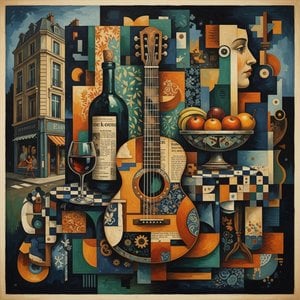
Bottle, Glass, And Pipe

Georges Braque's 'Bottle, Glass & Pipe' (1910) is a seminal Cubist collage—a vibrant exploration of form and perspective through newspaper clippings and wallpaper. Discover the innovative spirit behind this iconic work.

Esplora la vita e l'arte di Georges Braque (1882-1963), una figura chiave della pittura del XX secolo. Pioniere del Cubismo insieme a Picasso, noto per il Fauvismo, il collage e forme geometriche innovative. Scopri la sua eredità su WahooArt!

Giclée / Stampe d'arte

Stampa giclée o su tela di qualità museale, con produzione rapida e diverse opzioni di finitura. ( Ordina la riproduzione dipinta a mano Passa all'immagine digitale)

P118B $10
P118H $10
P118W $10
P438Z $10
P508JH $12
P508YH $12
P805H $10
P805Z $10
P919BZ $10
P919G $10
P919XJ $10
P959ZH $10
P968JZ $12
W106C $8
W218G $10
W218JH $8
W218Y $10
W307PJ $10
W316G $10
W316PJ $8
W316Y $10
W398PJ $8
W4111J $10
W500HY $15
W500JH $15
W692G $12
W849H $8
W940BG $15
W953PJ $8

Standard
personalizzato
CM
INCH

Scegli tra le nostre dimensioni predefinite, che rispettano le proporzioni originali dell'opera d'arte.

larghezza
altezza

È possibile inserire dimensioni personalizzate per adattare l'opera a una cornice o a uno spazio specifico. Se la dimensione selezionata non corrisponde alle proporzioni dell'immagine originale, procederemo al ritaglio dell'opera o all'estensione dell'immagine con un bordo specchiato o a tinta unita. Un mockup digitale ti verrà inviato per approvazione prima dell'inizio della produzione.
Si prega di notare che l'anteprima a schermo non riflette il ritaglio o l'estensione effettivi. Solo il mockup mostrerà accuratamente la composizione finale.
Sebbene siano disponibili dimensioni personalizzate, si raccomanda di selezionare una dimensione dall'elenco predefinito per preservare le proporzioni originali.

Consegna in tutto il mondo () in 2 settimane invece delle normali 4/5 settimane. (26 Settembre)

why_choose_icon
Spedizione espressa gratuita in tutto il mondo
why_choose_icon
Tela in lino di alta qualità
why_choose_icon
Assicurazione completa sulla spedizione
why_choose_icon
Garanzia di rimborso dei dazi doganali
why_choose_icon
Garanzia di perfetta fedeltà cromatica
why_choose_icon
Politica di reso entro 100 giorni (solo per difetti di fabbricazione)
why_choose_icon
Garanzia di rimborso al 100%
why_choose_icon
Sconto per acquisti multipli

Prezzo totale

$ 68

reproduction

Bottle, Glass, And Pipe

Giclée / Stampe d'arte

Dimensioni della riproduzione

-

Prezzo totale

$ 68

Dettagli rapidi

  • Movement: Cubism
  • Subject or theme: Still life objects
  • Artistic style: Fragmented forms
  • Artist: Georges Braque
  • Medium: Collage
  • Title: Bottle, Glass & Pipe

Quiz d'arte

Per ogni domanda è presente una sola risposta corretta.

Domanda 1:
Based on the image description, what is the dominant impression conveyed by the arrangement of objects within the bowl?
Domanda 2:
Georges Braque is most closely associated with which artistic movement?
Domanda 3:
The image description mentions the presence of 'paper' and a 'book'. What does this suggest about the potential subject matter or theme of the artwork?
Domanda 4:
Considering Braque's early training as a house painter and decorator, how might this background have influenced his artistic approach?
Domanda 5:
The use of collage in ‘Bottle, Newspaper, Pipe, and Glass’ reflects which broader artistic trend?

A Still Life of Disruption: Unpacking Georges Braque's "Bottle, Glass, and Pipe"

Georges Braque’s “Bottle, Glass, and Pipe” (circa 1910-12) isn’t merely a depiction of everyday objects; it’s a carefully orchestrated visual puzzle, a testament to the radical experimentation defining early Cubism. Born in Argenteuil, France, in 1882, Braque's artistic journey began with a grounding in his family’s trade as house painters and decorators – an experience that instilled within him a profound understanding of materials and structure. This practical foundation proved invaluable as he moved beyond traditional representation, dismantling familiar forms to reveal their underlying geometric essence.

The painting immediately confronts the viewer with a deliberately chaotic composition. A dark wooden bowl dominates the center, containing a jumble of items: fragments of paper resembling a book, two cups stacked precariously, and a vase positioned at the lower right corner. It’s a scene brimming with suggestion – a moment frozen in thought, perhaps a study for a larger work or simply an exploration of visual relationships. The deliberate lack of spatial depth, a hallmark of Cubism, forces us to actively engage with the image, reconstructing the scene within our own minds.

The Genesis of Cubism: Fragmentation and Multiple Perspectives

Braque’s development of Cubism was inextricably linked to his collaboration with Pablo Picasso. Initially, both artists were experimenting with ways to represent objects from multiple viewpoints simultaneously – a revolutionary concept at the time. “Bottle, Glass, and Pipe” exemplifies this approach. The bowl itself is broken down into fragmented planes, suggesting its three-dimensional form while simultaneously presenting it as a collection of geometric shapes. The paper fragments, too, are dissected and rearranged, creating an illusion of depth and layering that defies conventional perspective.

This technique wasn’t born in isolation. Braque's early exposure to the work of Paul Cézanne profoundly influenced his thinking. Cézanne’s emphasis on geometric forms and his exploration of multiple viewpoints laid the groundwork for Cubism’s core principles. Braque meticulously studied Cézanne’s paintings, analyzing how he rendered space and form, ultimately adapting these ideas into his own innovative style.

Symbolic Layers: Perfume, Smoke, and the Everyday

Beyond its purely formal concerns, “Bottle, Glass, and Pipe” hints at a deeper symbolic resonance. The inclusion of tobacco – represented by the pipe – evokes themes of contemplation, leisure, and perhaps even melancholy. The presence of perfume, suggested by the violet hues and the delicate glass bottle, adds an element of sensuality and refinement. These seemingly mundane objects are elevated to a level of artistic significance through Braque’s deliberate arrangement and his masterful manipulation of form and color.

Furthermore, the painting's overall sense of disorder can be interpreted as a reflection of the rapidly changing world at the turn of the 20th century – a period marked by industrialization, urbanization, and social upheaval. Braque’s fragmented composition mirrors this feeling of disorientation and uncertainty, capturing the spirit of modernity with remarkable acuity.

A Reproduction for Your Space: Bringing Cubist Innovation Home

WahooArt offers meticulously crafted hand-painted reproductions of “Bottle, Glass, and Pipe,” allowing you to bring this iconic work into your home or office. Our artists replicate Braque’s innovative techniques with the utmost care, ensuring that every detail – from the subtle nuances of color to the precise rendering of fragmented forms – is faithfully reproduced. Whether you're an art enthusiast, a collector, or simply seeking a unique and thought-provoking piece for your interior design, our reproduction provides an authentic representation of this seminal work of modern art.


Biografia dell'artista

**primi anni di vita e formazione**

Georges Braque, un illustre pittore francese, collageur, disegnatore, stampatore e scultore, nacque il 13 maggio 1882 ad Argenteuil, Val-d'Oise. È cresciuto a Le Havre e inizialmente si è formato per diventare pittore di facciate e decoratore come suo padre e nonno. Tuttavia, le inclinazioni artistiche di Braque lo hanno portato a studiare pittura all’École des Beaux-Arts a Le Havre dal 1897 al 1899.

**evoluzione artistica e fauvismo**

Nel 1902, dopo aver completato il suo apprendistato con un decoratore a Parigi, Braque ha frequentato l'Académie Humbert fino al 1904. Questo periodo ha segnato la sua introduzione al fauvismo, uno stile caratterizzato da colori vivaci e risposte emotive. Influenzato dalle opere di Henri Matisse e André Derain, Braque ha adottato un approccio fauvista, come si può vedere nel suo dipinto La Pazienza (fauvismo, olio su tela).

**contributo al cubismo**

La collaborazione di Braque con Pablo Picasso dal 1908 al 1912 ha portato allo sviluppo del cubismo. Le loro opere cubiste analitiche, come Georges Braque: La Pazienza e Pablo Picasso: Clarinet(cubismo analitico, olio su tela), sono oggi considerate pietre miliari della storia dell'arte.

**eredità e opere notevoli**

* Le Case all’Éstaque: una testimonianza dell'uso innovativo di geometria e prospettiva simultanea da parte di Braque. * La Pazienza(fauvismo, olio su tela): dimostra lo stile fauvista di Braque. * Clarinet(cubismo analitico, olio su tela): un'opera cubista collaborativa con Picasso.

**musei e collezioni**

* Musée d’Orsay: presenta una vasta collezione di arte impressionista e post-impressionista, inclusi lavori di Braque. * Musée de l’Orangerie: espone una vasta gamma di opere d'arte, inclusi quelle di Braque e altri artisti notevoli. **Lo stile innovativo di Georges Braque e la sua collaborazione con Pablo Picasso continuano a ispirare artisti e appassionati d'arte.**
Georges Braque

Georges Braque

1882 - 1963 , Francia

Informazioni rapide

  • Artisti Influenti:
    • Henri Matisse
    • André Derain
    • Paul Cézanne
  • Artisti Influenzati: ['Pablo Picasso']
  • Data Di Nascita: 13 maggio 1882
  • Luogo Di Nascita: Argenteuil, Francia
  • Movimento Artistico: Cubismo, Fauvismo
  • Nazionalità: Francese
  • Nome Completo: Georges Braque
  • Opere Notevoli:
    • Case a L'Estaque
    • La Pazienza (fauvista)
    • Chitarra, Frutta e Brocca
    • Natura morta con Bass
Esplora le opere d'arte organizzate per temi, stili e caratteristiche.