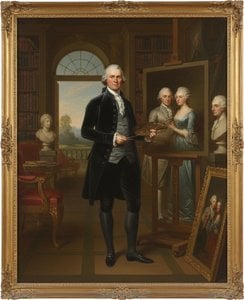
A Portrait of Refined Grace: Mrs. Musters by George Romney
George Romney’s “Mrs. Musters,” painted in 1779, offers a captivating glimpse into the world of Georgian portraiture – a realm defined by elegance, social status, and an acute awareness of artistic convention. This exquisite piece, depicting a woman of considerable standing, transcends a simple likeness; it's a carefully constructed tableau of wealth, refinement, and the burgeoning societal expectations surrounding female identity in late 18th-century Britain. The painting’s immediate appeal lies in its subject – Mrs. Musters herself – presented with a serene smile that suggests both composure and an underlying warmth. Her attire, meticulously rendered with a blue hat adorned with white trim, a flowing black dress, and the subtle gleam of a pearl necklace, speaks volumes about her position within the social hierarchy.
The Hand of the Master: Romney’s Technique
Romney's skill as a portraitist is immediately apparent in the delicate handling of light and shadow. He employs a technique known as *sfumato*, subtly blurring edges to create an almost dreamlike quality, particularly around Mrs. Musters’ face and hands. This approach wasn’t merely stylistic; it was integral to Romney's method of capturing not just physical appearance but also the sitter’s personality – their mood, their confidence, even a hint of melancholy. The greenish-yellow background, far from being a mere decorative element, serves to illuminate Mrs. Musters and subtly emphasize her importance within the composition. Note the careful attention to detail in the rendering of the fabric, achieved through layered brushstrokes that convey both texture and movement.
Historical Context: A Society Defined by Portraiture
"Mrs. Musters" was created during a pivotal period in British history – the late 18th century, a time of significant social and political change. Portraiture flourished as a means of solidifying status and demonstrating wealth. Commissioning a portrait was an investment, not just in art but also in one’s reputation. Romney's clientele included prominent figures from across society, reflecting his versatility and ability to capture the nuances of various personalities. The painting’s style—a blend of classical influences with emerging British sensibilities—reflects this dynamic environment.
Symbolism and Emotional Resonance
Beyond its aesthetic qualities, “Mrs. Musters” is laden with symbolic meaning. The woman's posture, the gentle curve of her hand resting on her lap, and her serene expression all contribute to a sense of quiet dignity and self-assurance. The pearl necklace, a timeless symbol of wealth and status, further reinforces this impression. Romney masterfully captures not just a physical likeness but also an emotional state – a feeling of contained grace and perhaps even a touch of wistful contemplation. This is more than just a portrait; it’s a carefully constructed narrative about identity, social standing, and the complexities of human emotion.



 Ordina la riproduzione
 Invia
Invia Condividi
 Dettagli

 Scarica
 Simili
 Radiografia
 Slideshow


 Scopri di più






































 L'opzione vetro è disponibile solo per dimensioni inferiori a 110 cm