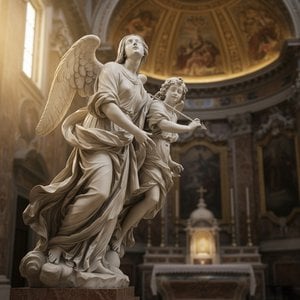
St Andrew: A Monumental Testament of Baroque Faith
François Duquesnoy’s sculpture of Saint Andrew stands as an emblem of the High Renaissance's transition into the Baroque era, embodying both intellectual rigor and profound spiritual fervor. Created in 1629 for St. Peter’s Basilica in Vatican City, this colossal marble figure transcends mere representation; it embodies a complex interplay of artistic innovation and religious devotion.
The Artist and His Context
Born in Nettuno, Italy, François Duquesnoy (1597-1643) emerged from the fertile artistic milieu of Brussels, where his father served as court sculptor to Archduchess Isabella and Archduke Albert. Recognizing Duquesnoy’s exceptional talent early on, the archduke generously supported his studies in Rome—a pivotal destination for artists seeking inspiration and mastering classical ideals.
A Classical Approach Infused with Baroque Dynamism
Duquesnoy's style distinguishes itself from the theatrical grandeur of Gian Lorenzo Bernini through a deliberate embrace of classicism. However, unlike Bernini’s overtly emotive gestures, Duquesnoy achieves an arresting stillness—a contemplative posture that reflects the humanist values prevalent during his time. He demonstrated particular affinity for Alessandro Algardi’s sculptures, prioritizing anatomical accuracy and refined drapery while avoiding excessive ornamentation.
The Sculpture's Composition and Symbolism
The statue depicts Saint Andrew with one arm raised in supplication, clutching a large cross—a potent symbol of his martyrdom and unwavering faith. The draped garment enveloping his torso contributes to the sculpture’s solemn atmosphere, emphasizing the saint’s dignity and spiritual contemplation. Above Andrew's head is Latin text proclaiming “SACROSANCTVS ROMANVS IMPERATORVS COLVMNVS,” signifying St Peter’s Basilica as a pillar of Christendom.
Technical Mastery and Artistic Legacy
Duquesnoy meticulously studied antique sculpture, famously climbing over the equestrian Marcus Aurelius to grasp its construction—a testament to his dedication to mastering classical techniques. His work exemplifies the Baroque's commitment to monumental scale and meticulous detail, securing his place as one of Rome’s foremost sculptors. The statue continues to inspire awe and reverence, serving as a timeless reminder of faith and artistic excellence.
- Artist: François Duquesnoy
- Year Created: 1629
- Location: St Peter’s Basilica, Vatican City
- Material: Marble
- Style: Baroque
The sculpture's enduring appeal lies in its ability to convey profound spiritual emotion within a framework of classical precision. It stands as an unforgettable monument to artistic achievement and religious devotion.
Domande e risposte
Quanto sono vivaci i colori di "St Andrew"?
La saturazione del colore di "St Andrew" è Saturazione tenue e la sua intensità è Monocromatico.
Con quale tecnica è realizzata "St Andrew" di François Duquesnoy?
François Duquesnoy ha utilizzato la tecnica del Acrilico su tela per "St Andrew". La tecnica definisce la natura materica dell'opera originale.
Quali colori dominano "St Andrew" di François Duquesnoy?
"St Andrew" è caratterizzato da una tavolozza Toni della terra dominata dal Magenta di chinacridone (#6e5a52).



 Anteprima in scala reale
 Passa alle stampe
 Invia
Invia Condividi
 Dettagli opera
 Guida
Guida

 Scarica
 Simili
 Radiografia
 Slideshow
 Statistiche


 Espandi i dettagli






































 L'opzione vetro è disponibile solo per dimensioni inferiori a 110 cm