Anteprima in scala reale Anteprima in AR Acquista il dipinto realizzato a mano Passa all'immagine digitale Invia
Dettagli opera Guida Aggiungi ai preferiti Scarica Simili Radiografia Slideshow Statistiche

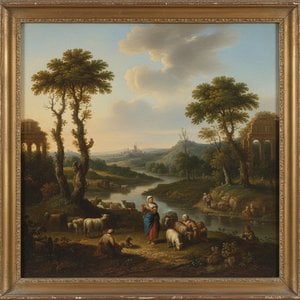
Imaginary Landscape

Explore Francisque Millet's 'Imaginary Landscape,' a serene Belgian Baroque masterpiece inspired by Poussin and Dughet, depicting figures strolling amidst mountains and classical architecture.

Francisque Millet (1642-1679): Pittore fiammingo-francese del Barocco di sereni paesaggi italiani e figure, influenzato da Poussin. Scopri il suo lascito e le sue opere!

Giclée / Stampe d'arte

Stampa giclée o su tela di qualità museale, con produzione rapida e diverse opzioni di finitura. ( Acquista il dipinto realizzato a mano Passa all'immagine digitale)

Corner sample of the P118B picture frame: polistirene stampato, 5 cm wide and 3 cm thick
P118B €10
Corner sample of the P118H picture frame: polistirene stampato, 5 cm wide and 3 cm thick
P118H €10
Corner sample of the P118W picture frame: polistirene stampato, 5 cm wide and 3 cm thick
P118W €10
Corner sample of the P438Z picture frame: polistirene stampato, 5.5 cm wide and 3.5 cm thick
P438Z €10
Corner sample of the P508JH picture frame: polistirene stampato, 7 cm wide and 3.5 cm thick
P508JH €12
Corner sample of the P508YH picture frame: polistirene stampato, 7 cm wide and 3.5 cm thick
P508YH €12
Corner sample of the P805H picture frame: polistirene stampato, 5 cm wide and 3.5 cm thick
P805H €10
Corner sample of the P805Z picture frame: polistirene stampato, 5 cm wide and 3.5 cm thick
P805Z €10
Corner sample of the P919BZ picture frame: polistirene stampato, 7 cm wide and 3.5 cm thick
P919BZ €10
Corner sample of the P919G picture frame: polistirene stampato, 7 cm wide and 3.5 cm thick
P919G €10
Corner sample of the P919XJ picture frame: polistirene stampato, 7 cm wide and 3.5 cm thick
P919XJ €10
Corner sample of the P959ZH picture frame: polistirene stampato, 5 cm wide and 3 cm thick
P959ZH €10
Corner sample of the P968JZ picture frame: polistirene stampato, 6 cm wide and 4 cm thick
P968JZ €12
Corner sample of the W106C picture frame: legno massello, 5 cm wide and 3 cm thick
W106C €8
Corner sample of the W218G picture frame: legno massello, 5 cm wide and 3 cm thick
W218G €10
Corner sample of the W218JH picture frame: legno massello, 5 cm wide and 3 cm thick
W218JH €8
Corner sample of the W218Y picture frame: legno massello, 5 cm wide and 3 cm thick
W218Y €10
Corner sample of the W307PJ picture frame: legno massello, 6 cm wide and 3 cm thick
W307PJ €10
Corner sample of the W316G picture frame: legno massello, 6 cm wide and 3 cm thick
W316G €10
Corner sample of the W316PJ picture frame: legno massello, 6 cm wide and 3 cm thick
W316PJ €8
Corner sample of the W316Y picture frame: legno massello, 6 cm wide and 3 cm thick
W316Y €10
Corner sample of the W398PJ picture frame: legno massello, 5 cm wide and 3 cm thick
W398PJ €8
Corner sample of the W4111J picture frame: legno massello, 6.5 cm wide and 3.5 cm thick
W4111J €10
Corner sample of the W500HY picture frame: legno massello, 7 cm wide and 5 cm thick
W500HY €15
Corner sample of the W500JH picture frame: legno massello, 7 cm wide and 5 cm thick
W500JH €15
Corner sample of the W692G picture frame: legno massello, 8 cm wide and 4 cm thick
W692G €12
Corner sample of the W849H picture frame: legno massello, 5 cm wide and 3 cm thick
W849H €8
Corner sample of the W940BG picture frame: legno massello, 7.5 cm wide and 4.5 cm thick
W940BG €15
Corner sample of the W953PJ picture frame: legno massello, 6 cm wide and 3.5 cm thick
W953PJ €8

Formato standard
su misura
CM
INCH

Scegli tra le nostre dimensioni predefinite, che rispettano le proporzioni originali dell'opera d'arte.

larghezza
altezza

Inserisci la larghezza e l'altezza desiderate, per adattarle alla tua cornice o alla tua parete. Una stampa può essere solo ritagliata, mai resa più grande dell'immagine originale; pertanto, un formato con una forma differente comporterà la perdita di una parte dell'opera. Ti invieremo un mockup digitale da approvare prima di procedere con la stampa. L'immagine mostrata in questa pagina non rappresenta il ritaglio reale — solo il mockup lo mostra.

Consegna in tutto il mondo () in 2 settimane invece delle normali 4/5 settimane. (26 Ottobre)

Spedizione espressa gratuita in tutto il mondo
Tela in lino di alta qualità
Assicurazione completa sulla spedizione
Garanzia di rimborso dei dazi doganali
Garanzia di fedeltà cromatica assoluta
Politica di reso entro 100 giorni (solo per difetti di fabbricazione)
Garanzia di rimborso al 100%
Offerta per acquisti multipli

Prezzo totale

€ 60

Imaginary Landscape

Giclée / Stampe d'arte

Dimensioni riproduzione

-

Prezzo finale calcolato

€ 60

Informazioni rapide

  • Artist: Francisque Millet
  • Influences:
    • Nicolas Poussin
    • Gaspard Dughet
  • Medium: Oil on Canvas
  • Year: 1660
  • Notable elements or techniques: Detailed depiction of classical architecture and vegetation.

Quiz d'arte

Per ogni domanda è presente una sola risposta corretta.

Domanda 1:
What artistic style is Francisque Millet’s ‘Imaginary Landscape’ primarily influenced by?
Domanda 2:
Who served as Francisque Millet's mentor during his artistic training?
Domanda 3:
What prominent artist’s brother-in-law did Laurentius Frank collaborate with, influencing Millet's artistic vision?
Domanda 4:
The painting depicts a scene inspired by what geographical location?
Domanda 5:
What is notable about Francisque Millet’s ability as described by Abraham Genoels?

A Serene Vision of Antiquity: Exploring Francisque Millet’s Imaginary Landscape

Francisque Millet's "Imaginary Landscape," painted in 1660, stands as a testament to the enduring influence of Italianate landscape painting during Louis XIV’s reign. More than just a depiction of scenery, it embodies a profound philosophical statement about humanity’s relationship with nature and its yearning for idealized beauty—a sentiment deeply rooted in the artistic currents sweeping across Europe at the time.
  • Subject Matter: The canvas portrays a tranquil valley bathed in soft sunlight, dominated by a majestic oak tree – a symbol of strength and longevity – beneath which two figures stroll leisurely. A distant bridge adds depth to the composition, hinting at connection and aspiration.
  • Style & Influences: Millet’s style is unmistakably indebted to Nicolas Poussin and Gaspard Dughet, masters of Italianate landscape whose works championed a harmonious blend of observation and imagination. Like his predecessors, Millet sought not merely to represent the external world but to convey an inner state of contemplation and spiritual elevation.
  • Technique: Executed in oil paint on canvas, Millet employed meticulous brushwork—characteristic of the Flemish tradition—to achieve remarkable tonal gradations and textural nuances. The artist skillfully captured the dappled light filtering through the foliage, creating a palpable sense of atmosphere that transports the viewer to a timeless realm of pastoral serenity.
The painting’s historical context is crucial to understanding its significance. Louis XIV's court embraced classical ideals as a means of asserting royal authority and glorifying France’s grandeur. Millet’s landscape reflects this preoccupation with antiquity, presenting a vision of paradise—a carefully constructed illusion designed to inspire awe and reaffirm faith in divine order. The oak tree itself is laden with symbolism; it represents resilience, nobility, and the enduring presence of God's grace – concepts central to Jansenist theology, which profoundly shaped intellectual life during Millet’s era.
  • Symbolism: Beyond its visual beauty, “Imaginary Landscape” speaks volumes about humanist concerns. The figures embody human dignity and tranquility, suggesting a harmonious coexistence with the natural world—a counterpoint to the anxieties of the turbulent political landscape of Louis XIV's France.
Ultimately, Millet’s masterpiece resonates with an emotional depth that transcends its formal conventions. It invites contemplation on themes of beauty, faith, and human aspiration. Its luminous palette and masterful brushwork evoke a feeling of profound peace—a reminder that even amidst worldly concerns, glimpses of idealized perfection can be found in the simplest of landscapes. Reproductions of “Imaginary Landscape” continue to captivate collectors and inspire interior designers seeking to infuse their spaces with an aura of timeless elegance and spiritual serenity.

Domande e risposte

A quale fase della carriera di Francisque Millet corrisponde la data del 1660 di "Imaginary Landscape"?

La data del 1660 colloca "Imaginary Landscape" nel Mature Period della carriera di Francisque Millet.

"Imaginary Landscape" di Francisque Millet è un dipinto, un disegno o una stampa?

Nel catalogo, "Imaginary Landscape" di Francisque Millet è classificato come WallArt. La categoria permette di trovare opere simili.

Quale tonalità dominante caratterizza "Imaginary Landscape" di Francisque Millet?

Una tonalità Amber to Saffron attraversa l'opera "Imaginary Landscape" di Francisque Millet.


Biografia dell'artista

Francisque Millet: Vita e Eredità

Primi Anni di Vita e Formazione

  • Nato ad Anversa, Belgio nel 1642, Francisque Millet (anche conosciuto come Jean-François Milée) era il figlio di un lavoratore francese di avorio che si era stabilito nella regione.
  • Ha iniziato la sua formazione artistica con Laurentius Frank, cugino di Abraham Genoels.
  • Talento Eccezionale: Genoels ha notato l'eccezionale capacità di Millet di copiare opere d'arte rapidamente e accuratamente dalla memoria, senza bisogno di fare continuamente riferimento all'originale.
  • All'età di diciotto anni, si è sposato con la figlia del suo maestro, consolidando la sua posizione all'interno della comunità artistica.

Sviluppo Artistico e Influenze

  • Paesaggi Italiani: Millet si è specializzato in paesaggi italiani popolati da figure, uno stile fortemente influenzato da Nicolas Poussin e suo fratello cognato, Gaspard Dughet.
  • Il suo lavoro raffigurava spesso scene serene ispirate alla campagna romana, con architettura classica, vegetazione lussureggiante e figure pastorali.
  • Viaggi ed Esposizione: Ha viaggiato ampiamente in Francia, Inghilterra e Paesi Bassi, acquisendo familiarità con diversi stili artistici e mecenati. Tuttavia, era noto per spendere oltre le sue possibilità.

Opere Principali e Stile

  • Millet ha prodotto un considerevole corpo di lavoro, tra cui paesaggi con temi religiosi come “Paesaggio con Cristo e i Suoi Discepoli” nonché scene mitologiche come “Mercurio e Battus”.
  • Caratteristiche Tipiche: I suoi dipinti sono caratterizzati da composizioni equilibrate, prospettiva atmosferica e meticolosa attenzione ai dettagli.
  • Ha integrato abilmente le figure nei suoi paesaggi, creando scene armoniose e visivamente accattivanti.
  • Esempi di opere notevoli includono “Paesaggio Immaginario”, “Scena Italiana con un Santuario” e “Paesaggio Classico”.

Vita Tarda e Morte

  • La vita di Millet è stata tragicamente interrotta nel 1679 all'età di 36 anni.
  • Malattia Improvvisa: È deceduto a causa di una febbre alta improvvisa che ha portato alla follia, e successivamente è morto poco dopo.
  • È stato sepolto nella chiesa di St Nicolas-des-Champs a Parigi.

Eredità Familiare e Significato Storico

  • Jean-François Millet II: Suo figlio, anch'egli chiamato Jean François Millet (1666–1723), ha seguito le orme del padre e è diventato membro dell'Accademia di Pittura nel 1709.
  • Il figlio Millet si è consultato con artisti come Watteau per migliorare le figure all'interno dei suoi paesaggi.
  • Influenza su Artisti Successivi: Pur essendo oscurato da artisti successivi con lo stesso nome, il lavoro di Francisque Millet ha aperto la strada alle generazioni successive di pittori di paesaggio.
  • Mark Twain si è persino ispirato alla vita di Millet (e al caos causato dalla confusione sui suoi nomi) per scrivere la commedia farsesca “È morto?”.
  • Il contributo di Millet risiede nella sua abile esecuzione dei paesaggi italiani e nella sua capacità di fondere influenze classiche con sensibilità barocche.
Francisque Millet

Francisque Millet

1642 - 1679 , Belgio

Dettagli rapidi

  • Artistic Movement Or Style: Baroque
  • Artists Or Movements Influenced By This Artist: ['Jean-François Millet II']
  • Artists Who Influenced This Artist:
    • Nicolas Poussin
    • Gaspard Dughet
  • Date Of Birth: 1642-04-27
  • Full Name: Francisque Millet
  • Nationality: Flemish-French
  • Notable Artworks:
    • Landscape with Christ and His Disciples
    • Imaginary Landscape
    • Mountain Landscape With Lightning
  • Place Of Birth: Antwerp, Belgium
Esplora le opere d'arte organizzate per temi, stili e caratteristiche.