Fernand Léger’s “Three Characters”: A Symphony of Geometric Form and Industrial Soul
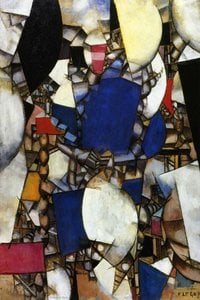
Fernand Léger's *“Three Characters,”* painted in 1924, stands as an emblem of Tubism – a singular evolution of Cubism championed by the artist himself. More than just a visual experiment in abstraction, this monumental canvas delves into Léger’s profound contemplation of modernity and its impact on human experience, presenting a captivating dialogue between artistic innovation and socio-cultural transformation. It's a piece that continues to resonate with audiences today, prompting reflection on themes of isolation, purpose, and the enduring fascination with the machine age.
Deconstructing the Composition: Style & Technique
Léger’s masterful approach abandons traditional perspective, opting instead for a flattened picture plane populated by simplified cylindrical forms – the defining characteristic of Tubism. These aren't mere geometric shapes; they are meticulously crafted to convey solidity and monumentality, grounding the abstracted figures within an almost sculptural presence. The technique is characterized by smooth brushstrokes blended with remarkable precision, achieving a polished surface that belies the angularity inherent in the composition. Léger’s deliberate use of color – primarily muted shades of grey punctuated by subtle hints of ochre – contributes to this sense of solemn contemplation and reinforces the artwork's connection to industrial aesthetics. The artist’s meticulous attention to detail ensures that every element serves a purpose, furthering the overall narrative of form and feeling.
A Palette of Modernity: Color & Symbolism
Despite its stylistic roots in Cubism’s analytical phase, *“Three Characters”* distinguishes itself through Léger's bold chromatic choices. Moving beyond the subdued tones favored by early Cubists, he embraces hues that inject warmth and vibrancy into the canvas—a deliberate defiance of prevailing artistic conventions. The inclusion of symbolic objects – a baseball bat and a book – adds layers of intellectual depth to the composition. These aren’t merely decorative additions; they represent facets of everyday life and leisure, hinting at Léger's desire to portray the modern individual within their environment. Furthermore, the positioning of these items suggests an interplay between physical activity and mental pursuits—a visual representation of the multifaceted nature of human existence during this pivotal period in history.
Historical Context: Cubism & Beyond – The Echoes of War
Created in the immediate aftermath of World War I, *“Three Characters”* reflects a broader cultural preoccupation with rebuilding society amidst the ruins of conflict. Léger’s artistic trajectory was profoundly shaped by his experiences as a soldier during the Great War—a formative period that instilled within him a deep appreciation for resilience and an unwavering commitment to capturing the spirit of the machine age. Tubism emerged from this context, representing a reaction against the emotional excesses of Expressionism and embracing instead a rigorously rational aesthetic informed by scientific advancements and industrial progress. Léger’s work stands as a testament to the transformative power of art—its ability to grapple with complex social realities while simultaneously pursuing formal innovation.
Emotional Impact: Contemplation Amidst Angular Forms
Ultimately, *“Three Characters”* compels viewers to confront questions about identity, purpose, and the human condition within an increasingly mechanized world. The artwork’s austere palette and geometric forms evoke a sense of quiet contemplation—a deliberate contrast to the turbulent energies of its time. Léger's masterful manipulation of space and form invites introspection, prompting us to consider how we perceive our surroundings and how art can communicate profound ideas about human experience. It remains an enduring symbol of modernist ambition and a poignant reminder that beauty can be found even in the seemingly sterile landscapes of industrial society.
Domande e risposte
Che intensità cromatica ha "Tre personaggi" di Fernand Léger?
"Tre personaggi" di Fernand Léger mostra un'intensità cromatica Monocromatico.
Qual è la luminosità di "Tre personaggi" di Fernand Léger?
"Tre personaggi" di Fernand Léger ha una luminanza di Luminosità moderata. La luminanza descrive quanta luce sembrano riflettere i colori.
Quanti anni aveva Fernand Léger quando è stata creata "Tre personaggi"?
Quando "Tre personaggi" fu creata nel 1924, Fernand Léger - nato nel 1881 - aveva 43 anni.
Quale uso e quale spazio si consigliano per "Tre personaggi" di Fernand Léger?
"Tre personaggi" è consigliato per Accento cromatico, e lo spazio ideale è un Zona giorno.
In che anno è stata realizzata "Tre personaggi"?
"Tre personaggi" di Fernand Léger è stata creata nel 1924.
Quanto è luminoso, in generale, "Tre personaggi"?
In termini di luminosità percepita, "Tre personaggi" di Fernand Léger è luminosi.
A quale artista è attribuito "Tre personaggi"?
"Tre personaggi" è stata creata da Fernand Léger. Le informazioni contenute in questa pagina descrivono l'opera originale di Fernand Léger.



 Anteprima in scala reale
 Passa alle stampe
 Condividi
 Condividi
 Dettagli
 Guida stampabile

 Scarica
 Articoli simili
 Radiografia
 Slideshow
 Statistiche

 Leggi tutto






































 L'opzione vetro è disponibile solo per dimensioni inferiori a 110 cm