Fernand Léger’s “Sunflower”: A Geometric Bloom Reflecting Modern Life
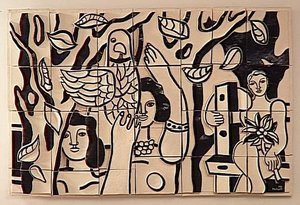
A Radiant Burst: Fernand Léger’s “Sunflower” stands as an extraordinary testament to the artist's unwavering commitment to exploring new artistic horizons while honoring the enduring beauty of nature. This isn’t merely a depiction of a sunflower; it’s an ambitious reimagining – a vibrant mosaic constructed from ceramic tiles that embodies Léger’s signature Tubism style and his fascination with the dynamism of the machine age. Unlike traditional floral paintings, Léger abandons representational accuracy in favor of a powerfully expressive abstraction, prioritizing texture and form to convey emotion and intellectual contemplation.
Style & Technique: Embracing Tubism – Beyond Imitation
Fernand Léger’s groundbreaking approach to art began with Impressionism but swiftly propelled him toward Cubism alongside Picasso and Braque. However, Léger quickly distinguished himself by forging his own distinctive aesthetic vocabulary centered on cylindrical shapes and bold colors. “Sunflower” exemplifies this mature style perfectly—a masterful application of Tubism, where the organic form of a sunflower is dissected into a rigorously constructed composition of ceramic tiles. The technique itself is revolutionary: each tile, painstakingly hand-cut and arranged, contributes to an astonishingly tactile surface and creates an illusion of depth achieved through layering and varied orientation. This deliberate manipulation of material—ceramic—is not simply decorative; it speaks to Léger’s belief in the transformative potential of industrial processes and their ability to inspire artistic innovation. The resulting texture isn't merely visual; it invites a physical connection with the artwork, hinting at its robust materiality and grounding it firmly in the tangible world.
Historical Context: From Cubism to Anticipating Pop Art
Born in Argentan in 1881, Léger witnessed – and actively participated in – an era of seismic artistic upheaval. His early explorations absorbed Impressionistic influences before he embraced the fragmented forms of Cubism alongside fellow pioneers like Picasso and Braque. Yet, Léger swiftly diverged from his peers, developing a unique visual language focused on cylindrical shapes and bold colors that would foreshadow developments decades later. “Sunflower” reflects this pivotal moment in artistic history—a celebration of modern life’s energy and beauty found not only in natural forms but also in the burgeoning industrial landscape. Léger's work anticipates the stylistic concerns of Pop Art, with its embrace of popular imagery and industrial aesthetics, demonstrating his profound understanding of cultural trends and his ability to translate them into compelling artistic expression.
Symbolism & Emotional Resonance: The Geometry of Adoration
The sunflower itself carries a rich tapestry of symbolic meaning – representing adoration, longevity, and an unwavering gaze toward the sun’s radiant warmth. Léger's decision to portray this flower in geometric abstraction isn’t arbitrary; it underscores his belief that form can convey emotion just as effectively as color or narrative detail. The radial arrangement of tiles mimics the sunflower’s central disc, emphasizing its core energy and radiating outwards into a constellation of angular shapes. This deliberate structuring reflects Léger's fascination with mathematical principles—a desire to capture the underlying order of the universe within an artistic framework. Viewing “Sunflower” evokes feelings of vibrancy, strength, and perhaps even a nostalgic yearning for simpler times – reminding us that beauty can be found in unexpected places, even amidst the complexities of the modern world.
- Artist: Fernand Léger
- Born Year: 1881
- Death Year: 1955
- Birth City: Argentan
- Birth Country: France
Additional Research:
“Sunflower” was created in 1953 by Fernand Léger in Purism style. Find more prominent pieces of flower painting at WikiArt.org – best visual art database.
WikiArt.org: https://www.wikiart.org/en/fernand-leger/sunflowers-1953
- Size: Unknown
- Date: Unknown
Catalogue Raisonné:
Brunhammer, Y. (2005). Fernand Léger: The Monumental Art. 5 Continents Editions: Milan. Monumental works listed and illustrated as catalogue raisonné no. 176, 178-181. Further discussion on pgs. 126 & 156.
Certificate of Authenticity:
A Certificate of Authenticity will accompany this work.
Denis Bloch Fine Art Gallery, Beverly Hills CA.



 Ordina la riproduzione
 Invia
Invia Condividi
 Dettagli opera

 Scarica
 Simili
 Radiografia
 Slideshow

 Scopri di più






































 L'opzione vetro è disponibile solo per dimensioni inferiori a 110 cm