An Intimate Portrait of Existential Anguish: Unveiling "Untitled (4681)"
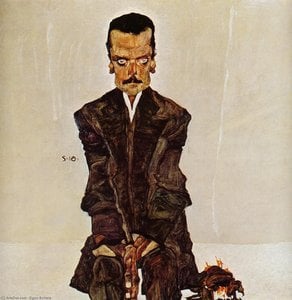
Egon Schiele’s “Untitled (4681)” is not merely a depiction of a woman; it's a raw, unflinching exploration of the human condition – a meditation on mortality, vulnerability, and the quiet despair that can reside within even the most seemingly ordinary moments. Painted in 1917-18, during a period of immense personal turmoil for the artist, this work embodies the core tenets of Schiele’s expressionist style: a deliberate distortion of form to convey inner emotion rather than objective reality. The subject, a woman with dark hair meticulously styled into a bun and adorned with a hat, is rendered with an almost unsettling directness. Her downward gaze, coupled with the clutching of a handkerchief – a recurring motif in Schiele’s oeuvre – immediately evokes a sense of sorrow and introspection. The painting's power lies not in idealized beauty but in its honest portrayal of emotional fragility.
Echoes of Vienna: Schiele’s Expressionist Vision
Schiele’s artistic trajectory was profoundly shaped by the anxieties and uncertainties of early 20th-century Vienna. The city, a hotbed of intellectual and artistic ferment, was also grappling with social upheaval and political instability. Schiele's work reflects this atmosphere, anticipating the horrors of the impending World War I. His style, heavily influenced by Symbolism and particularly by artists like Gustav Klimt (though Schiele ultimately rejected Klimt’s decorative aesthetic), is characterized by elongated figures, angular poses, and a deliberate lack of polish. The use of muted earth tones – browns, ochres, and grays – further contributes to the painting's somber mood, creating a visual space that feels both claustrophobic and profoundly intimate.
Technique and Detail: A Study in Controlled Distortion
- Brushwork: Schiele’s technique is immediately recognizable through his rapid, almost frantic brushstrokes. These aren't smooth or blended; instead, they are deliberately applied to create a sense of movement and unease. The varying degrees of detail – the meticulously rendered hat and hair contrasted with the looser depiction of her hands – serve to heighten this effect, drawing attention to specific areas while simultaneously disrupting the overall sense of composure.
- Composition: The composition itself is deliberately unbalanced, contributing to the feeling of instability and vulnerability. The woman’s position within the frame, slightly off-center and with a downward gaze, reinforces her sense of isolation and introspection.
- Color Palette: The restricted color palette – dominated by earthy tones – amplifies the painting's emotional intensity, evoking feelings of melancholy and quiet desperation.
Symbolism and Emotional Resonance
The handkerchief held in the woman’s hands is a particularly potent symbol within Schiele’s work. It represents not just physical cleanliness but also grief, sorrow, and perhaps even a desperate attempt to control overwhelming emotions. The downward gaze suggests contemplation of mortality or a profound sense of loss. Considering Schiele's own personal struggles – his father's illness and death, the premature passing of his sister – it’s clear that “Untitled (4681)” is deeply rooted in his own anxieties and fears. This painting transcends mere portraiture; it becomes a poignant testament to the artist’s ability to translate profound emotional experience into a powerfully evocative visual statement. The work continues to resonate with viewers today, offering a glimpse into the complexities of human emotion and the enduring power of artistic expression.



 Anteprima in scala reale
 Acquista il dipinto realizzato a mano
 Invia
Invia Condividi
 Dettagli opera

 Scarica immagine
 Simili
 Radiografia
 Slideshow
 Statistiche

 Espandi i dettagli






































 L'opzione vetro è disponibile solo per dimensioni inferiori a 110 cm