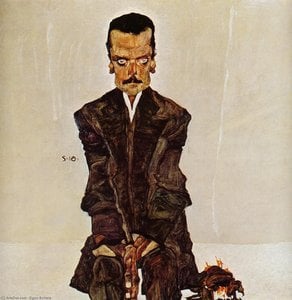
Dead Mother
Egon Schiele, an Austrian Expressionist painter, stands as one of the most unsettling figures in early 20th century art. His oeuvre is marked by visceral emotion and psychological depth—a stark contrast to the polished surfaces of Impressionism and Post-Impressionism that dominated the era. Among his unforgettable creations is
Dead Mother (1910), an oil on panel masterpiece that encapsulates Schiele’s singular artistic vision. This artwork isn't merely a depiction of figures; it’s a confrontation with primal anxieties and the fragility of existence—a testament to Schiele’s ability to translate inner turmoil into visual form.
The Painting: A Symbolic Representation
“Cite>Dead Mother” immediately grabs the viewer’s attention with its stark simplicity and chilling realism. Two figures intertwine, their faces pressed together in an embrace that borders on intimacy yet exudes palpable dread. The artist meticulously renders the musculature of the bodies—the woman's torso is powerfully sculpted, conveying both vulnerability and resilience. Her gaze is averted downwards, suggesting a profound sadness or perhaps resignation to fate. Simultaneously, her partner’s posture embodies defiance—he leans forward, attempting to lift his companion, as if battling against an unseen force. This dynamic interplay of movement contributes significantly to the painting's dramatic tension. The unsettling detail of blood emanating from both mouths underscores the artwork’s symbolic core: it represents not just physical injury but also the inescapable reality of mortality and decay—themes central to Schiele’s broader artistic concerns.
The dark sky serves as a backdrop, amplifying the mood of despair and isolation. Schiele skillfully employs chiaroscuro—the dramatic contrast between light and shadow—to sculpt the figures' forms and heighten their emotional impact. The artist’s meticulous brushstrokes convey an almost obsessive attention to detail, capturing every nuance of expression and texture. This technique is characteristic of Expressionism, where artists sought to bypass rational representation in favor of conveying subjective experience.
Artistic Style and Influence
Schiele’s style owes considerable debt to Gustav Klimt, whose decorative motifs and opulent color palettes influenced Schiele's early works. However, Schiele swiftly forged his own distinctive path—one defined by elongated figures, distorted perspectives, and a preoccupation with themes of sexuality and death. He drew inspiration from Vincent van Gogh’s expressive brushwork and Edvard Munch’s psychologically charged imagery, incorporating elements of Symbolism into his artistic vocabulary. The artist's use of line—particularly thick, agitated lines—creates a sense of dynamism and unease, mirroring the turbulent emotions he sought to portray.
Historical Context
The early 20th century witnessed an explosion of artistic experimentation, fueled by intellectual currents such as Psychoanalysis and Nietzschean philosophy. Schiele’s work emerged during this period of profound cultural upheaval—a time when artists questioned traditional conventions and embraced new modes of expression. The painting reflects the broader anxieties of the era—concerns about societal change, personal vulnerability, and the inescapable confrontation with death.
Schiele's exploration of human psychology aligns perfectly with Freud’s groundbreaking theories on unconscious desire and repression. Like Freud, Schiele believed that art could serve as a conduit for accessing hidden realms of experience—a way to confront anxieties and traumas that lie beneath the surface of consciousness. The artist’s unflinching gaze at the darker aspects of human nature distinguishes him from many of his contemporaries who favored idealized representations of beauty and harmony.
For those interested in delving deeper into Schiele's artistic legacy, the Österreichische Galerie Belvedere in Vienna houses a comprehensive collection of his paintings—a must-visit destination for art enthusiasts seeking to appreciate the profound impact of Expressionism on 20th century art. To learn more about Egon Schiele’s life and work, visit
Egon Schiele: Dead Mother. For insights into the role of light in art, see
Light in Painting. At WahooArt.com, we offer high-quality, handmade oil painting reproductions of famous works like Schiele's—bringing the intensity and emotion of his vision into your home.
Domande e risposte
Da quale paese proviene l'opera del Expressionism "Dead Mother"?
"Dead Mother" è stata creata da Egon Schiele, nato in Croazia, nell'ambito del movimento Expressionism. L'origine dell'artista lega l'opera al Expressionism così come praticato dagli artisti di Croazia.
Quale emozione trasmette "Dead Mother" di Egon Schiele?
"Dead Mother" è associata a una sensazione Malinconico. Il tono emotivo descrive l'impressione che l'opera trasmette.
È possibile visualizzare un'anteprima in realtà aumentata di "Dead Mother"?
"Dead Mother" dispone di un'anteprima in realtà aumentata: la pagina Anteprima in AR dell'opera ti permette di visualizzarla nel tuo spazio tramite un dispositivo compatibile.



 Anteprima in scala reale
 Passa alle stampe
 Invia
Invia Condividi
 Dettagli opera
 Guida
Guida

 Scarica
 Simili
 Radiografia
 Slideshow
 Statistiche

 Espandi i dettagli






































 L'opzione vetro è disponibile solo per dimensioni inferiori a 110 cm