
Eleven AM di Edward Hopper, riproduzione di un dipinto a olio realizzato a mano da un maestro d'arte
Anteprima in scala reale Anteprima in AR Passa alle stampe Passa all'immagine digitale Invia
Dettagli opera Guida Aggiungi ai preferiti Scarica Simili Radiografia Slideshow Domande e risposte Scarica presentazione Statistiche

Eleven AM Riproduzione di un dipinto a olio dipinto a mano

Una maestosa opera di Hopper che cattura l'intimità della solitudine urbana attraverso una luce soffusa e un ambiente domestico minimalista. Scopri la bellezza del realismo americano.

Maestro del realismo americano, ha catturato la solitudine in Nighthawks. Scopri oggi i suoi dipinti iconici e i suoi giochi di luce e ombra.

L'opera d'arte visualizzata in questa pagina è protetta dalle leggi sul diritto d'autore, il che significa che non possiamo legalmente creare o vendere una riproduzione identica. Tale protezione è garantita da accordi internazionali quali la Convenzione di Berna e dalle leggi nazionali, incluse quelle stabilite da Legge sul copyright degli Stati Uniti - Titolo 17. Tutti i diritti riservati. Le immagini presenti su questo sito sono protette da copyright e non possono essere riprodotte o utilizzate senza l'autorizzazione scritta di WahooArt.com o dei rispettivi proprietari del copyright.

Come alternativa rispettosa e legale, offriamo opere d'arte personalizzate e dipinte a mano, ispirate all'originale. I nostri artisti esperti e professionisti studiano con cura lo stile, l'atmosfera e l'essenza artistica dell'opera originale per creare un pezzo nuovo e unico che evochi la stessa emozione, pur rimanendo una creazione originale a pieno titolo.

Questo metodo è pienamente conforme alle normative sul diritto d'autore poiché non prevede la copia o la duplicazione dell'opera protetta. Si tratta invece di una rielaborazione creativa: un nuovo dipinto che trae ispirazione dall'originale, senza tuttavia esserne identico.

Riproduzione a olio fatta a mano

Olio su tela dipinto a mano nelle tue dimensioni e con la tua cornice, realizzato su ordinazione dai nostri artisti. ( Passa alle stampe Passa all'immagine digitale)

Corner sample of the P118B picture frame: polistirene stampato, 5 cm wide and 3 cm thick
P118B €10
Corner sample of the P118H picture frame: polistirene stampato, 5 cm wide and 3 cm thick
P118H €10
Corner sample of the P118W picture frame: polistirene stampato, 5 cm wide and 3 cm thick
P118W €10
Corner sample of the P438Z picture frame: polistirene stampato, 5.5 cm wide and 3.5 cm thick
P438Z €10
Corner sample of the P508JH picture frame: polistirene stampato, 7 cm wide and 3.5 cm thick
P508JH €12
Corner sample of the P508YH picture frame: polistirene stampato, 7 cm wide and 3.5 cm thick
P508YH €12
Corner sample of the P805H picture frame: polistirene stampato, 5 cm wide and 3.5 cm thick
P805H €10
Corner sample of the P805Z picture frame: polistirene stampato, 5 cm wide and 3.5 cm thick
P805Z €10
Corner sample of the P919BZ picture frame: polistirene stampato, 7 cm wide and 3.5 cm thick
P919BZ €10
Corner sample of the P919G picture frame: polistirene stampato, 7 cm wide and 3.5 cm thick
P919G €10
Corner sample of the P919XJ picture frame: polistirene stampato, 7 cm wide and 3.5 cm thick
P919XJ €10
Corner sample of the P959ZH picture frame: polistirene stampato, 5 cm wide and 3 cm thick
P959ZH €10
Corner sample of the P968JZ picture frame: polistirene stampato, 6 cm wide and 4 cm thick
P968JZ €12
Corner sample of the W106C picture frame: legno massello, 5 cm wide and 3 cm thick
W106C €8
Corner sample of the W218G picture frame: legno massello, 5 cm wide and 3 cm thick
W218G €10
Corner sample of the W218JH picture frame: legno massello, 5 cm wide and 3 cm thick
W218JH €8
Corner sample of the W218Y picture frame: legno massello, 5 cm wide and 3 cm thick
W218Y €10
Corner sample of the W307PJ picture frame: legno massello, 6 cm wide and 3 cm thick
W307PJ €10
Corner sample of the W316G picture frame: legno massello, 6 cm wide and 3 cm thick
W316G €10
Corner sample of the W316PJ picture frame: legno massello, 6 cm wide and 3 cm thick
W316PJ €8
Corner sample of the W316Y picture frame: legno massello, 6 cm wide and 3 cm thick
W316Y €10
Corner sample of the W398PJ picture frame: legno massello, 5 cm wide and 3 cm thick
W398PJ €8
Corner sample of the W4111J picture frame: legno massello, 6.5 cm wide and 3.5 cm thick
W4111J €10
Corner sample of the W500HY picture frame: legno massello, 7 cm wide and 5 cm thick
W500HY €15
Corner sample of the W500JH picture frame: legno massello, 7 cm wide and 5 cm thick
W500JH €15
Corner sample of the W692G picture frame: legno massello, 8 cm wide and 4 cm thick
W692G €12
Corner sample of the W849H picture frame: legno massello, 5 cm wide and 3 cm thick
W849H €8
Corner sample of the W940BG picture frame: legno massello, 7.5 cm wide and 4.5 cm thick
W940BG €15
Corner sample of the W953PJ picture frame: legno massello, 6 cm wide and 3.5 cm thick
W953PJ €8

Formato standard
su misura
CM
INCH

Scegli tra le nostre dimensioni predefinite, che rispettano le proporzioni originali dell'opera d'arte.

larghezza
altezza

Inserisci la larghezza e l'altezza desiderate, per adattarle alla tua cornice o alla tua parete. Trattandosi di un'opera dipinta a mano, in caso di dimensioni con un formato differente, l'artista può estendere leggermente il dipinto oltre i bordi dell'immagine o ritagliare una piccola parte — la scelta spetta a te. Ti invieremo un mockup digitale da approvare prima che la realizzazione abbia inizio. L'immagine mostrata in questa pagina non rappresenta il risultato finale — solo il mockup lo fa.

Esempi di ciò che può essere modificato: sostituire il volto con una foto del cliente; aggiungere un animale domestico (ad esempio, sostituire un gatto con un cane); inserire un messaggio nascosto nello sfondo; cambiare il paesaggio o gli elementi dello sfondo.
Dopo l'ordine, il team di WahooArt.com contatterà il cliente via e-mail per ricevere le istruzioni e fornirà un'anteprima del mockup

Consegna in tutto il mondo () in 3/4 settimane anziché nelle normali 5 settimane. (11 Novembre). Nessun compromesso sulla qualità.

Spedizione espressa gratuita in tutto il mondo
Tela in lino di alta qualità
Assicurazione completa sulla spedizione
Garanzia di rimborso dei dazi doganali
Garanzia di fedeltà cromatica assoluta
Politica di reso entro 100 giorni (solo per difetti di fabbricazione)
Garanzia di rimborso al 100%
Offerta per acquisti multipli

Prezzo totale

€ 243

Eleven AM

Tecnica di riproduzione

Dimensioni riproduzione

-

Prezzo finale calcolato

€ 243

Informazioni rapide

  • Artist: Edward Hopper
  • Medium: Oil on Canvas
  • Year: 1926
  • Movement: Realism
  • Subject or theme: Urban Solitude

Quiz d'arte

Per ogni domanda è presente una sola risposta corretta.

Domanda 1:
Qual è il tema principale della pittura "Eleven AM" di Edward Hopper?
Domanda 2:
Come Hopper utilizza la luce nella pittura "Eleven AM"?
Domanda 3:
In quale contesto storico è stata realizzata la pittura "Eleven AM"?
Domanda 4:
Qual è lo stile artistico dominante utilizzato da Hopper nella creazione di "Eleven AM"
Domanda 5:
Qual è il significato simbolico della finestra nella pittura "Eleven AM"?

A Quiet Moment of Urban Solitude: Exploring Edward Hopper’s “Eleven AM”

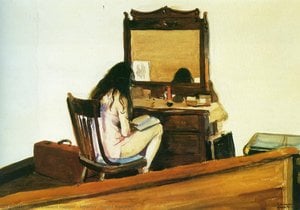
Edward Hopper, a master of American realism, possessed an uncanny ability to distill the essence of modern life – its quiet desperation, its pervasive loneliness, and its fleeting moments of beauty – onto canvas. “Eleven A.M.”, painted in 1926, is a particularly poignant example of this skill. The painting depicts a solitary woman seated by a window, bathed in a soft yet revealing light that seems to simultaneously illuminate and isolate her. It’s not a scene of dramatic action, but rather one of profound stillness, inviting the viewer into an intimate contemplation of interiority and the human condition.

The composition is deceptively simple: a woman in a blue armchair, positioned near a window that offers a glimpse of the world outside. However, it’s within this simplicity that Hopper's genius resides. The room itself is modestly furnished – a dresser, a framed picture, and a lamp all contribute to a sense of everyday life, yet they also underscore the woman’s isolation. She isn’t actively engaged with her surroundings; instead, she appears lost in thought, her gaze directed outwards but seemingly unfocused. The careful arrangement of objects within the room doesn’t feel cluttered or busy, but rather deliberately sparse, emphasizing the emptiness that surrounds the figure. Hopper masterfully uses light and shadow to sculpt the form of the woman and define the space around her, creating a dramatic contrast that draws the eye and heightens the emotional impact.

The Language of Light and Shadow: Hopper’s Technical Brilliance

Hopper's technique in “Eleven A.M.” is characterized by a meticulous attention to detail and a masterful command of oil paint. His brushstrokes are relatively smooth, creating a realistic depiction of form and texture. The light streaming through the window isn’t merely illumination; it’s a character in itself, shaping the mood and revealing subtle nuances of emotion. Notice how the light catches on the woman's skin, highlighting her vulnerability, while simultaneously casting deep shadows that suggest a sense of melancholy or introspection. The color palette is restrained – blues, browns, and muted reds dominate the scene – further contributing to the painting’s somber atmosphere. This isn’t a vibrant, celebratory depiction of life; it’s a quiet, introspective study of human emotion.

Echoes of Modern Life: Context and Symbolism

To understand “Eleven A.M.” fully, it's essential to consider the historical context in which it was created. The 1920s were a period of rapid social change in America – urbanization, industrialization, and shifting societal norms all contributed to a sense of alienation and disillusionment. Hopper’s work often reflects these anxieties, capturing the loneliness and isolation that many people experienced in the modern world. The window in “Eleven A.M.” is particularly symbolic; it represents a connection to the outside world, yet the woman's position within the room suggests a barrier between her and that world. She is both present and absent, connected and disconnected. The painting invites us to consider the complexities of human experience – our longing for connection, our fear of isolation, and our search for meaning in a rapidly changing world.

Hopper's artistic influences are also apparent in “Eleven A.M.”. While he developed his own unique style, he was deeply influenced by French Impressionists like Édouard Manet and Edgar Degas, as well as American artists such as Robert Henri. Like these predecessors, Hopper sought to capture the realities of modern life with honesty and sensitivity. However, he went beyond mere representation; he imbued his paintings with a psychological depth that resonated with viewers on an emotional level. “Eleven A.M.” is not simply a depiction of a woman in a room; it’s a powerful exploration of the human condition – a timeless meditation on solitude, introspection, and the search for meaning.

A Detailed Examination: Hopper's Approach to Form and Color

Hopper’s meticulous attention to detail is evident throughout Eleven AM. He employs a technique that prioritizes realism, meticulously rendering textures and contours with subtle brushstrokes—primarily smooth, horizontal strokes—to convey the materiality of surfaces like the armchair upholstery and the woman’s skin. Hopper skillfully uses light and shadow to sculpt form and create depth within the confined space of the room. The dominant illumination emanates from a lamp positioned on a table in the foreground, casting dramatic shadows that accentuate the contours of the furniture and contribute to the painting's melancholic mood.

The color palette is restrained, favoring muted hues—primarily blues and browns—that reinforce the painting’s contemplative atmosphere. Hopper’s use of color isn’t intended to dazzle or excite; rather, it serves as a tool for conveying emotion and establishing tonal harmony. The woman's skin tone appears pale, reflecting the diffused light from the window, while the lamp emits a warm reddish glow that contrasts with the cooler blues of the room—a visual device that underscores the emotional tension inherent in the scene.

Furthermore, Hopper’s careful composition emphasizes the spatial relationships within the room. The woman is positioned centrally, anchoring the painting's structure and directing the viewer's gaze toward the window. The placement of objects—the dresser, framed picture, and lamp—creates a sense of deliberate arrangement that contributes to the overall feeling of stillness and isolation.

Ultimately, Eleven AM exemplifies Hopper’s commitment to portraying human experience with profound psychological insight. It is not merely an aesthetic exercise; it's a meditation on themes of loneliness, contemplation, and the elusive nature of connection—themes that continue to resonate with audiences today.

Domande e risposte

Per quale motivo lo stato del copyright di "Eleven AM" è questo?

"Eleven AM" di Edward Hopper è di ancora protetta dal diritto d'autore. La durata del copyright decorre dalla morte dell'artista, avvenuta nel 1967.

È disponibile una scheda informativa su "Eleven AM" di Edward Hopper per gli studenti?

La pagina Schede didattiche di "Eleven AM" di Edward Hopper offre una scheda informativa stampabile su due fogli: l'opera d'arte con la sua tabella identificativa, una linea temporale decennale che la colloca nel periodo di vita dell'artista, altre opere dello stesso autore, la tavolozza dei colori misurata e citazioni pronte da copiare in quattro stili diversi.

L'opera "Eleven AM" è complessivamente più luminosa o più scura?

"Eleven AM" presenta una luminosità complessiva di ombre profonde e una luminanza pari a Scuro.


Biografia dell'artista

La Quiete della Scena Americana

Edward Hopper nacque a Upper Nyack, negli Stati Uniti d'America. I suoi primi anni furono trascorsi a osservare il mondo con uno sguardo costante, un'abitudine iniziata con schizzi d'infanzia meticolosamente datati e firmati. Mentre i suoi genitori gli suggerivano un percorso pratico nell'illustrazione commerciale, il suo interesse rimase ancorato alla fine art. Studiò presso la New York School of Art sotto la guida di William Merritt Chase e Robert Henri. Questi anni gli insegnarono la maestria tecnica necessaria per ritrarre il mondo in modo nudo e onesto. Non cercò le pennellate fugaci degli Impressionisti che incontrò a Parigi; al contrario, sviluppò un modo di vedere che privilegiava la staticità di un istante rispetto al movimento di una folla.

La sua opera si concentra spesso sul quotidiano. Esplorò case, diner, uffici e stanze d'albergo, spogliando ogni scena dai dettagli superflui per trovarne la verità emotiva sottostante. In House by the Railroad (1925), una composizione semplice rivela un senso di mistero e isolamento. Utilizzò la luce e l'ombra non solo per descrivere una stanza, ma per instaurare un'atmosfera: la resa precisa di un'ombra su una parete o il modo in cui la luce colpisce una finestra divennero il suo mezzo per comunicare lo stato psicologico dei suoi soggetti.

Luce e Interni Urbani

Il modo in cui la luce entra in uno spazio è un protagonista centrale nei suoi dipinti. In Nighthawks (1942), la cruda luce fluorescente di un diner a tarda notte squarcia l'oscurità di una strada urbana deserta. Le figure all'interno sono fisicamente vicine, ma appaiono perse nei propri pensieri, scollegate l'una dall'altra. Questo senso di anonimato in una città affollata divenne un tema ricorrente. Hopper catturò la tensione di essere soli in un luogo pubblico, una sensazione che risuona in opere come Automat e Office in a Small City. Era affascinato dal modo in cui la luce artificiale interagisce con l'oscurità naturale della notte.

Sua moglie, Josephine Nivison Hopper, fu una presenza costante: artista a pieno titolo, fu spesso la sua modella. La sua presenza si avverte nella caratterizzazione di molte delle sue figure femminili. Insieme, condussero una vita modesta, trascorrendo spesso le estati nella Nuova Inghilterra, un elemento che influenzò i paesaggi da lui dipinti. Le sue rappresentazioni del paesaggio americano, sia rurale che urbano, enfatizzano spesso una certa austerità o vuoto. Che si tratti di una stazione di servizio lungo la strada in Gas (1940) o di una stanza silenziosa in un hotel, il soggetto è sempre l'intersezione tra un luogo fisico e un'esperienza privata e interiore.

Un'Eredità di Osservazione

L'influenza di Hopper si estende nel linguaggio visivo del cinema e della letteratura. La sua capacità di creare tensione psicologica attraverso la composizione è stata sottolineata da molti studiosi del modo in cui le storie vengono raccontate attraverso le immagini. I suoi dipinti sono conservati nei principali musei di tutto il mondo, in collezioni prestigiose come il Whitney Museum of American Art e il Museum of Fine Arts di Boston. Non mirava a grandi narrazioni storiche; trovava il suo soggetto negli angoli silenziosi della vita quotidiana, trasformando una semplice finestra o uno sconosciuto di passaggio in uno studio della condizione umana. La sua opera rimane una meditazione sul silenzio che esiste tra gli esseri umani.

Edward Hopper

Edward Hopper

1931 - 1967 , Stati Uniti d'America

Dettagli rapidi

  • Artistic Movement Or Style: Realismo americano
  • Artists Or Movements Influenced By This Artist: ['Pierre Sanford Ross']
  • Artists Who Influenced This Artist:
    • William Merritt Chase
    • Robert Henri
    • Edgar Degas
    • Édouard Manet
  • Date Of Birth: 1931
  • Date Of Death: 1967
  • Full Name: Edward Hopper
  • Nationality: Americano
  • Notable Artworks:
    • Nighthawks
    • Gas
    • House by the Railroad
    • Automat
    • Office in a Small City
    • Summertime
  • Place Of Birth: Upper Nyack, Stati Uniti d'America
Esplora le opere d'arte organizzate per temi, stili e caratteristiche.


































