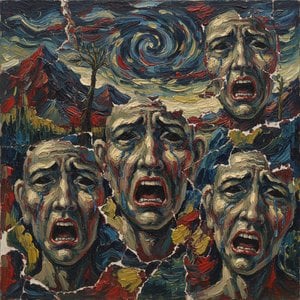
Girl and Three Men's Heads
Edvard Munch, a pivotal figure in modern art, was born on December 12, 1863, in Norway. Globally renowned for his iconic masterpiece
The Scream (1893), he is considered one of the most influential artists of the late 19th and early 20th centuries. Munch's unique style, characterized by intense emotions and psychological depth, has had a profound impact on modern art movements such as Expressionism and Symbolism. He explored themes of anxiety, mortality, love, and trauma with unflinching honesty—subjects that would permeate his artistic output throughout his life.
The Painting Style
Girl and Three Men's Heads, painted using oil on canvas, measures 100 x 80 cm (39.4 x 31.5 inches). The painting is currently housed at the
Munch Museum in Oslo, Norway. This intriguing piece showcases Munch’s mastery in capturing human emotions through his distinctive style. The composition is striking, as the figures are arranged asymmetrically and seem to be engaged in an intense conversation or exchange of glances. It's a deliberate disruption of conventional artistic norms—a rejection of balance and harmony in favor of conveying raw feeling.
Symbolism and Figurative Expressionism
Munch’s work can be classified under two major art movements:
Figurative Expressionism and
Symbolism.
Figurative Expressionism emerged as a reaction against the conceptual and minimalist art of the 1970s, characterized by intense subjectivity, rough handling of materials, and the return to portraying recognizable objects such as the human body in a way that reflects inner turmoil. To learn more about this movement, visit
Figurative Expressionism Art Movement Introduction. Munch’s approach aligns perfectly with the Expressionist impulse to depict not just what is seen but what is felt—to translate psychological experience onto canvas.
Symbolism, on the other hand, sought to express spiritual truths and emotions through evocative imagery and allusion, often departing from literal representation. The painting's muted palette contributes to this atmosphere of contemplation and unease.
Handmade Oil Paintings Reproductions
At
WahooArt.com, we specialize in creating high-quality handmade oil paintings reproductions of famous artworks, including those by
Edvard Munch. Our skilled artists meticulously recreate each detail to ensure that our reproductions are as close to the original as possible. You can find more information about our handmade oil paintings reproductions on our website, including
Girl and Three Men's Heads by
Edvard Munch.
To explore our collection of handmade oil paintings reproductions, including those inspired by
Edvard Munch's work, visit
WahooArt.com today. Our team is dedicated to providing the highest quality artworks and exceptional customer service.
Photo Description: The painting is a black and white artwork featuring three men's heads and one woman's head. The woman appears to be sitting in the foreground of the painting, while the three men are positioned behind her. Each man has a different expression on their face, with two appearing to look at the camera and one looking away. The woman is wearing a dress, which adds an interesting contrast between her and the men's more formal attire. The overall composition of the painting creates a sense of depth and intrigue, as it invites the viewer to explore the relationships between the subjects and their expressions.
Size: Unknown
Date: Unknown
ARTIST INFORMATION:
==================
Artist: Edvard Munch
Birth Year: 1863
Death Year: 1944
Birth City: Adelsbruk
Birth Country: Sweden
Biography:
Edvard Munch: Life and Legacy
Early Life and Influences (1863-1889)
Edvard Munch was born on December 12, 1863, in Adelsbruk, Sweden, though he spent most of his life in Norway. His childhood was profoundly shaped by tragedy and instability. The early loss of his mother to tuberculosis when he was five years old, followed by the death of his sister Sophie from the same disease nine years later, left an indelible mark on Munch’s psyche. He also battled a lifelong fear of inheriting the familial mental illness that plagued his father. These experiences instilled in him a deep preoccupation with mortality, sickness, and psychological distress – themes that would dominate his artistic output.
Munch's early education at the Royal School of Art and Design in Kristiania (now Oslo) proved pivotal. There, he encountered nihilist philosopher Hans Jæger, who encouraged Munch to explore his inner turmoil and express it through art, rejecting conventiona
Domande e risposte
Dove posso trovare opere d'arte simili a "Ragazza e Tre Teste Umane" di Edvard Munch?
La pagina Opere simili di "Ragazza e Tre Teste Umane" di Edvard Munch presenta opere correlate.
Cosa rappresenta "Ragazza e Tre Teste Umane" di Edvard Munch, e quale atmosfera trasmette?
"Ragazza e Tre Teste Umane" mostra emotion, psychology, fear, mortality, woman, men, landscape, expressionism, e l'atmosfera che ne deriva è Drammatico.
A quale stile appartiene "Ragazza e Tre Teste Umane"?
Il movimento associato a "Ragazza e Tre Teste Umane" di Edvard Munch è Figurative Expressionism. Questa classificazione colloca l'opera tra artisti e opere d'arte correlati.
Quale artista e quale stile si celano dietro "Ragazza e Tre Teste Umane"?
"Ragazza e Tre Teste Umane" è stata creata da Edvard Munch in stile Figurative Expressionism. L'artista e il movimento identificano la tradizione dell'opera.
Posso esaminare "Ragazza e Tre Teste Umane" più nel dettaglio?
La pagina Raggi X di "Ragazza e Tre Teste Umane" di Edvard Munch è un visualizzatore interattivo che permette di scorrere tra undici livelli ottici dell'immagine dell'opera, inclusa una vista in stile raggi X.
"Ragazza e Tre Teste Umane" dispone di un'anteprima in realtà aumentata?
Puoi visualizzare "Ragazza e Tre Teste Umane" di Edvard Munch sulla tua parete grazie alla pagina Anteprima AR dell'opera, utilizzando la realtà aumentata su un dispositivo compatibile.
Quale dimensione è consigliata per "Ragazza e Tre Teste Umane" in un/una Zona giorno?
L'abbinamento consigliato per "Ragazza e Tre Teste Umane" di Edvard Munch: una stampa di dimensioni Large in un/una Zona giorno.
Che intensità cromatica ha "Ragazza e Tre Teste Umane" di Edvard Munch?
I colori in "Ragazza e Tre Teste Umane" di Edvard Munch hanno un'intensità Monocromatico.



 Anteprima in scala reale
 Passa alle stampe
 Condividi
 Condividi
 Dettagli
 Guida stampabile

 Scarica
 Articoli simili
 Radiografia
 Slideshow
 Statistiche

 Leggi tutto






































 L'opzione vetro è disponibile solo per dimensioni inferiori a 110 cm