The Geometry of Equilibrium: A Journey Through Annesley’s Vision
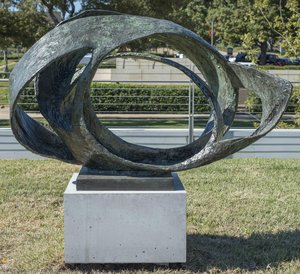
In the vast landscape of mid-century modernism, few works capture the delicate tension between weight and weightlessness quite like David Annesley’s ‘Untitled’ (1969). This mesmerizing, mandala-like sculpture serves as a masterclass in structural harmony, inviting the viewer into a rhythmic dance of shapes that seem to breathe within their own metallic confines. At first glance, the eye is drawn to the vibrant, sun-drenched yellow of its aluminum form, a hue that radiates energy and warmth against the natural backdrop of its surroundings. Yet, as one lingers, the true magic reveals itself: a complex, nested architecture where smaller geometric shapes are cradled within larger ones in a state of perfect, unshakeable equilibrium.
Annesley’s technique is deeply rooted in his unique personal history, specifically his formative years as an RAF pilot. The sculpture’s open-form design does not merely occupy space; it actively engages with and expands into the atmosphere, mimicking the sensation of flight and the liberation found in the clouds. By utilizing lightweight metal, Annesley achieves a paradoxical effect—the sculpture possesses a commanding physical presence, yet it conveys an ethereal sense of buoyancy. This mastery of linear form allows the piece to envelop the surrounding environment, making the air around the sculpture feel like an integral part of the artwork itself.
A Bridge Between Mediums and Movements
The historical significance of this work lies in its role as a bridge between the worlds of painting and sculpture. During the 1960s, Annesley found profound inspiration in his friendship with the American Color Field painter Kenneth Noland. This connection was transformative, encouraging the sculptor to move beyond mere shape and explore the emotive power of color relationships. In ‘Untitled’, we see the influence of Color Field theory translated into a three-dimensional language; the yellow is not just a coating, but a structural element that defines the boundaries of the form. The piece stands as a testament to a period when the boundaries of artistic disciplines were dissolving, giving rise to a new, multidisciplinary approach to abstraction.
For the discerning collector or interior designer, this work offers more than just aesthetic beauty; it provides a psychological sanctuary. Annesley himself described his structured compositions as restorative, noting that they release endorphins by providing the brain with the order and predictability it craves. The way the sculpture contains smaller shapes within itself creates a sense of safety and containment, making it an ideal centerpiece for spaces designed for contemplation and peace. Whether placed in a sunlit garden or featured as a focal point in a contemporary gallery setting, ‘Untitled’ acts as a visual anchor that brings a sense of profound, organized calm to any environment.
Owning a high-quality reproduction of such a seminal piece allows one to bring this sense of mathematical grace and aeronautical lightness into the home. It is an invitation to experience the intersection of modernist rigor and organic fluidity, offering a timeless elegance that continues to resonate with the human desire for balance and beauty.
Domande e risposte
In che modo i colori di "Untitled" si relazionano tra loro?
"Untitled" di David Annesley presenta un'armonia cromatica Strong Color Unity.
Come posso acquistare una stampa di "Untitled" di David Annesley?
Per ordinare una stampa di "Untitled" di David Annesley, ti basta procedere con l'ordine su questa pagina: una stampa fine art su tela di cotone o carta canvas d'archivio.
Quale tecnica è stata utilizzata per "Untitled" e quando è stata realizzata?
"Untitled" è stata realizzata nel 1969 con la tecnica Metal. Il materiale e la data descrivono come e quando è stata creata l'opera originale.
A quale fase della carriera di David Annesley appartiene "Untitled" (1969)?
La data del 1969 colloca "Untitled" nel Mature Period dello sviluppo di David Annesley.
In che modo "Untitled" bilancia luci e ombre?
La luminosità di "Untitled" di David Annesley è registrata come shadow, con una luminanza di Soft Shadow.
A quale fase dello sviluppo di David Annesley appartiene "Untitled"?
All'interno della carriera di David Annesley, "Untitled" appartiene al Mature Period. Questa fase permette di confrontarla con le altre opere dell'artista.
Che emozione trasmette "Untitled" di David Annesley?
"Untitled" di David Annesley trasmette una sensazione Calm all'interno di un'atmosfera complessivamente Modern.
Qual è la collocazione storica di "Untitled"?
Storicamente, "Untitled" è un'opera Color Field appartenente alla più ampia epoca Modern.



 Passa alle stampe
 Condividi
 Condividi
 Dettagli
 Guida stampabile

 Scarica
 Articoli simili
 Slideshow
 Statistiche


 Leggi tutto






































 L'opzione vetro è disponibile solo per dimensioni inferiori a 110 cm