Anteprima in scala reale Prova in AR Ordina la riproduzione dipinta a mano Passa all'immagine digitale Condividi
Dettagli Guida stampabile Aggiungi ai preferiti Scarica Articoli simili Radiografia Slideshow Statistiche

Springtime

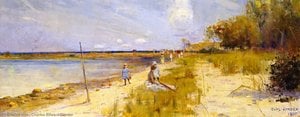
Charles Conder's 'Springtime' captures a serene Australian countryside scene with figures and nature bathed in sunlight. A beautiful example of Heidelberg School art.

Scopri Charles Edward Conder (1868-1909), figura chiave della Heidelberg School australiana! Ammira i suoi vibranti paesaggi, porti e scene balneari su WahooArt.

Giclée / Stampe d'arte

Stampa giclée o su tela di qualità museale, con produzione rapida e diverse opzioni di finitura. ( Ordina la riproduzione dipinta a mano Passa all'immagine digitale)

Corner sample of the P118B picture frame: polistirene stampato, 5 cm wide and 3 cm thick
P118B €10
Corner sample of the P118H picture frame: polistirene stampato, 5 cm wide and 3 cm thick
P118H €10
Corner sample of the P118W picture frame: polistirene stampato, 5 cm wide and 3 cm thick
P118W €10
Corner sample of the P438Z picture frame: polistirene stampato, 5.5 cm wide and 3.5 cm thick
P438Z €10
Corner sample of the P508JH picture frame: polistirene stampato, 7 cm wide and 3.5 cm thick
P508JH €12
Corner sample of the P508YH picture frame: polistirene stampato, 7 cm wide and 3.5 cm thick
P508YH €12
Corner sample of the P805H picture frame: polistirene stampato, 5 cm wide and 3.5 cm thick
P805H €10
Corner sample of the P805Z picture frame: polistirene stampato, 5 cm wide and 3.5 cm thick
P805Z €10
Corner sample of the P919BZ picture frame: polistirene stampato, 7 cm wide and 3.5 cm thick
P919BZ €10
Corner sample of the P919G picture frame: polistirene stampato, 7 cm wide and 3.5 cm thick
P919G €10
Corner sample of the P919XJ picture frame: polistirene stampato, 7 cm wide and 3.5 cm thick
P919XJ €10
Corner sample of the P959ZH picture frame: polistirene stampato, 5 cm wide and 3 cm thick
P959ZH €10
Corner sample of the P968JZ picture frame: polistirene stampato, 6 cm wide and 4 cm thick
P968JZ €12
Corner sample of the W106C picture frame: legno massello, 5 cm wide and 3 cm thick
W106C €8
Corner sample of the W218G picture frame: legno massello, 5 cm wide and 3 cm thick
W218G €10
Corner sample of the W218JH picture frame: legno massello, 5 cm wide and 3 cm thick
W218JH €8
Corner sample of the W218Y picture frame: legno massello, 5 cm wide and 3 cm thick
W218Y €10
Corner sample of the W307PJ picture frame: legno massello, 6 cm wide and 3 cm thick
W307PJ €10
Corner sample of the W316G picture frame: legno massello, 6 cm wide and 3 cm thick
W316G €10
Corner sample of the W316PJ picture frame: legno massello, 6 cm wide and 3 cm thick
W316PJ €8
Corner sample of the W316Y picture frame: legno massello, 6 cm wide and 3 cm thick
W316Y €10
Corner sample of the W398PJ picture frame: legno massello, 5 cm wide and 3 cm thick
W398PJ €8
Corner sample of the W4111J picture frame: legno massello, 6.5 cm wide and 3.5 cm thick
W4111J €10
Corner sample of the W500HY picture frame: legno massello, 7 cm wide and 5 cm thick
W500HY €15
Corner sample of the W500JH picture frame: legno massello, 7 cm wide and 5 cm thick
W500JH €15
Corner sample of the W692G picture frame: legno massello, 8 cm wide and 4 cm thick
W692G €12
Corner sample of the W849H picture frame: legno massello, 5 cm wide and 3 cm thick
W849H €8
Corner sample of the W940BG picture frame: legno massello, 7.5 cm wide and 4.5 cm thick
W940BG €15
Corner sample of the W953PJ picture frame: legno massello, 6 cm wide and 3.5 cm thick
W953PJ €8

Standard
personalizzato
CM
INCH

Scegli tra le nostre dimensioni predefinite, che rispettano le proporzioni originali dell'opera d'arte.

larghezza
altezza

Inserisci la larghezza e l'altezza desiderate, per adattarle alla tua cornice o alla tua parete. Una stampa può essere solo ritagliata, mai resa più grande dell'immagine originale; pertanto, un formato con una forma differente comporterà la perdita di una parte dell'opera. Ti invieremo un mockup digitale da approvare prima di procedere con la stampa. L'immagine mostrata in questa pagina non rappresenta il ritaglio reale — solo il mockup lo mostra.

Consegna in tutto il mondo () in 2 settimane invece delle normali 4/5 settimane. (24 Ottobre)

Spedizione espressa gratuita in tutto il mondo
Tela in lino di alta qualità
Assicurazione completa sulla spedizione
Garanzia di rimborso dei dazi doganali
Garanzia di perfetta fedeltà cromatica
Politica di reso entro 100 giorni (solo per difetti di fabbricazione)
Garanzia di rimborso al 100%
Sconto per acquisti multipli

Prezzo totale

€ 60

Springtime

Giclée / Stampe d'arte

Dimensioni della riproduzione

-

Prezzo totale

€ 60

Dettagli rapidi

  • Medium: Oil on canvas
  • Title: Springtime
  • Movement: Heidelberg School
  • Location: NGV, Melbourne
  • Artist: Charles Conder

Quiz d'arte

Per ogni domanda è presente una sola risposta corretta.

Domanda 1:
What artistic movement is Charles Edward Conder primarily associated with?
Domanda 2:
In 'Springtime', what is the primary subject matter depicted?
Domanda 3:
What year was 'Springtime' painted?
Domanda 4:
Charles Edward Conder was born in which city?
Domanda 5:
Which of the following best describes Conder's style as evident in 'Springtime'?

Charles Edward Conder’s “Springtime,” A Window into Heidelberg’s Soul

Charles Edward Conder's "Springtime," painted in 1888, isn’t merely a depiction of a rural scene; it’s a vibrant distillation of the Heidelberg School’s artistic philosophy – a celebration of light, color, and the fleeting beauty of the Australian landscape. This oil on canvas captures a moment of idyllic tranquility nestled within the rolling hills of New South Wales, yet it resonates with a deeper sense of observation and emotional resonance that distinguishes Conder's work from purely topographical representations.

The painting immediately draws the eye to the luminous quality of the light, characteristic of the Heidelberg School’s approach. Conder masterfully employs broken brushstrokes and a palette dominated by greens, blues, and yellows – not in a photographic realism, but rather as an expression of how these colors *feel* under the intense Australian sun. The composition is deceptively simple: a meandering dirt track cuts through a field dotted with grazing sheep and cows, leading towards distant trees that are rendered with a hazy, atmospheric quality. A small group of figures – likely children – are visible in the foreground, adding a touch of human presence to this otherwise serene vista.

The Heidelberg School and its Artistic Roots

To fully appreciate “Springtime,” it’s crucial to understand the context within which Conder was working. The Heidelberg School, emerging in Melbourne during the 1880s, represented a significant shift away from the academic traditions of European art that had previously dominated Australian painting. Artists like Conder, Tom Roberts, and Frederick McCubbin sought inspiration directly from the Australian landscape, rejecting idealized representations in favor of capturing its raw beauty and inherent drama. They embraced *plein air* painting – working outdoors directly from nature – a technique championed by Impressionist painters in Europe.

Conder’s early life, marked by his mother's death in India and subsequent relocation to England before returning to Australia, undoubtedly shaped his artistic sensibility. His experiences as a surveyor instilled a keen eye for detail and an appreciation for the natural world, while his time spent studying art in London exposed him to the burgeoning Impressionist movement. However, Conder ultimately forged his own unique style, blending European influences with a distinctly Australian perspective.

Symbolism and Emotional Resonance

Beyond its picturesque subject matter, “Springtime” is rich in symbolic meaning. The dirt track suggests a journey – perhaps a metaphorical one – while the grazing animals represent the bounty of the land. The figures in the foreground invite us to contemplate our relationship with nature and the simple pleasures of rural life. There’s an underlying sense of nostalgia for a bygone era, a yearning for connection with the earth and its rhythms.

The hazy atmosphere and diffused light contribute significantly to the painting's emotional impact. It evokes a feeling of warmth, tranquility, and perhaps even melancholy – a recognition that such moments of beauty are fleeting and precious. Conder’s use of color is particularly effective in conveying this mood, creating a sense of depth and luminosity that draws the viewer into the scene.

A Legacy of Australian Impressionism

“Springtime” stands as a pivotal work in the development of Australian Impressionism. It exemplifies the Heidelberg School’s commitment to capturing the essence of the Australian landscape with vibrant color, loose brushwork, and an emphasis on light and atmosphere. Conder's ability to imbue his paintings with both visual beauty and emotional depth cemented his place as one of Australia’s most important artists. Reproductions of this captivating work continue to resonate with audiences today, offering a glimpse into the soul of Heidelberg and the enduring appeal of the Australian landscape.

Domande e risposte

In che modo "Springtime" si inserisce nei temi e nello stile di Charles Edward Conder?

"Springtime" condivide con le altre opere di Charles Edward Conder lo stile Heidelberg School e i temi ricorrenti: heidelberg school realism, australian landscape painting, impressionistic light study, rural life depiction”, “conder’s artistic evolution”.

"Springtime" presenta forti contrasti chiaroscurali?

Il livello di contrasto di "Springtime" di Charles Edward Conder è Bold.

Quali dimensioni e orientamento si raccomandano per una stampa di "Springtime" di Charles Edward Conder?

Per una stampa di "Springtime" di Charles Edward Conder, si consiglia il formato Medium con orientamento Landscape.


Biografia dell'artista

vita iniziale e percorso artistico

Charles Edward Conder, pittore, litografo e designer di origine britannica, ha lasciato un segno indelebile nel mondo dell'arte. Nato a Tottenham, Middlesex, il 24 ottobre 1868, la giovinezza di Conder fu segnata dalla scomparsa di sua madre in India quando aveva appena quattro anni.

carriera artistica in australia

Nel 1884, all'età di 16 anni, Conder si trasferì a Sydney, in Australia, dove lavorò per suo zio come rilevatore di terreni. Tuttavia, presto scoprì che la sua vera passione risiedeva nel dipingere il paesaggio piuttosto che nella misurazione del terreno. Entro il 1886, era diventato artista per l'Illustrated Sydney News, al fianco di artisti illustri come Albert Henry Fullwood e Frank Mahony.

la scuola di heidelberg e opere significative

Il capolavoro di Conder, Departure of the Orient – Circular Quay (1888), ne dimostrò la ritrovata padronanza di forma e pennellata. Questa scena portuale, che ritrae il vivace porto di Sydney Cove, fu rapidamente acquistata dalla Art Gallery of New South Wales, rendendola il primo lavoro di Conder ad entrare in una collezione pubblica.
  • A Holiday at Mentone (1888), un dipinto pieno di vita che mostra uomini e donne rilassati sulla spiaggia, è un altro esempio notevole dell'opera di Conder.
  • L'associazione di Conder con G. P. Nerli, un pittore italiano itinerante, ne influenzò profondamente lo sviluppo come artista.
  • I suoi contributi alla 9 by 5 Impression Exhibition a Melbourne, insieme a Tom Roberts e Arthur Streeton, consolidarono la sua posizione all'interno del movimento della Heidelberg School.

eredità e anni successivi

Gli ultimi anni di Conder furono segnati da problemi di salute, inclusa la paralisi e un episodio di delirium tremens. Nonostante ciò, continuò a dipingere, lasciando dietro di sé l'eredità di una figura chiave della Heidelberg School. La sua arte fu accolta meglio in Inghilterra che a Parigi, con il ritratto dipinto da Henri de Toulouse-Lautrec nel 1892. Visualizza le opere di Conder presso la Art Gallery of New South Wales o esplora di più sulla Heidelberg School sulla pagina Charles Edward Conder di WahooArt.

conclusione

L'impatto di Charles Edward Conder sull'impressionismo australiano è innegabile. La sua eredità, segnata dai suoi dipinti affascinanti e dall'associazione con la Heidelberg School, continua a ispirare appassionati d'arte in tutto il mondo.

Charles Edward Conder

Charles Edward Conder

1868 - 1909 , Regno Unito

Informazioni rapide

  • Artistic Movement Or Style: Impressionismo australiano
  • Artists Who Influenced This Artist: ['G. P. Nerli']
  • Date Of Birth: 24 ottobre 1868
  • Date Of Death: 1909
  • Full Name: Charles Edward Conder
  • Nationality: Britannico
  • Notable Artworks:
    • Departure of the Orient
    • A Holiday at Mentone
  • Place Of Birth (City And Country): Tottenham, Regno Unito
Esplora le opere d'arte organizzate per temi, stili e caratteristiche.