Michelangelo Merisi da Caravaggio: The Lute Player – A Masterpiece of Light and Emotion
Michelangelo Merisi da Caravaggio (1571–1610), universally known as Caravaggio, stands as one of the most influential figures in Baroque art. His revolutionary approach to painting—characterized by dramatic chiaroscuro, intense realism, and psychological depth—continues to captivate audiences centuries later. This essay delves into the intricacies of “The Lute Player,” examining its artistic merits, historical significance, and enduring legacy.
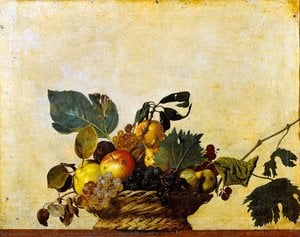
Background: Caravaggio’s early biographer Giovanni Baglione recounts a tale that encapsulates his artistic vision: he painted for Cardinal Francesco Maria del Monte a young man who played the lute. The artist meticulously recreated the scene—a carafe of flowers brimming with water reflecting in a window, overlaid with shimmering dew—capturing not merely visual accuracy but also an overwhelming sense of vitality and truthfulness.
The Composition: “The Lute Player” depicts a young woman absorbed in music, her eyes closed as she performs. The lute itself dominates the foreground, positioned prominently before her gaze. Two vases—one on the upper left corner and another on the lower right—add to the compositional complexity, creating depth and visual interest. Beneath the lute rests a book, suggesting that the musician is accompanied by sheet music.
Symbolism and Elements: The inclusion of fruits—apples in the lower left and oranges near the upper right—serves as more than mere decorative embellishment; they symbolize abundance and harmony, mirroring the overarching theme of serenity conveyed by Caravaggio. Furthermore, the cracked lute embodies the transient nature of beauty and life.
Versions and Exhibitions: Three versions of “The Lute Player” exist—the original housed at Badminton House since 2001, another residing in the Wildenstein Collection, and a third part of the Hermitage Museum’s holdings. The Hermitage and Badminton House versions were showcased together in St. Petersburg in 2020, offering visitors an unparalleled opportunity to contemplate Caravaggio's genius alongside its counterpart.
Artistic Influence: Caravaggio’s stylistic innovations profoundly impacted subsequent artists such as Diego Velázquez, whose portraits—particularly “Head of a Man”—demonstrate the enduring influence of Caravaggio’s technique. His approach to capturing human emotion and portraying realistic detail continues to inspire painters today.
Reproductions and Prints: WahooArt.com presents meticulously crafted oil painting reproductions and prints on canvas of celebrated artworks, including “The Lute Player.” These reproductions faithfully preserve the essence of Caravaggio’s masterpiece, allowing art enthusiasts to experience its beauty firsthand.
Conclusion Caravaggio’s “The Lute Player” remains an emblem of Baroque artistry—a testament to his mastery of light and shadow, coupled with his profound understanding of human psychology. This painting continues to resonate with viewers worldwide, cementing Caravaggio's place as one of the most revered painters in history.
Domande e risposte
Quanti anni aveva Caravaggio quando è stata creata "Muzico per liuto"?
Quando "Muzico per liuto" fu creata nel 1596, Caravaggio - nato nel 1571 - aveva 25 anni.
Quali sono la tecnica e le dimensioni di "Muzico per liuto" di Caravaggio?
La tecnica di "Muzico per liuto" di Caravaggio è Acrilico su tela e le sue dimensioni riportate sono 94 x 119 cm.
Quale formato di stampa di "Muzico per liuto" di Caravaggio si adatta alla stanza consigliata?
L'abbinamento consigliato per "Muzico per liuto" di Caravaggio: una stampa di dimensioni Formato grande in un/una Zona giorno.



 Anteprima in scala reale
 Ordina la riproduzione dipinta a mano
 Condividi
 Condividi
 Dettagli
 Guida stampabile

 Scarica
 Articoli simili
 Radiografia
 Slideshow
 Statistiche


 Leggi tutto






































 L'opzione vetro è disponibile solo per dimensioni inferiori a 110 cm