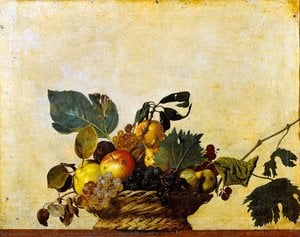
Bacchus (detail): A Symphony of Darkness and Delight
Michelangelo Merisi da Caravaggio’s
Bacchus (detail) stands as a cornerstone of Baroque art—a painting that transcends mere representation to embody the very spirit of its era and captivate viewers with its dramatic intensity. Housed in the Galleria degli Uffizi in Florence, Italy, this masterpiece exemplifies Caravaggio’s revolutionary approach to artistic expression, marking him as one of the most influential painters of the seventeenth century. Let's delve into the intricacies of this artwork, exploring its stylistic innovations, historical significance, and enduring emotional resonance.
The Genius of Chiaroscuro: Caravaggio’s Revolutionary Technique
Caravaggio fundamentally altered the artistic landscape with his masterful use of *chiaroscuro*, a technique that employs stark contrasts between light and dark to create depth and heighten emotional impact. Unlike Renaissance painters who favored diffused illumination, Caravaggio plunged his figures into darkness—often impenetrable—allowing only slivers of light to illuminate key elements within the composition. This dramatic effect wasn’t merely stylistic; it served as a conduit for conveying psychological states—fear, ecstasy, contemplation—drawing the viewer directly into the scene and fostering an immersive experience. As evidenced in
Bacchus (detail), this technique is palpable: the absence of visible light source amplifies the textures of the objects—the wine glass and bottle—making them almost tangible to the eye.
A Classical Echo in Baroque Rome
Painted in 1596 during Caravaggio’s formative years in Rome,
Bacchus (detail) reflects Caravaggio's fascination with classical mythology and his ability to infuse it with a distinctly modern sensibility. The depiction of Dionysus—the Greek god of wine—is rendered with meticulous realism, mirroring the sculptural traditions of antiquity. Scholars have noted parallels between Caravaggio’s pose and gestures and those found in statues commemorating Hadrian’s beloved Antinous—a deliberate homage to artistic precedent that underscores Caravaggio's commitment to elevating painting beyond mere imitation. The inclusion of symbols like the pomegranate and the rotting apple further reinforces this connection to classical iconography, hinting at themes of mortality and the ephemeral nature of pleasure.
Symbolism Beyond Literal Representation
Beyond its visual splendor,
Bacchus (detail) is laden with symbolic meaning—a testament to Caravaggio’s intellectual engagement with humanist thought. The dark liquid in the wine glass serves as a metaphor for life itself—fleeting and vulnerable—while the empty bottle symbolizes the inevitable absence of joy after indulgence. These interpretations align seamlessly with Caravaggio's broader exploration of human condition, prompting viewers to contemplate questions of existence and decay. As Mina Gregori eloquently stated, Caravaggio’s vision celebrates freedom of senses, mirroring the Bacchic rituals practiced in Rome—a deliberate nod to artistic heritage that elevates the painting beyond mere visual pleasure.
A Legacy That Continues To Inspire
Caravaggio's influence on subsequent Baroque artists is undeniable—figures like Rubens and Rembrandt adopted his dramatic lighting and realistic depiction of human anatomy, establishing a new aesthetic standard that reverberates through art history. Anthony van Dyck’s portraiture style similarly benefited from Caravaggio’s pioneering approach to capturing psychological nuance, shaping the visual language of aristocratic England.
Handmade oil painting reproductions of
Bacchus (detail) offer a unique opportunity to experience the transformative power of Caravaggio’s genius—preserving his artistic vision for generations to come. Explore this extraordinary artwork at WahooArt.com!
Domande e risposte
Come posso visualizzare un'anteprima di una riproduzione di "Bacco" di Caravaggio?
È disponibile un'anteprima di "Bacco" di Caravaggio nella pagina Anteprima dell'opera.
Quando e con quali materiali è stata realizzata "Bacco"?
"Bacco" è stata realizzata nel 1596, con la tecnica Acrilico su tela.
Quanto è satura la tavolozza di "Bacco"?
La tavolozza di "Bacco" ha una saturazione Subtle Color.



 Anteprima in scala reale
 Ordina la riproduzione dipinta a mano
 Condividi
 Condividi
 Dettagli
 Guida stampabile

 Scarica
 Articoli simili
 Radiografia
 Slideshow
 Statistiche


 Leggi tutto






































 L'opzione vetro è disponibile solo per dimensioni inferiori a 110 cm