A Glimpse Into Georgian Grandeur
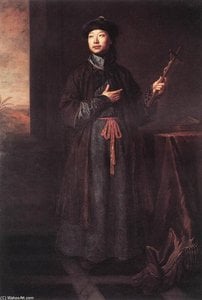
In the quiet dignity of Sir Godfrey Kneller’s portrait of John Moore, we find more than just a likeness; we encounter a window into the refined elegance of the early eighteenth century. Painted in 1705, this work serves as a profound testament to the era of the Restoration and the burgeoning sophistication of Georgian Britain. The subject, John Moore, is presented with a commanding yet intimate presence, his gaze meeting the viewer with an unwavering directness that bridges the centuries. As he sits poised in his chair, the subtle details of his attire—the crisp, long white collar and the somber, structured black vest—speak volumes of a man of status, embodying the formal decorum that defined the upper echelons of society during Kneller's prolific career.
The composition is masterfully orchestrated to draw the eye toward Moore’s countenance, yet it does not leave the viewer in isolation. The presence of secondary figures in the periphery adds a layer of narrative depth, suggesting a social milieu filled with movement and connection. This arrangement creates a sense of lived experience, as if we have stumbled upon a private moment within a bustling aristocratic estate. For the discerning collector or interior designer, such a piece offers an unparalleled opportunity to introduce a sense of historical weight and classical poise to a contemporary space, acting as a focal point that commands respect and invites contemplation.
The Mastery of Light and Shadow
To understand the allure of this portrait, one must delve into the technical brilliance of Sir Godfrey Kneller, a painter whose name became synonymous with the English Baroque. Kneller was a virtuoso of chiaroscuro, utilizing the dramatic interplay between light and shadow to sculpt the features of his subjects with remarkable three-dimensionality. In this depiction of Moore, the light does not merely illuminate; it breathes life into the textures of the fabric and the subtle contours of the face. By employing techniques such as grisaille—the application of delicate white pigments over darker underpaintings—Kneller achieved a luminous quality that makes the highlights on the collar and skin appear to glow from within.
This meticulous approach to light serves a dual purpose: it provides a hyper-realistic texture that satisfies the eye, and it imbues the portrait with a psychological depth. The shadows are not merely absences of light but are used to suggest the gravity and character of the man portrayed. This interplay creates an emotional resonance, evoking a sense of nostalgia for a lost age of refinement. For those seeking to adorn a room with art that possesses both substance and soul, Kneller’s ability to capture the very essence of his subject through technical precision offers a timeless aesthetic appeal that transcends mere decoration.
A Legacy of Prestige and Presence
The historical significance of this work is inextricably linked to Kneller's role as the preeminent portraitist of his age. As the court painter to successive monarchs, including Charles II and George I, Kneller shaped the visual identity of a nation. His "Kit-Cat" portraits and individual commissions like that of John Moore were instrumental in documenting the power structures and cultural aspirations of the British elite. To possess a reproduction of such a work is to hold a piece of art history—a fragment of the era when the visual landscape of Britain was being redefined by the brushstrokes of a master.
Beyond its historical value, the portrait offers a profound emotional impact. It evokes a sense of permanence and stability in an ever-changing world. The dignified posture of Moore and the classical balance of the composition provide a calming, sophisticated energy to any setting, whether it be a formal library, a stately dining room, or a modern gallery space. It is an investment in atmosphere, bringing the prestige of the Baroque period into the heart of the modern home, and ensuring that the elegance of 1705 continues to inspire generations to come.



 Anteprima in scala reale
 Passa alle stampe
 Condividi
 Condividi
 Dettagli
 Guida
Guida

 Scarica
 Articoli simili
 Radiografia
 Slideshow
 Statistiche


 Leggi tutto