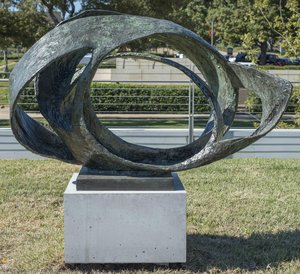
A Sculptural Embrace: Barbara Hepworth’s ‘Torso’
Barbara Hepworth's “Torso,” created in 1928, isn’t merely a depiction of the human form; it’s an embodiment of movement and quiet contemplation. This remarkable sculpture, rendered in the rich, dark tones of mahogany wood, immediately draws the viewer into its world – a world where form and space intertwine with a profound sense of stillness. Hepworth, a pivotal figure in the development of modern sculpture, masterfully eschews traditional representation, opting instead to capture an essence, a feeling, rather than a literal likeness. The piece speaks volumes about her pioneering approach to abstraction, prioritizing the inherent qualities of materials and the interplay between positive and negative space.
The Language of Form: Technique and Material
Hepworth’s technique is characterized by subtractive carving – a painstaking process of carefully removing material from a solid block of wood to reveal the desired shape. This method, demanding immense skill and patience, allows her to coax forth organic forms that seem to grow naturally from the raw material. Notice the subtle variations in texture across the surface; these aren’t simply cosmetic details but rather evidence of the sculptor's hand, each ridge and curve a testament to the physical act of creation. The choice of mahogany is particularly significant. Its deep, resonant color provides a dramatic backdrop for the sculpted form, while its grain adds layers of visual complexity – hints of light and shadow that dance across the surface. The smooth, polished finish further enhances the tactile quality of the piece, inviting viewers to imagine running their hands along its contours.
Roots in Modernism: Context and Influences
“Torso” emerged during a period of intense artistic experimentation and a rejection of academic traditions. Hepworth was deeply influenced by movements like Abstraction-Création, which sought to explore the fundamental qualities of form and material. Her work reflects this spirit of innovation, moving away from representational art towards a more conceptual approach. The sculpture’s emphasis on geometric shapes and its exploration of negative space align with the broader trends of early 20th-century modernism, where artists were increasingly interested in reducing forms to their essential elements. Hepworth's time spent studying Italian Renaissance sculpture also informed her work, particularly her understanding of classical anatomy, which she then reinterpreted through a distinctly modernist lens.
A Study in Quietude: Symbolism and Emotional Resonance
While “Torso” avoids overt symbolism, it possesses a powerful emotional resonance. The pose itself – a relaxed yet alert stance – suggests a state of contemplative awareness. The smooth curves and flowing lines evoke a sense of grace and fluidity, while the solidity of the wood grounds the form in the physical world. There’s an inherent vulnerability in the exposed torso, inviting viewers to contemplate themes of beauty, strength, and mortality. It's not a celebration of physicality but rather an exploration of the human condition – a quiet meditation on the essence of being. The sculpture’s timeless quality speaks to its ability to connect with viewers across generations, offering a moment of stillness in our increasingly frenetic world.
Reproductions and Display
A high-quality reproduction of “Torso” can bring the spirit of this iconic work into any space. Consider framing it within a simple, elegant setting to allow the sculpture’s form and texture to take center stage. The rich tones of the wood will complement a wide range of interior design styles, from minimalist modern to classic contemporary. When selecting a reproduction, prioritize materials that accurately capture the depth and nuance of Hepworth's original work – archival-quality prints on textured paper are ideal for achieving a truly authentic effect.
Domande e risposte
Esistono opere simili a "Torso"?
Le opere simili a "Torso" di Barbara Hepworth sono raccolte nella pagina Opere simili dell'opera.
Quale stato d'animo esprime "Torso" di Barbara Hepworth all'interno di Modernism?
L'emozione Reflective di "Torso" accompagna il suo stile Modernism.
In quale fase della carriera di Barbara Hepworth si colloca "Torso", considerando la sua datazione?
"Torso", realizzata nel 1929, appartiene al Early Period della carriera di Barbara Hepworth.



 Ordina la riproduzione dipinta a mano
 Condividi
 Condividi
 Dettagli
 Guida stampabile

 Scarica
 Articoli simili
 Slideshow
 Statistiche


 Leggi tutto






































 L'opzione vetro è disponibile solo per dimensioni inferiori a 110 cm