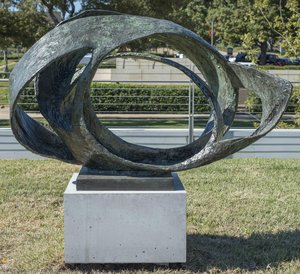
The Ethereal Geometry of Genesis III
In the quiet realm of modern abstraction, few works command a sense of profound stillness quite like Genesis III. Created in 1966 by the visionary sculptor Barbara Hepworth, this piece serves as an exquisite embodiment of contemplation and the delicate interplay between form and space. While Hepworth is celebrated for her mastery of three-dimensional stone and bronze, this particular iteration presents a captivating visual dialogue through its circular motifs. The composition is anchored by two primary interlocking circles—one a deep, resonant black and the other a vibrant, warm red—positioned in an asymmetrical dance across the canvas. This arrangement creates a subtle visual tension, a push and pull that prevents the eye from resting too easily, instead inviting a continuous, meditative journey through the work's geometric landscape.
The technique employed in this piece reflects a masterful control over texture and light. The surface possesses a luminous quality, where the application of color feels both deliberate and fluid. Scattered throughout the composition are smaller celestial-like circles and delicate dots that suggest a vast, quiet universe. This intricate layering creates an effect of depth, as if the viewer is peering into a cosmic void where shapes emerge from and recede into a luminous background. For the discerning collector or interior designer, such a work offers more than mere decoration; it provides a focal point of understated elegance, capable of anchoring a room with its sophisticated balance of weight and lightness.
Symbolism and the Spirit of Modernism
Beyond its striking visual presence, Genesis III is steeped in the symbolic language of the mid-20th century. The choice of circular forms is far from arbitrary; these shapes represent wholeness, unity, and the eternal cycle of existence. By juxtaposing the dark, grounding black with the energetic red, Hepworth explores the concept of duality—the balance between opposing forces such as stability and movement, or shadow and light. This exploration of fundamental geometries allows the artwork to transcend specific imagery, offering an experience that is deeply personal yet universally resonant.
Historically, this work emerged from a period of significant experimentation within British sculpture and abstraction. Hepworth, a pioneer of the modern movement, sought to move away from traditional representation toward a language of pure form and emotion. The influence of Abstract Expressionism is palpable here, as the piece prioritizes the emotional impact of color and shape over the depiction of the physical world. To encounter Genesis III is to enter a meditative space; its smooth, polished aesthetic and tranquil composition nourish the soul, making it an enduring masterpiece for those who seek to surround themselves with art that inspires introspection and peace.
Domande e risposte
Con quale tecnica è realizzato "Genesi III"?
Barbara Hepworth ha utilizzato la tecnica del Scultura per "Genesi III". La tecnica definisce la natura materica dell'opera originale.
Qual è il tono emotivo di "Genesi III" di Barbara Hepworth?
Il tono emotivo registrato per "Genesi III" di Barbara Hepworth è Riflessivo. Esso riassume la sensazione espressa dall'opera.
In quale ambiente si consiglia di collocare "Genesi III" di Barbara Hepworth?
Una riproduzione di "Genesi III" si adatta perfettamente a un/una Soggiorno.



 Acquista il dipinto realizzato a mano
 Invia
Invia Condividi
 Dettagli opera
 Guida
Guida

 Scarica
 Simili
 Slideshow
 Q&A
Q&A Statistiche


 Espandi i dettagli






































 L'opzione vetro è disponibile solo per dimensioni inferiori a 110 cm