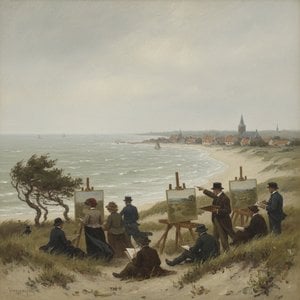
A Dutch Road by Anton Mauve: Echoes of Impressionism in Rural Tranquility
Led by Anton Mauve, the group of Dutch painters known as the Hague School distinguished itself by its exceptional rendering of moody atmosphere and light. As a Dutch critic wrote of the Hague School in 1875, “The artists try, by preference, to render mood; and they give precedence to tone above color… They have revealed the poetry of gray in a hitherto unprecedented manner.” Like the Barbizon painters (see 1933.37), they preferred to work out-of-doors and remained true to the tonality of the Dutch countryside, affected by the moist climate. Mauve's A Dutch Road reveals his characteristic “poetry of gray” and his debt to the great Dutch seventeenth-century masters of landscape (see 1978.68) and the French Realist artist Jean-François Millet (1814-1875).
This monumental canvas, measuring 368 x 505 cm, captures a quintessential scene from rural Holland – a solitary road winding its way into the distance beneath an overcast sky. Painted around 1880, “A Dutch Road” exemplifies Mauve’s unwavering commitment to capturing the essence of nature and conveying profound emotional resonance. The artwork depicts a bleak and somber winter landscape. It’s an oil painting with a realistic style, showcasing a muddy road receding into the distance, flanked by bare trees under a heavy, overcast sky. A lone figure on horseback is the central subject, walking away from the viewer.
Composition and Technique: Embracing Impressionistic Light
The composition prioritizes horizontal lines – the road, the tree trunks – creating a sense of vastness and isolation that speaks to the melancholic spirit of the era. Lines are loose and expressive, suggesting brushstrokes rather than precise detail. Shapes are largely geometric – the road, trees, and sky – but softened by the texture of the paint. The technique is characteristic of oil painting, utilizing layering and blending to achieve the desired effects. Thick impasto—heavy application of pigment—dominates particularly in the wet ground and tree branches, adding a tactile quality to the image that invites contemplation.
Symbolism and Emotional Impact: Loneliness Amidst Beauty
Beyond its technical brilliance, “A Dutch Road” resonates with deeper symbolic meanings. The desolate landscape embodies themes of solitude and travel, reflecting Mauve’s own fascination with the human condition amidst the grandeur of nature. The figure on horseback, walking away from the viewer, symbolizes departure—perhaps a journey into introspection or a farewell to earthly concerns. The muted color palette – predominantly grays, browns, and whites – reinforces the pervasive gloom but simultaneously highlights the subtle beauty of the winter scene.
Historical Context: The Hague School's Legacy
“A Dutch Road” stands as a cornerstone of the Hague School’s artistic legacy. Influenced by Impressionism and rooted in the Barbizon tradition, Mauve sought to depict nature with uncompromising honesty and sensitivity. He aimed to capture not merely what he saw but how it felt—the quiet contemplation evoked by the stillness of winter light. This painting exemplifies the school's belief that art should strive for emotional truthfulness, mirroring the profound connection between humanity and its environment.
Further Information
The Toledo Museum of Art houses a stunning reproduction of “A Dutch Road,” allowing viewers to experience Mauve’s masterful technique and evocative vision firsthand. For more details about this artwork and its provenance, please visit Toledo Museum of Art.



 Anteprima in scala reale
 Ordina la riproduzione dipinta a mano
 Condividi
 Condividi
 Dettagli
 Guida
Guida

 Scarica
 Articoli simili
 Radiografia
 Slideshow
 Statistiche


 Leggi tutto






































 L'opzione vetro è disponibile solo per dimensioni inferiori a 110 cm