Stampa giclée o su tela di qualità museale, con produzione rapida e diverse opzioni di finitura. ( Acquista il dipinto realizzato a mano Passa all'immagine digitale)





























Scegli tra le nostre dimensioni predefinite, che rispettano le proporzioni originali dell'opera d'arte.

Inserisci la larghezza e l'altezza desiderate, per adattarle alla tua cornice o alla tua parete. Una stampa può essere solo ritagliata, mai resa più grande dell'immagine originale; pertanto, un formato con una forma differente comporterà la perdita di una parte dell'opera. Ti invieremo un mockup digitale da approvare prima di procedere con la stampa. L'immagine mostrata in questa pagina non rappresenta il ritaglio reale — solo il mockup lo mostra.
Consegna in tutto il mondo () in 2 settimane invece delle normali 4/5 settimane. (8 Novembre)
Litografia floreale
Dimensioni riproduzione
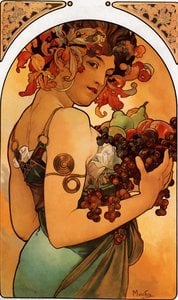
This exquisite 1897 lithograph, titled simply “Flower Litho,” offers a captivating glimpse into the world of Alphonse Maria Mucha, one of the most celebrated figures of the Art Nouveau movement. Measuring 44 x 66 cm, this piece isn’t merely a depiction of a woman holding flowers; it's an embodiment of a particular aesthetic – a harmonious blend of natural beauty and stylized elegance that defined Mucha’s distinctive vision. The vibrant palette, dominated by rich reds, yellows, greens, blues, and purples, immediately draws the eye, creating a sense of opulent warmth and inviting contemplation.
Born in Brno, Czech Republic, in 1860, Alphonse Maria Mucha’s artistic journey began with formal training at the Academy of Fine Arts in Prague. However, he quickly recognized the limitations of traditional academic approaches, seeking instead a more fluid and expressive style. His relocation to Paris in 1887 proved pivotal, allowing him to fully immerse himself in the burgeoning Art Nouveau movement. Mucha’s work is instantly recognizable for its flowing lines, organic forms, and an almost palpable sense of movement – qualities he consciously adopted from influences like Pierre-Auguste Renoir and Gustave Moreau. This “Flower Litho” exemplifies this style perfectly, showcasing a woman draped in a delicate lace dress, crowned with symbolic ornamentation, and presented amidst a profusion of blossoms.
The central figure, a beautifully idealized woman, is a recurring motif in Mucha’s oeuvre. Her pose, holding bouquets of flowers, speaks to themes of beauty, fertility, and perhaps even remembrance – common subjects within Art Nouveau's romantic sensibility. The two bouquets themselves are not simply decorative; they likely represent carefully chosen floral symbols with specific meanings, though the precise interpretation would have been understood within the context of late 19th-century symbolism. The potted plant in the background adds depth and a subtle connection to nature, reinforcing the artwork’s core themes. The overall composition evokes a sense of serenity and quiet contemplation, inviting the viewer to lose themselves in its delicate beauty.
This “Flower Litho” is a lithograph, a printmaking technique that allowed Mucha to reproduce his designs with remarkable precision and detail. The process involved transferring ink from a stone onto paper, resulting in rich, velvety tones – particularly evident in the vibrant hues of the flowers. Created in 1897, this piece reflects the peak of Mucha’s fame, following his success at the Salon des Cent in 1898. It's a testament to his ability to capture and translate the spirit of Art Nouveau into a commercially viable format, influencing countless artists and designers during that era. This reproduction offers an authentic connection to a pivotal moment in art history, allowing you to experience Mucha’s genius firsthand.
La luminosità percepita di "Litografia floreale" di Alphonse Maria Mucha è luminoso. Può essere armonizzata con la luce dello spazio destinato all'opera.
La tecnica di "Litografia floreale" di Alphonse Maria Mucha è Litografia e le sue dimensioni sono 44 x 66 cm.
In "Litografia floreale", un Deciso contrasto si sposa con una Tavolozza unitaria armonia.


1860 - 1939 , Repubblica Ceca

Scopri la scienza e il valore delle litografie originali tra pietra e chimica. Approfondisci la tecnica con i nostri esperti.

Discover the enchanting world of Art Nouveau. Explore the flowing lines of Alphonse Mucha and learn how to integrate these timeless, organic masterpieces into your collection with expert guidance on fine art appreciation and preservation.

Scopri l'essenza dell'Art Nouveau tra botanica e design. Esplora la bellezza delle linee sinuose con i nostri esperti.
 Anteprima in scala reale
 Invia
Invia Condividi
 Dettagli opera
 Guida
Guida

 Scarica
 Simili
 Radiografia
 Slideshow
 Domande e risposte
 Statistiche

 Espandi i dettagli









 L'opzione vetro è disponibile solo per dimensioni inferiori a 110 cm