Allaert van Everdingen: Pioneer of Norwegian Landscape Painting
Allaert van Everdingen (dutch pronunciation: , bapt. 18 june 1621 – 8 november 1675 (buried)), stands as a singular figure in the Dutch Golden Age, distinguished not merely for his prolific output but for his groundbreaking approach to landscape painting—a style that foreshadowed the dramatic tonal qualities of Rembrandt and cemented his place as a precursor to Romanticism. Born at Alkmaar, the son of a government clerk, Everdingen’s artistic journey began under the tutelage of Roelandt Savery at Utrecht, establishing him within the influential Baroque tradition before embracing a more contemplative aesthetic honed in Haarlem and Amsterdam.
- Early Influences & Training: Savery's mastery of chiaroscuro—the interplay of light and shadow—provided Everdingen with a foundational understanding of artistic technique, shaping his subsequent explorations into atmospheric perspective and expressive brushwork. However, unlike Savery’s flamboyant style, Everdingen swiftly diverged toward a quieter, more psychologically resonant vision of the natural world.
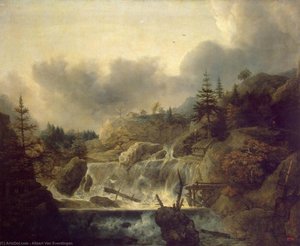
- The Norwegian Expedition (1644): A serendipitous voyage to Norway during a violent storm irrevocably altered Everdingen's artistic trajectory. Recognizing an opportunity presented by his ship’s predicament, he embarked on detailed sketches documenting the rugged beauty of the Norwegian coastline and inland valleys—a project that captivated contemporaries and profoundly impacted his oeuvre.
- A Distinctive Style: Everdingen's landscapes are characterized by a remarkable depth of tonal gradation—a technique remarkably similar to Rembrandt’s—that conveys an unparalleled sense of mood and atmosphere. Unlike Savery’s opulent compositions, Everdingen favored simplicity in execution, prioritizing expressive brushstrokes and subtle shading to capture the essence of his subjects. His canvases depict serene valleys bathed in misty light, cascading waterfalls rendered with breathtaking realism, and dramatic coastal scenes imbued with palpable energy.
- Notable Works & Legacy: Among Everdingen’s most celebrated paintings are “De geschutgieterij Julita Bruk van de familie Trip,” depicting a picturesque Dutch farmhouse scene; “Scandinavian Rocky River Landscape,” showcasing the grandeur of Norwegian fjords; and “Paysage Scandinave près de Mölndal,” capturing the tranquil beauty of Swedish valleys. His etchings and mezzotints further disseminated his artistic vision, establishing him as one of the foremost printmakers of his era.
- Influence & Significance: Everdingen’s pioneering use of tonal shading—a technique that would become synonymous with Rembrandt—laid the groundwork for Romantic landscape painting and profoundly influenced subsequent generations of artists. His unwavering commitment to capturing the emotional impact of nature solidified his reputation as a visionary artist who transcended stylistic conventions, leaving an indelible mark on European art history. He remains a testament to the transformative power of observation and artistic innovation.
Technical Innovations & Artistic Approach
Everdingen’s distinctive style wasn't merely about capturing visual beauty; it was underpinned by meticulous technical considerations. Unlike many of his peers who prioritized decorative embellishment, Everdingen focused on achieving a profound sense of realism through masterful tonal manipulation—a technique he honed under Pieter de Molijn and perfected during his time in Haarlem.
He meticulously studied the effects of light and shadow, employing subtle gradations of color to convey atmospheric depth and emotional resonance. His canvases are characterized by expansive brushstrokes that capture the movement of air and water with remarkable accuracy—a stylistic hallmark that distinguishes him from artists like Jacob van Ruisdael who favored a more restrained palette.
This dedication to tonal realism—a precursor to Rembrandt’s groundbreaking approach—established Everdingen as a pivotal figure in shaping the trajectory of landscape painting during the Dutch Golden Age.
The Norwegian Sketches & Their Impact
Everdingen's journey to Norway in 1644 proved to be more than just an unplanned detour; it constituted a catalyst for artistic transformation.
Recognizing the potential of capturing the dramatic landscapes of Scandinavia—a region largely unexplored by Dutch artists at the time—he embarked on a comprehensive sketching expedition, documenting the rugged beauty of Norwegian fjords and valleys with unprecedented detail. These sketches served as inspiration for numerous paintings executed in his studio, demonstrating Everdingen’s ability to translate observation into artistic expression.
The meticulous documentation of these landscapes—particularly the cascading waterfalls—established him as a pioneer of tonal shading and foreshadowed the stylistic innovations championed by Jacob van Ruisdael. His sketches exemplify the Romantic impulse toward capturing sublime vistas and conveying profound emotional responses—a legacy that continues to resonate within contemporary landscape art.
Connections & Collaborations
Everdingen’s artistic development was shaped by interactions with fellow artists of his time, notably Roelandt Savery and Pieter de Molijn. Savery's influence instilled in Everdingen a foundational understanding of Baroque chiaroscuro—a technique that would inform his subsequent explorations into atmospheric perspective.
Furthermore, Everdingen’s collaboration with Pieter de Molijn fostered a shared commitment to artistic excellence and honed his observational skills.
His correspondence reveals an intellectual curiosity and engagement with contemporary artistic debates—demonstrating Everdingen's role as a participant in the broader cultural landscape of the Dutch Golden Age.



 Anteprima in scala reale
 Ordina la riproduzione dipinta a mano
 Condividi
 Condividi
 Dettagli
 Guida stampabile

 Scarica
 Articoli simili
 Radiografia
 Slideshow
 Statistiche


 Leggi tutto






































 L'opzione vetro è disponibile solo per dimensioni inferiori a 110 cm