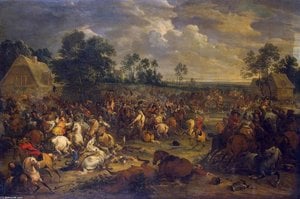
A Chronicle of Power and Precision: Adam Frans van der Meulen’s Cavalry Engagement
Adam Frans van der Meulen's “Cavalry Engagement” isn’t merely a depiction of battle; it’s a meticulously crafted testament to the burgeoning power of Louis XIV, the ‘Sun King,’ and a stunning example of Baroque artistry. Completed in 1657 and currently residing within the hallowed halls of the Hermitage Museum in St. Petersburg, this oil on canvas painting transcends its historical subject matter to become a vibrant tableau of dynamic movement, opulent detail, and calculated propaganda. Van der Meulen, a key figure in shaping Louis XIV’s image, understood that visual narratives could be as potent as royal decrees, and “Cavalry Engagement” stands as a prime illustration of this strategic approach to art.
The scene unfolds with breathtaking immediacy – a chaotic yet controlled clash of cavalry. Horses, rendered with an almost palpable sense of energy, surge forward in various states of motion; riders, clad in the rich fabrics and gleaming armor characteristic of the period, engage in fierce combat. The artist’s mastery lies not just in capturing the physicality of the scene but also in conveying a profound sense of depth and texture. Light and shadow are deployed with masterful precision, carving out forms and directing the viewer's eye towards the heart of the action – a cluster of soldiers locked in deadly struggle. The attention to detail is remarkable; from the intricate stitching on the armor to the subtle variations in the horses’ manes and tails, every element speaks to Van der Meulen’s dedication to historical accuracy and his profound understanding of equestrian art.
Baroque Brilliance: Technique and Style
Van der Meulen's style is deeply rooted in the Baroque tradition, yet he possesses a distinctly individual voice. He employs a rich palette – deep reds, blues, and golds dominate, creating an atmosphere of dramatic intensity. The brushwork is loose and expressive, contributing to the sense of movement and immediacy. However, it’s not simply about capturing raw emotion; Van der Meulen meticulously builds up layers of paint, achieving remarkable detail in the rendering of textures – the polished steel of the armor, the flowing fabric of the clothing, and the muscular forms of the horses. The composition itself is carefully balanced, guiding the eye through the scene with a clear sense of hierarchy. The background landscape, though somewhat generalized, provides essential context, grounding the action within a recognizable, albeit idealized, setting.
- Oil on Canvas: The medium lends itself perfectly to capturing both detail and luminosity, crucial elements in Van der Meulen’s style.
- Dynamic Composition: The arrangement of figures creates a sense of movement and drama, pulling the viewer into the heart of the conflict.
- Rich Color Palette: Deep reds, blues, and golds evoke a sense of power, wealth, and military might.
A Window to the 17th Century: Historical Context
“Cavalry Engagement” offers a valuable glimpse into the military practices and societal norms of the 17th century. The attire worn by the soldiers – armor, weaponry, and clothing styles – are all meticulously researched and faithfully reproduced, providing insights into the equipment and uniforms used during this period. Beyond its aesthetic qualities, the painting holds historical significance as a visual record of warfare and military strategy. It reflects the importance of cavalry in 17th-century conflicts, showcasing their role in flanking maneuvers and decisive charges. Furthermore, it’s important to consider that Van der Meulen wasn't simply documenting history; he was actively contributing to its narrative by creating images that glorified Louis XIV and his reign.
Bringing the Masterpiece Home: Reproductions for Today
WahooArt offers meticulously crafted hand-painted reproductions of “Cavalry Engagement,” allowing art lovers to experience the beauty and power of this iconic work in their own homes. Our skilled artists replicate Van der Meulen’s techniques with exceptional accuracy, capturing not only the visual details but also the emotional impact of the original painting. Whether you're a collector, an interior designer seeking a statement piece, or simply someone captivated by Baroque art, our reproductions provide a stunning and authentic representation of this remarkable masterpiece. Explore the collection at WahooArt.com to discover the perfect reproduction for your space.



 Anteprima in scala reale
 Passa alle stampe
 Condividi
 Condividi
 Dettagli
 Guida
Guida

 Scarica
 Articoli simili
 Radiografia
 Slideshow
 Statistiche


 Leggi tutto






































 L'opzione vetro è disponibile solo per dimensioni inferiori a 110 cm