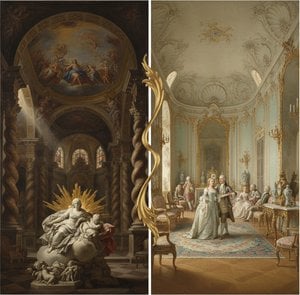
The Master of the Rococo Flame
Thomas Germain (1673–1748) stands as the undisputed titan of Parisian silversmithing during the opulent Rococo era—a period defined by extravagant ornamentation, playful asymmetry, and a fervent embrace of nature’s beauty. Born in Paris to Pierre Germain, whose artistic legacy remains elusive, young Thomas initially pursued painting, honing his skills in Rome between 1687 and 1702 where he swiftly transitioned into the craft of goldsmithing, establishing himself as a true artisan. This formative experience instilled within him an unwavering dedication to meticulous technique and a profound understanding of sculptural principles—qualities that would permeate his entire oeuvre. His early years in Italy allowed him to absorb the dramatic energy of Baroque sculpture, a foundation that would later enable him to manipulate precious metals with the fluidity of a painter's brush.
Returning to Paris in 1720, Germain ascended to the prestigious rank of Maître (master), securing his position as Orfèvre du Roi—the King’s Goldsmith. This appointment was more than a mere title; it was a gateway to the very heart of French power. Granted apartments within the Palais du Louvre in 1723, Germain operated at the epicenter of European luxury. His workshop became a sanctuary of creation where he served Louis XV and the French royal family with unparalleled devotion. From the delicate gold mustard pots used in intimate royal breakfasts to the grand, ceremonial objects destined for foreign thrones, his work embodied the prestige of the Bourbon monarchy. His influence was truly international, as his exquisite silver pieces traveled to the courts of Spain, Naples, and Portugal, leaving an indelible mark on the decorative arts of the entire continent.
A Legacy in Silver and Gold
The genius of Germain resided not merely in replicating established styles but in elevating them to breathtaking heights. He possessed a rare ability to blend the structural rigor of his training with the whimsical, organic motifs that defined the Rococo spirit. His work often featured:
- Naturalistic Motifs: Intricate depictions of flora, fauna, and flowing acanthus leaves that seemed to grow directly from the metal surfaces.
- Sculptural Depth: A masterful use of light and shadow achieved through high-relief chasing and complex, multi-dimensional forms.
- Royal Symbolism: The creation of magnificent presentation swords for military heroes like Marshal Foch, blending martial strength with artistic elegance.
- Mythological Narratives: The integration of figures such as satyrs, putti, and even Egyptian-inspired sphinxes, reflecting the era's fascination with classical and exotic themes.
Beyond his functional masterpieces, Germain’s impact reached into the very fabric of Parisian architecture and culture. His involvement in the reconstruction of Saint-Louis-du-Louvre demonstrated a versatility that few craftsmen could claim. Even the great philosopher Voltaire recognized his extraordinary talent, immortalizing Germain's "divine hand"* in verse. When he passed away in 1748, his contribution to French artistry was so profound that the King of France himself ordered a requiem mass to be sung in his honor. Today, the surviving pieces of Thomas Germain—from his legendary hunting-themed surtout de table to his delicate royal rattles—remain as shimmering testaments to a man who transformed cold metal into the living pulse of the Rococo age.



 Megtekintés
 Áttérés Nyomtatványra
 Küldés
 Megosztás
 Részletek

 Letöltés
 Hasonló darabok
 X-ray felvétel
 Diavetítés
 Statisztika

 Összes részlet megjelenítése






































 Az üvegkeretes opció csak 110 cm alatti méretben érhető el